A smart lock distribution business sources electronic door locks from manufacturers — typically in China’s Shenzhen electronics manufacturing cluster — and sells them to end buyers: locksmiths, security installers, property managers, hotel operators, hardware retailers, e-commerce platforms, and real estate developers. The global smart lock market exceeded $4.8 billion in 2026 with a projected compound annual growth rate of 12–14% through 2035, driven by residential smart home adoption, commercial access control upgrades, and the expansion of short-term rental platforms. Starting a distribution operation requires four foundational decisions: selecting target market segments, choosing a manufacturer with OEM branding capability and flexible minimum order quantities, building a product line that covers the access control needs of your buyers, and establishing a go-to-market channel (B2B direct sales, e-commerce, security industry trade networks, or a combination). This guide covers each step from market analysis through first-order logistics, written from the manufacturer’s perspective to help prospective distributors evaluate the opportunity, structure their business, and source hardware efficiently. For manufacturer evaluation criteria, see our checklist for choosing a smart lock manufacturer in China.
Market Opportunity: Why Smart Lock Distribution Is Growing
The smart lock market is expanding across every buyer segment simultaneously — a convergence that creates distribution opportunities in multiple verticals from a single product category.
| Market Segment | Growth Driver | Buyer Profile | Product Demand |
|---|---|---|---|
| Residential smart home | Smart home adoption, voice assistant ecosystems (Alexa, Google), consumer awareness | Homeowners, home automation retailers, e-commerce shoppers | Fingerprint + PIN + app locks, Tuya/Zigbee compatible |
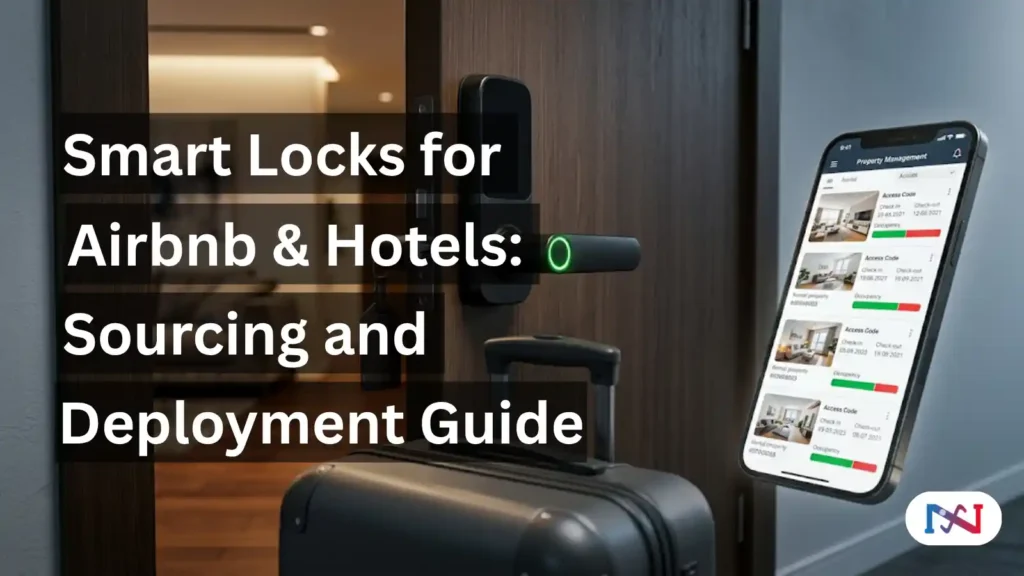
| Short-term rental / Airbnb | Self-check-in standardization, PMS automation, property management scaling | Property managers, Airbnb hosts, serviced apartment operators | Multi-access locks with temporary code generation (TTLock/Tuya) |
| Hotels and hospitality | RFID migration from magstripe, mobile key adoption, PMS integration | Hotel operators, hospitality groups, resort developers | RFID card locks, Bluetooth hotel locks, PMS-integrated systems |
| Commercial and office | Multi-tenant access control, co-working space growth, hybrid work security | Property managers, co-working operators, office building owners | RFID + fingerprint + PIN multi-factor locks |
| Real estate development | Smart home as a property selling feature, developer-grade supply requirements | Real estate developers, construction companies, project managers | Consistent finish locks in volume, Tuya ecosystem integration |
| Institutional and government | Access control upgrades, compliance requirements, facility security budgets | School districts, government facilities, healthcare campuses | Commercial-grade RFID and biometric locks with audit logging |
A smart lock distributor does not need to serve all these segments. The strongest distribution businesses focus on one or two segments where they have existing relationships, domain expertise, or geographic advantage — then expand from that base. A security hardware distributor adds smart locks to an existing catalog. A property management technology company adds lock hardware to complement its software offering. An e-commerce entrepreneur builds a product line for the residential smart home market. The hardware is the same — the distribution strategy and buyer relationships differ.
Distribution Business Models for Smart Locks
Smart lock distribution operates across several business models, each with different capital requirements, margin structures, and operational complexity. Understanding these models helps prospective distributors choose the structure that matches their resources and market access.
| Model | How It Works | Typical Margin | Capital Required | Best For |
|---|---|---|---|---|
| Wholesale distribution | Buy in bulk from manufacturer, warehouse inventory, sell to retailers/installers/integrators | 25–45% | Medium-high (inventory + warehouse) | Established hardware distributors adding smart locks to catalog |
| Private label / OEM brand | Source from manufacturer with your brand on the product — logo, packaging, user manual | 40–60% | Medium (MOQ + branding setup) | Entrepreneurs building a proprietary smart lock brand |
| Project-based supply | Source locks for specific hotel, real estate, or commercial projects on a per-deal basis | 20–35% | Low (order per project, no standing inventory) | System integrators, security consultants, project-based sellers |
| E-commerce / DTC | Sell direct to consumers via Amazon, Shopify, or own website | 50–70% | Medium (inventory + marketing + fulfillment) | E-commerce operators targeting residential smart home buyers |
| Master distributor | Exclusive territory agreement with manufacturer — you are the sole authorized distributor in a region | 30–50% | High (volume commitments + market development) | Established companies with proven distribution networks in a country/region |
These models are not mutually exclusive. A distributor might start with project-based supply (low risk, no inventory commitment), validate market demand, build relationships with buyers, then transition to wholesale distribution or private label branding as volume justifies the investment.
Step 1: Select Your Target Market and Buyer Segments
Before contacting a manufacturer or placing a first order, define who you will sell to. The target market decision determines everything downstream — which products to carry, which platform firmware to specify (TTLock or Tuya), what certifications to verify, what price positioning to establish, and which sales channels to develop.
Start with these questions:
Do you have existing relationships in a specific industry? If you already operate in the security hardware, property management, hospitality technology, or home automation space, smart locks are a product extension — you add a category to a channel that already exists. This is the lowest-risk entry point because the buyer relationships and sales infrastructure are in place.
Is there an underserved geographic market? Some countries and regions have strong demand for smart locks but limited local supply — particularly markets in the Middle East, Africa, South America, Southeast Asia, and Eastern Europe where smart home adoption is accelerating but established Western brands (Schlage, Yale, dormakaba) have limited distribution. Factory-direct sourcing from a Chinese manufacturer with OEM branding and customization services can position you as a local brand with competitive pricing.
Which buyer segment aligns with your operational model? Selling to Airbnb property managers requires different support capabilities (platform onboarding, PMS integration guidance) than selling to hardware retail stores (point-of-sale materials, product training) or hotel developers (project-level quotation, phased delivery coordination). Choose the segment where your operational strengths create the most value for the buyer. For industry-specific smart lock solutions, see our deployment guides by vertical.
Step 2: Build Your Product Line
A distribution product line should be curated, not comprehensive. Carrying too many SKUs increases inventory cost, complicates support, and confuses buyers. A focused product line of 4–8 models covering your target segments’ core needs is more effective than a 30-model catalog that tries to serve everyone.
Starter Product Line by Target Market
| Target Market | Recommended Product Types | Key Access Methods | Platform |
|---|---|---|---|
| Residential / smart home | Multi-access mortise lock + smart deadbolt + knob lock | Fingerprint, PIN, app, IC card, key | Tuya (Alexa/Google compatibility) |
| Airbnb / short-term rental | Multi-access mortise lock (e.g., K9) + handle lock for interior doors | PIN, fingerprint, IC card, app | TTLock (PMS integration) or Tuya (Wi-Fi direct) |
| Hotels / hospitality | RFID card lock (e.g., SU7-03) + cabinet lock for storage | IC card (Mifare 13.56MHz), mechanical key | TTLock (PMS integration) |
| Commercial / office | Multi-access mortise lock + handle lock + cabinet lock | Fingerprint, PIN, IC card, app | TTLock (multi-tenant management) |
| Mixed / general distributor | Multi-access mortise lock + RFID hotel lock + glass door lock + cabinet lock + padlock | Full range | Both (TTLock for B2B, Tuya for residential) |
For the full range of available hardware, browse the Nice Smart full product catalog. For platform selection guidance, see our Tuya vs TTLock platform comparison.
Step 3: Source from a Manufacturer
Smart lock distribution economics depend on the sourcing relationship. Factory-direct purchasing from a Chinese manufacturer provides the cost structure needed for viable distribution margins — typically 50–70% below the retail price of equivalent Western-brand products. The sourcing process follows a defined sequence.
Manufacturer Evaluation Criteria
Not every factory that produces smart locks is equipped to support a distribution partnership. Evaluate potential manufacturers against these criteria:
| Criterion | What to Verify | Why It Matters for Distribution |
|---|---|---|
| OEM capability | Logo engraving, custom packaging, firmware configuration, private labeling | Your brand on the product — not the factory’s brand |
| MOQ flexibility | Minimum order quantities per model and per customization tier | Lower MOQs reduce initial inventory risk and enable market testing |
| Product range | Number of models across lock types (mortise, deadbolt, glass, cabinet, padlock) | One supplier for your entire product line — simplifies logistics and quality consistency |
| Platform support | TTLock and Tuya compatibility on the same hardware | Serve both B2B (TTLock) and residential (Tuya) segments from one supplier |
| Certifications | CE, FCC, RoHS at minimum; UL, BHMA support for US market | Required for customs clearance and market compliance in destination countries |
| Lead time | Days from order confirmation to FOB shipment for standard and OEM orders | Affects inventory planning and your ability to fulfill buyer orders promptly |
| Production capacity | Monthly unit output and ability to scale with your growth | A factory that maxes out at 1,000 units/month cannot support a growing distributor |
| Sample availability | Sample units shipped within 3–5 business days for evaluation | You need to test products before committing to bulk orders |
| Communication quality | Responsiveness, English proficiency, dedicated account management | Ongoing partnership requires clear, timely communication across time zones |
Nice Smart meets all nine criteria: OEM/ODM branding services, MOQs from 20 units, 30+ models across all major lock types, dual-platform support (TTLock and Tuya), CE/FCC/RoHS/IP67 certifications, 7-day standard lead times, 8,000+ units monthly production capacity, 3–5 day sample shipping, and dedicated account management via WhatsApp and email. For a detailed manufacturer evaluation framework, see our guide to choosing a smart lock manufacturer in China.
First Order Strategy: Start Small, Validate, Scale
The recommended first-order approach for new distributors:
- Sample order (2–5 units): Request samples of the models you plan to carry. Test all access methods (fingerprint enrollment, PIN code generation, IC card pairing, app connectivity), evaluate build quality, and install on representative door types. If evaluating both TTLock and Tuya, order duplicates on each platform. Nice Smart ships samples within 3–5 business days.
- Pilot order (20–50 units): Place a minimum order to begin selling to initial buyers. This batch validates market demand — do buyers respond to the product? What questions do they ask? Which models move fastest? Use this batch to refine your product line, pricing, and support materials before committing to larger inventory.
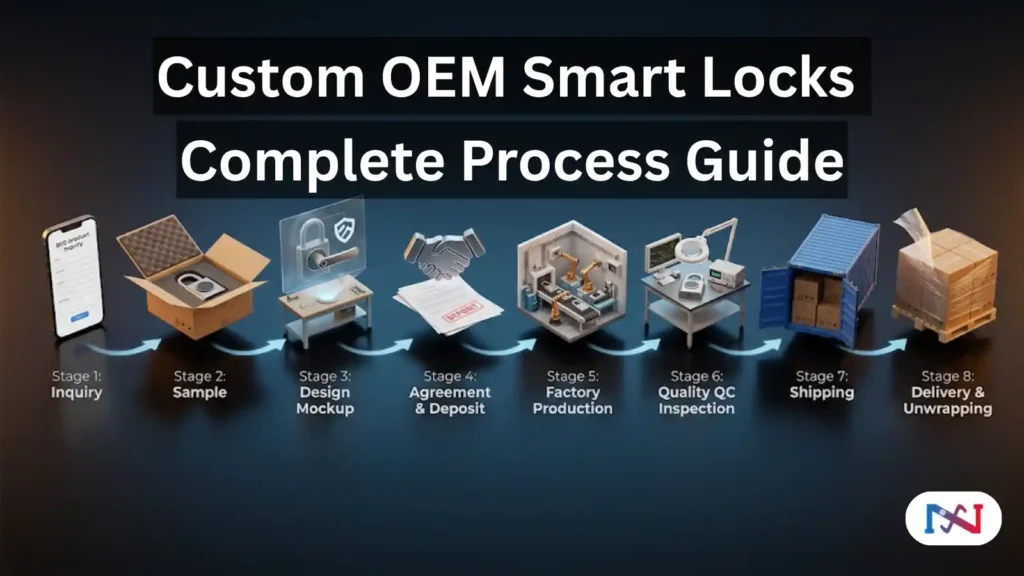
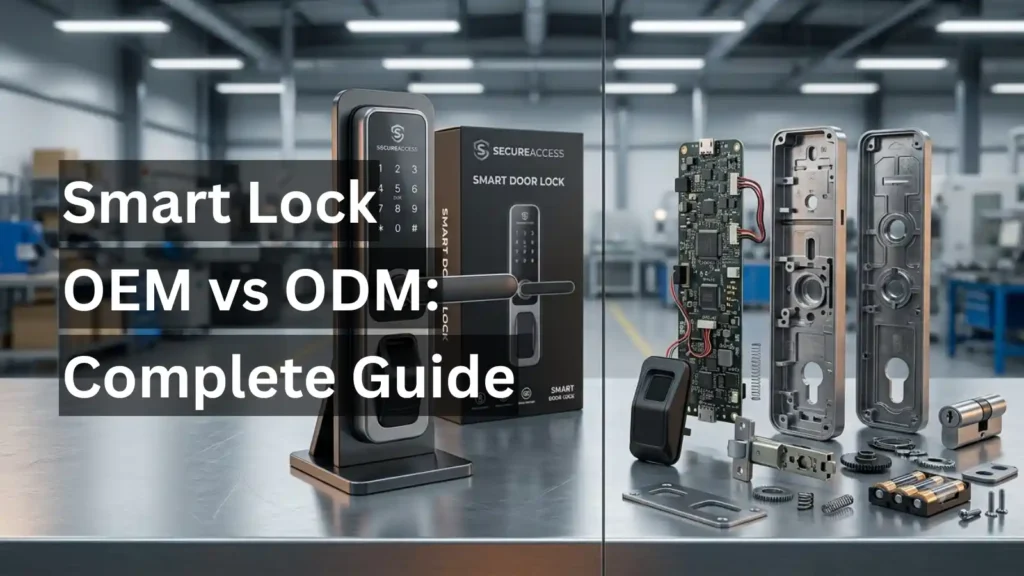
- Growth order (100+ units): With demand validated, place an OEM-branded order with your logo, packaging, and firmware configuration. This is where the brand-building begins — every product that reaches a buyer now carries your identity, not the factory’s. For detailed guidance on the ordering and customization process, see our OEM vs ODM manufacturing guide.
Step 4: Brand Your Product Line
The difference between a distributor and a brand is packaging. A distributor resells a manufacturer’s product. A brand sells its own product — sourced from a manufacturer but carrying the distributor’s identity, marketing, warranty, and customer relationship. Private label branding transforms a commodity smart lock into a differentiated product that commands premium pricing and builds customer loyalty.
OEM branding services available from manufacturers like Nice Smart include laser logo engraving on the lock body and interior panel, custom-branded retail or industrial packaging with your company identity and product photography, multilingual user manuals with your brand name, support contact information, and warranty terms, firmware configuration including app platform binding, default language settings, and voice prompt customization, and consistent finish selection (matte black, satin nickel, gold, silver, bronze) across your entire product line.
For a comprehensive guide to the private label process — from brand name selection through packaging design and market launch — see our article on building a private label smart lock brand.
Step 5: Handle Logistics, Compliance, and Import
Importing smart locks from China requires attention to shipping terms, customs procedures, and destination market certification requirements. The standard process:
Shipping terms: Most factory orders ship FOB Shenzhen (Free on Board — the manufacturer delivers goods to Shenzhen port, and the distributor arranges ocean freight or air freight from there). CIF (Cost, Insurance, and Freight to destination port) and DDP (Delivered Duty Paid to your door) terms are available for distributors who prefer the manufacturer to handle international logistics.
Customs and import duties: Smart locks are classified as electronic door hardware. Import duty rates vary by destination country — typically 0–6% for most markets under HS code 8301.40 (locks of base metal for doors). Check your country’s tariff schedule and verify whether any preferential trade agreements reduce the duty rate.
Certification compliance: Your destination market determines which certifications the products must carry. CE marking is required for all European Economic Area countries. FCC Part 15 is required for the US market. RoHS compliance is effectively universal. Additional certifications (UL 294, BHMA, EN standards) may be required depending on the product application and buyer requirements. For a detailed certification breakdown, see our guide to smart lock certification requirements.
For step-by-step logistics guidance including freight forwarding, customs documentation, and import procedures, see our complete article on importing smart locks from China.
Step 6: Go to Market — Sales Channels for Smart Lock Distributors
The go-to-market strategy depends on your target segments and business model. Most successful smart lock distributors operate across two or three channels simultaneously.
| Sales Channel | How It Works | Setup Requirements | Best For |
|---|---|---|---|
| B2B direct sales | Outbound sales to locksmiths, integrators, property managers, developers, hotel operators | Sales team (or solo founder), CRM, product samples, quotation capability | Project-based supply, wholesale distribution, master distribution |
| Security industry trade network | Attend and exhibit at security trade shows (ISC West, Intersec, CPSE); join security industry associations | Trade show booth, product samples, marketing materials, catalog PDF | Building installer/integrator network, market visibility |
| E-commerce (Amazon, Shopify, own website) | List products on marketplaces or build a branded online store | Product photography, listing content, fulfillment logistics (FBA or self-shipped) | Residential/consumer smart home market, volume-driven model |
| Hardware retail distribution | Supply to brick-and-mortar hardware stores, home improvement chains, electronics retailers | Retail packaging, point-of-sale displays, sales representative coverage | Mass market residential, regional brand building |
| Referral and partnership network | Partner with electricians, locksmiths, interior designers, property management software companies who recommend your locks | Referral commission structure, product training program, co-marketing | Low-overhead lead generation, service professional network |
The most capital-efficient entry is B2B direct sales combined with a basic website and product catalog PDF — you sell to buyers who have immediate project needs, fulfill from manufacturer-direct shipments, and reinvest revenue into inventory and branding as the business grows.
Distribution Economics: Understanding Your Margins
Smart lock distribution margins depend on sourcing cost, sales channel, and value-added services. The margin structure differs significantly by business model.
| Revenue Component | Typical Contribution |
|---|---|
| Hardware margin (factory cost to buyer price) | 25–60% depending on model, volume, channel, and brand positioning |
| Installation and setup services | $75–$150 per unit (if you provide or coordinate installation) |
| Technical support and warranty service | Included in margin or charged as annual support contract |
| Recurring software/platform fees | Some distributors bundle TTLock or Tuya premium features as a service fee |
| Accessory and consumable sales | Replacement batteries, additional IC cards, gateway hardware, mounting kits |
The strongest distribution businesses build recurring revenue beyond the initial hardware sale — installation services, support contracts, accessory sales, and platform management services. A property management company that buys 50 locks also needs battery replacement service, card replenishment, firmware updates, and technical support. The distributor who provides these services locks in the customer relationship beyond the first transaction. For a deeper analysis of manufacturing economics, see our smart lock manufacturing cost breakdown.
Common Mistakes New Smart Lock Distributors Make
Based on the patterns observed across Nice Smart’s distributor network in 30+ countries, these are the most frequent errors that new distributors encounter — and how to avoid them.
Carrying too many SKUs too early. A 20-model inventory ties up capital and creates support complexity before you understand which products your market actually demands. Start with 3–5 models, learn which access methods and form factors your buyers prefer, then expand based on data.
Ignoring platform selection. Ordering locks without specifying TTLock or Tuya firmware — then discovering the platform doesn’t integrate with your buyers’ property management systems. Confirm the platform requirement with your target buyers before placing bulk orders.
Underestimating certification requirements. Shipping products that lack the required certifications for the destination market leads to customs holds, product seizures, or liability exposure. Verify CE/FCC/RoHS compliance for every model before importing.
Competing on price alone. Selling factory-direct locks at the lowest possible margin attracts price-sensitive buyers who switch suppliers whenever they find a cheaper option. Compete on service, availability, technical support, and brand trust — these create defensible relationships that price alone cannot.
No after-sales support infrastructure. Selling hardware without providing installation documentation, troubleshooting assistance, and warranty processing frustrates buyers and generates negative reputation. Budget for support as a core function, not an afterthought.
Not requesting territory protection. Some manufacturers offer exclusive territory agreements for qualifying distributors — preventing other distributors in your market from undercutting you on the same product. Ask about territory protection during supplier negotiations.
Nice Smart Distributor Partnership Program
Nice Smart partners with security product distributors, hardware wholesalers, e-commerce sellers, and project-based suppliers across 30+ countries. The distributor program is structured to support both first-time entrants and established distribution companies expanding into smart lock hardware.
Program features include factory-direct pricing with tiered volume discounts, minimum order quantities from 20 units (no large inventory commitment required to start), full OEM branding services (logo, packaging, manual, firmware configuration), both TTLock and Tuya platform support across the product line, CE, FCC, RoHS, and IP67 certifications on all products, product training and technical documentation, sample evaluation program before commitment, dedicated account management with 24-hour response time, and exclusive territory agreements available for qualifying partners.
Nice Smart currently serves distributor partners in Qatar, Saudi Arabia, UAE, India, Bangladesh, Pakistan, Philippines, Indonesia, Vietnam, Malaysia, USA, Portugal, Spain, Italy, Greece, Austria, Russia, Morocco, South Africa, Brazil, Mexico, Chile, and additional markets. For the Airbnb and rental property market specifically, distributors can position the K9 model as the primary product for property management companies in their region.
Frequently Asked Questions About Smart Lock Distribution
How do I become a smart lock distributor?
To become a smart lock distributor, identify your target market segments (residential, hospitality, commercial, rental properties), evaluate and select a manufacturer with OEM capability and flexible MOQs, order product samples for evaluation, place a pilot order of 20–50 units to validate market demand, and establish sales channels (B2B direct, e-commerce, trade network, or retail). No special licensing is typically required for lock distribution beyond standard business registration and import compliance — though some markets require specific product certifications (CE for Europe, FCC for US) which the manufacturer should provide.
How much capital is needed to start a smart lock distribution business?
The minimum startup investment depends on the business model. A project-based supply model requires the least capital — you source locks per deal with no standing inventory, investing only in samples and sales infrastructure. A wholesale distribution model with branded inventory requires budget for initial stock (20–100 units to start), branding setup, shipping, and warehousing. An e-commerce model requires product inventory plus marketplace fees, product photography, and marketing spend. Factory-direct pricing from manufacturers like Nice Smart, with MOQs starting from 20 units, significantly lowers the entry barrier compared to Western brands that may require 500+ unit minimums.
What margins can smart lock distributors expect?
Hardware distribution margins typically range from 25–60% depending on the channel (B2B wholesale runs lower; direct-to-consumer e-commerce runs higher), the level of brand positioning (private label brands command higher margins than unbranded resale), and the value-added services bundled with the hardware (installation, technical support, maintenance contracts). Additional revenue streams from installation services, accessory sales, and recurring support contracts can increase total customer lifetime value beyond the initial hardware margin.
Do I need exclusive territory rights from the manufacturer?
Exclusive territory agreements protect your market investment by preventing other distributors from selling the same manufacturer’s products in your region. They are valuable but not required — many successful distributors operate without exclusivity by building strong local brand identity and customer relationships. Manufacturers like Nice Smart offer exclusive territory agreements for qualifying partners who demonstrate volume commitment and market development capability. If territory protection is important to your business model, discuss it during initial manufacturer negotiations.
What certifications do I need to import smart locks?
The distributor does not need to obtain certifications — the manufacturer provides them. Verify that the manufacturer holds CE marking (required for European markets), FCC Part 15 (required for US), and RoHS compliance (effectively universal). The manufacturer should provide test reports and certification documents that your customs broker needs for import clearance. Additional certifications (UL 294, BHMA, EN standards) may be required for specific product applications — confirm requirements based on your destination market and buyer needs before ordering.
Can I sell smart locks under my own brand name?
Yes. This is called OEM or private label manufacturing. The manufacturer produces the locks using their hardware and engineering, customized with your brand logo (laser engraved or pad printed on the lock body), your packaging design, your user manual, and your firmware settings (app branding, language, voice prompts). The product that reaches your buyer carries your identity entirely. Nice Smart supports full OEM branding at 50+ unit orders for most customization tiers. For detailed guidance, see our article on building a private label smart lock brand.
Which smart lock manufacturer offers distributor programs?
Several smart lock manufacturers in China offer distributor programs with varying levels of support. When evaluating manufacturer programs, compare MOQ flexibility, OEM branding capability, platform support (TTLock, Tuya, or both), product range, certification coverage, lead times, and whether dedicated account management is provided. Nice Smart’s distributor program supports partners across 30+ countries with MOQs from 20 units, dual-platform support, full OEM services, and dedicated account managers. The program is open to new distributors with no minimum annual volume requirement to get started.
Ready to explore smart lock distribution? Whether you are an established hardware distributor adding smart locks to your catalog, an entrepreneur launching a private label brand, or a system integrator sourcing project-based hardware, Nice Smart’s distributor program provides factory-direct pricing, OEM branding, dual-platform support, and dedicated account management to help you build a competitive position in your market. Apply for a distributor partnership or contact our distribution team via WhatsApp to discuss your market and requirements.