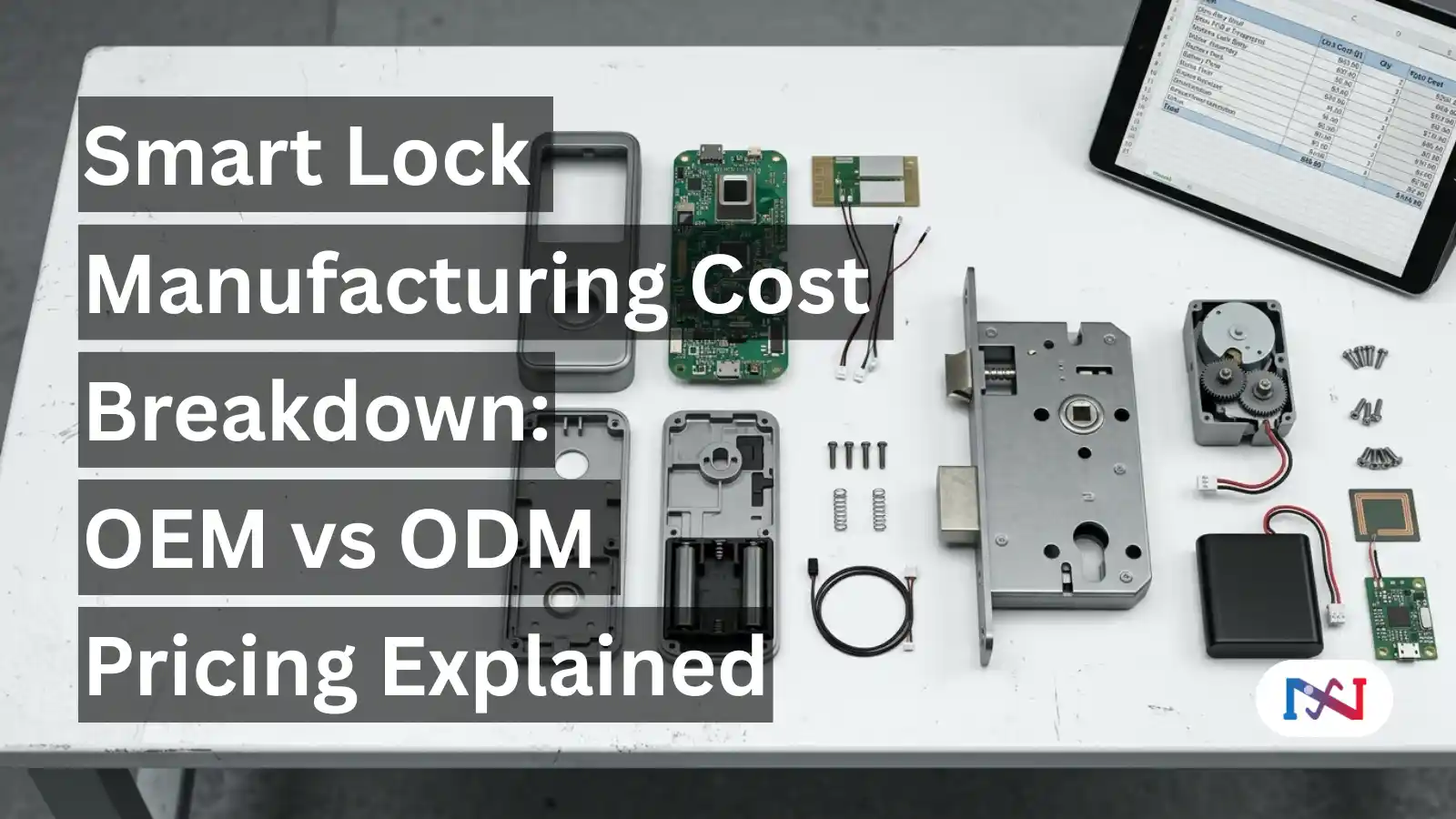
Smart lock manufacturing costs range from under $25 for basic entry-level models to $80–$120+ for premium face recognition locks, depending on BOM (Bill of Materials) configuration, access method complexity, housing material, and IoT platform integration. OEM orders (using existing hardware) carry lower per-unit costs with no tooling investment, MOQs from 20 units, and 7–25 day lead times. ODM orders (custom hardware design) require additional investment in mold development, PCB engineering, firmware programming, and new certification testing, with MOQs of 300–500 units and 8–12 week timelines. Total landed cost for B2B importers includes factory gate price, OEM customization fees, certification transfer, packaging, freight, customs duties, and destination logistics. This guide breaks down each cost layer so distributors, integrators, and project developers can build accurate procurement budgets when sourcing from a smart lock wholesale supplier in China. For a comparison of OEM versus ODM manufacturing models, see our OEM vs ODM manufacturing comparison.
Smart Lock BOM: What Drives the Factory Gate Price
The BOM (Bill of Materials) represents the combined cost of every physical component inside a smart lock. BOM cost is the single largest factor in factory gate pricing, typically accounting for 55–70% of the final unit cost. The remaining 30–45% covers assembly labor, quality control, overhead, factory margin, and packaging.
Understanding BOM composition allows B2B buyers to evaluate why two seemingly similar smart locks can differ by $30–$50 in wholesale price — and whether the higher-priced option represents better engineering value or simply higher margin.
Six Core BOM Components
Every smart lock BOM contains six cost categories, each contributing differently to the total depending on the product’s feature set and quality tier.
1. Housing and exterior materials. The lock’s outer shell is typically zinc alloy (most common for residential and hotel locks), aluminium alloy (lighter, used for glass door locks and slim-profile models), or a combination with tempered glass panels for touchscreen interfaces. Surface finishing — PVD coating, electroplating, or anodizing — adds cost but determines scratch resistance, corrosion protection, and aesthetic positioning. Zinc alloy housings with PVD coating represent the industry standard for mid-range and premium B2B smart locks.
2. Lock body mechanism. The mortise lock body is the mechanical core — deadbolt, latch, springs, and gear assembly. Quality ranges from stamped steel components in budget models to CNC-machined stainless steel in commercial-grade locks tested to 200,000+ open/close cycles. The lock body must also match the target market’s door standard: European DIN, American ANSI, or regional specifications affecting mortise pocket dimensions and spindle length.
3. PCB and electronic control system. The main control board includes the microcontroller (MCU), power management circuits, wireless connectivity modules (Bluetooth 5.0, Wi-Fi 2.4GHz, or Zigbee), and sensor interface circuits. Multi-layer PCB designs with integrated Wi-Fi and Bluetooth antennas cost more than single-layer boards with offline-only operation. The chipset selection and PCB complexity are the primary electronic cost drivers.
4. Biometric and access modules. Fingerprint sensor modules represent the highest-variance cost component across the entire BOM. Capacitive semiconductor sensors (faster recognition under 0.5 seconds, higher accuracy, better wet-finger performance) cost significantly more than optical sensors. 3D structured-light face recognition modules — used in premium models like the SU7 face recognition smart lock — add substantial cost but enable dual-camera facial recognition with anti-spoofing capability. RFID/IC card readers (13.56MHz Mifare) and capacitive touch PIN keypads add moderate and minimal cost respectively.
5. Motor and actuation system. The motor executes every lock/unlock operation. Higher-torque motors with metal gear assemblies cost more than basic DC motors with plastic gears, but metal-gear motors maintain consistent performance across 200,000+ cycles — the standard durability benchmark for hotel and commercial deployments. Motor failure is one of the primary causes of field warranty claims in lower-quality locks.
6. Power system. Lithium-ion rechargeable batteries (3,800–4,200mAh, USB-C charging) cost more than 4×AA alkaline battery configurations but offer better energy density and user experience. Battery life — typically 10,000–12,000 operations per charge or battery set — is directly influenced by power management IC efficiency and wireless module standby draw.
Smart Lock Price Tiers: Entry-Level to Premium
Factory gate pricing from a smart lock wholesale supplier in China generally falls into three tiers based on BOM configuration. These ranges reflect wholesale pricing for B2B orders of 50–500 units before OEM customization, shipping, or certification fees.
| Price Tier | Typical BOM Configuration | Access Methods | Common Applications |
|---|---|---|---|
| Entry-level ($20–$40) | Zinc alloy housing, optical fingerprint sensor, basic MCU, single-layer PCB, Bluetooth only, 4×AA batteries, basic mortise body | Fingerprint + PIN + IC Card + Key | Budget residential, price-sensitive markets, interior doors |
| Mid-range ($40–$75) | Zinc alloy with PVD coating, semiconductor fingerprint sensor, multi-layer PCB, Bluetooth + Wi-Fi, Tuya/TTLock, improved motor, lithium battery option | Fingerprint + PIN + IC Card + App + Key | Mainstream residential, rental properties, small commercial, distributor standard lines |
| Premium ($75–$120+) | Zinc/aluminium alloy with tempered glass panel, 3D face recognition + semiconductor fingerprint, IPS display, dual cameras, advanced MCU, Wi-Fi + Bluetooth, lithium-ion 4,200mAh, CNC mortise body | Face ID + Fingerprint + PIN + IC Card + App + Video Intercom + Key | Premium residential, developer projects, hotels, commercial high-security |
The mid-range tier represents the highest volume for B2B wholesale — models like the Q1 slim profile smart lock with semiconductor fingerprint, quad-bolt lock body, and Tuya/TTLock connectivity. The premium tier includes face recognition models with IPS displays and dual-camera systems, suited for developer projects and high-end distribution channels.
For hotel-specific deployments using RFID card-only locks like the SU7-03 RFID hotel lock with 500-card capacity and hierarchical card management, pricing depends on TTLock integration scope and project volume.
OEM vs ODM: How the Manufacturing Model Affects Total Cost
The choice between OEM and ODM manufacturing determines not just the per-unit price, but the total investment required before the first commercial shipment. Understanding these cost structures prevents budget surprises that delay market entry.
OEM Cost Structure
OEM orders use the manufacturer’s existing hardware platform, so the buyer pays only for the unit cost plus customization services. There is no engineering investment or tooling cost.
Typical OEM cost components beyond the base unit price include logo engraving (laser or pad printing — minimal per-unit addition, often included at MOQ thresholds), custom packaging design and printing (varies by complexity), firmware configuration (Tuya OEM app binding, TTLock platform assignment, language localization — typically included in engineering setup at no per-unit premium above MOQ), and surface finish selection (standard finishes at no premium; specialty custom PVD colors may carry upcharges).
OEM orders carry no tooling investment, no NRE (non-recurring engineering) fees, and no certification costs when the base hardware remains unchanged — existing CE, FCC Part 15, and RoHS certifications transfer directly. MOQ from 20 units on select models. Lead time 7–25 business days. Full details on available OEM services are covered in our OEM and ODM manufacturing services overview.
ODM Cost Structure
ODM orders create a new product from the buyer’s specifications, adding several investment layers on top of per-unit manufacturing cost.
Mold and tooling investment is the largest upfront ODM cost. Smart lock mold sets include front panel, back panel, interior bracket, and handle molds — each requiring precision CNC fabrication. Mold investment is amortized across the initial production run (300–500 units) and subsequent orders use the same tooling at no repeat cost.
PCB engineering and firmware development — custom circuit board design, component selection, firmware programming (locking logic, power management, sensor calibration, wireless protocol stack), and SDK/API documentation — represent a one-time NRE (non-recurring engineering) cost recovered across the product lifecycle.
Prototyping and pilot production require 3D-printed prototypes for design validation followed by a pilot run of 50–100 units for field testing, certification submission, and quality verification. Pilot units carry a per-unit premium over mass production due to lower volume.
New certification testing applies when the ODM design modifies electronics. CE, FCC, and RoHS retesting through accredited laboratories (SGS, TÜV, Intertek) adds cost and 4–8 weeks to the timeline.
Total ODM parameters: MOQ 300–500 units, development timeline 8–12 weeks. Per-unit cost on the first order is higher than OEM; subsequent reorders use existing tooling, bringing unit cost down toward OEM levels as volume scales.
OEM vs ODM Cost Comparison
| Cost Category | OEM | ODM |
|---|---|---|
| Per-unit manufacturing cost | Base unit price per tier | Base unit price + amortized tooling/NRE |
| Mold/tooling investment | None | Required — CNC mold set for housing |
| NRE (engineering) fees | None | Required — PCB, firmware, industrial design |
| Logo/branding cost | Minimal — included at MOQ | Integrated into industrial design |
| Packaging cost | Per-unit based on complexity | Per-unit based on complexity |
| Certification cost | None — existing certs transfer | Required if electronics modified |
| Prototype/sampling | From stock (3–5 days) | 3D prototypes + pilot run |
| MOQ | 20–100 units | 300–500 units |
| Lead time | 7–25 business days | 8–12 weeks |
| Reorder cost | Same per-unit pricing | Lower — tooling already paid |
| Payment terms | 30% deposit / 70% pre-shipment (T/T) | 30% deposit / 70% pre-shipment (T/T) |
Total Landed Cost: Factory Gate to Warehouse
Factory gate price (FOB Shenzhen) is only one component of total import cost. B2B buyers must account for the full landed cost to build accurate margin models.
International freight. Air freight is typical for samples and batches under 200 units (5–7 day delivery, higher per-unit cost). Sea freight is cost-effective above 500 units (20–35 day transit, significantly lower per-unit cost). Most bulk smart lock suppliers ship FOB Shenzhen; CIF and DDP terms are available for delivered pricing with freight and insurance included.
Customs duties and import taxes. Import duty rates on electronic door locks (HS code typically 8301.40 for lock fittings with electronic features) vary by destination country and trade agreements. VAT or GST is typically applied on the CIF value plus duty. Consult your customs broker for applicable rates and preferential tariff agreements.
Documentation and clearance. The manufacturer provides commercial invoice, packing list, certificate of origin, and certification documents (CE, FCC, RoHS test reports) for customs clearance. Brokerage fees at the destination port are the buyer’s responsibility.
Domestic logistics. Port-to-warehouse transportation and warehousing costs at the destination complete the landed cost calculation.
How Order Volume Affects Unit Cost
Smart lock wholesale pricing follows a volume-tiered structure. Per-unit cost decreases as quantity increases due to production efficiency (longer runs reduce per-unit setup time), material procurement leverage (larger component orders from sub-suppliers), and fixed cost amortization (QC, packaging setup, and shipping documentation spread across more units).
Orders at MOQ level (20–50 units) carry the highest per-unit price — suitable for market testing but not margin-optimized. Orders in the 100–300 unit range unlock the first volume tier with meaningful per-unit reductions. Orders above 500 units reach project-level pricing with maximum production efficiencies. Buyers with predictable recurring demand can negotiate better pricing than one-time project buyers at equivalent volume, because predictable orders allow the manufacturer to optimize component procurement and production scheduling.
For accurate pricing across specific models and quantities, request a detailed quotation with your target models, estimated volumes, and customization requirements.
Cost Profiles by Application Type
Different B2B applications carry different cost profiles based on hardware configuration, platform requirements, and deployment scale.
Hotel and hospitality. Hotel locks prioritize RFID card access (13.56MHz Mifare with AES encryption), TTLock PMS integration, and 200,000+ cycle durability. Total project cost includes TTLock gateway hardware, card encoder equipment, and phased delivery logistics. For industry-specific deployment solutions across hospitality and commercial buildings, OEM provides the most cost-effective path with proven hardware.
Real estate developer projects. Require consistent aesthetics across hundreds of units, Tuya smart home compatibility, and phased delivery aligned with construction timelines. Total project volume is the primary cost lever — developer orders often qualify for the best pricing tiers.
Distributor inventory. Distributors balance unit cost against inventory risk. Low MOQs (20–50 units) allow market testing with minimal capital exposure; transitioning to quarterly orders of 200–500 units unlocks volume pricing that supports competitive resale margins. Mixed-model orders across 30+ smart lock models are supported in a single shipment.
Commercial installations. Often require multi-factor authentication (RFID + PIN + fingerprint) and TTLock centralized management, trending toward mid-range to premium pricing tiers.
Common Cost Mistakes B2B Buyers Make
Several procurement cost mistakes recur frequently among first-time importers and distributors entering the smart lock market.
Comparing unit price without comparing BOM quality. Two quotes at $35 and $55 for a seemingly identical fingerprint lock may reflect a $20 difference in component quality — optical vs semiconductor sensor, plastic vs metal motor gears, stamped vs CNC lock body. The cheaper product may generate warranty claims and returns that exceed the per-unit savings.
Ignoring certification in ODM budgets. First-time ODM buyers sometimes budget for tooling and engineering but overlook certification testing costs when the custom design modifies wireless electronics. This can add unplanned cost and 4–8 weeks of delay.
Placing multiple small orders instead of consolidated volumes. Multiple 50-unit orders cost more than a single 200-unit order due to repeated shipping, documentation, and production setup costs. Buyers who can forecast 6–12 months of demand should consolidate.
Choosing the cheapest supplier without total cost of ownership analysis. A factory offering prices 25–30% below market range may be cutting components, skipping QC, or using uncertified materials. Total ownership cost — including defect rates, replacement logistics, and brand damage — often exceeds per-unit savings. Use our manufacturer evaluation checklist to assess suppliers beyond unit price.
Frequently Asked Questions About Smart Lock Costs
How much does it cost to manufacture a smart lock?
Factory gate cost ranges from under $25 for entry-level models with optical fingerprint and Bluetooth-only connectivity, to $40–$75 for mid-range models with semiconductor fingerprint and Tuya/TTLock Wi-Fi, to $80–$120+ for premium models with 3D face recognition and IPS display. These ranges reflect B2B wholesale orders of 50–500 units.
What is the wholesale price of smart locks from China?
Wholesale pricing depends on product tier, order volume, and customization scope. Entry-level locks: $20–$40. Mid-range: $40–$75. Premium face recognition: $75–$120+. Volume discounts apply — orders above 500 units typically reach the most favorable tier. OEM customization may add modest per-unit costs depending on scope.
What is the cost difference between OEM and ODM?
OEM uses existing hardware with no tooling or engineering investment — buyers pay per-unit cost plus customization fees. ODM requires upfront investment in mold development, PCB engineering, firmware, prototyping, and potentially new certification. First ODM order per-unit cost is higher; subsequent reorders approach OEM levels as tooling and NRE are recovered.
What is the MOQ for wholesale smart lock orders?
MOQs start from 20 units on select models and 50 units on most product lines for standard OEM orders. Custom packaging and firmware orders require 100–300 units. ODM projects with new mold development require 300–500 units minimum.
Do I pay for certification on OEM orders?
No — when the OEM order uses existing hardware without electronic modifications, CE, FCC Part 15, and RoHS certifications transfer at no additional cost. The manufacturer provides certification documents for customs clearance. New testing is required only if the design modifies electronics or wireless modules.
How does volume affect smart lock pricing?
Per-unit cost decreases with volume. MOQ-level orders (20–50 units) carry the highest per-unit price. First volume tier activates at 100–300 units. Project-level pricing (best cost) typically available above 500 units. Recurring buyers with predictable demand can negotiate better rates than one-time buyers at equivalent volume.
What shipping method is most cost-effective?
Air freight for samples and orders under 200 units (5–7 days, higher per-unit cost). Sea freight for bulk above 500 units (20–35 days, much lower per-unit cost). Standard shipping terms are FOB Shenzhen, with CIF and DDP available.
What payment terms do wholesale suppliers accept?
Standard B2B terms: 30% deposit upon order confirmation, 70% balance before shipment via T/T wire transfer. Established partners may qualify for 30-day net terms. Avoid suppliers requiring 100% prepayment on first orders.
Ready to build your procurement budget? Send us your target models, estimated volumes, and customization requirements. Our team provides itemized quotations within 24 hours including unit pricing, OEM customization costs, and shipping estimates. Request a detailed quotation or message us on WhatsApp.