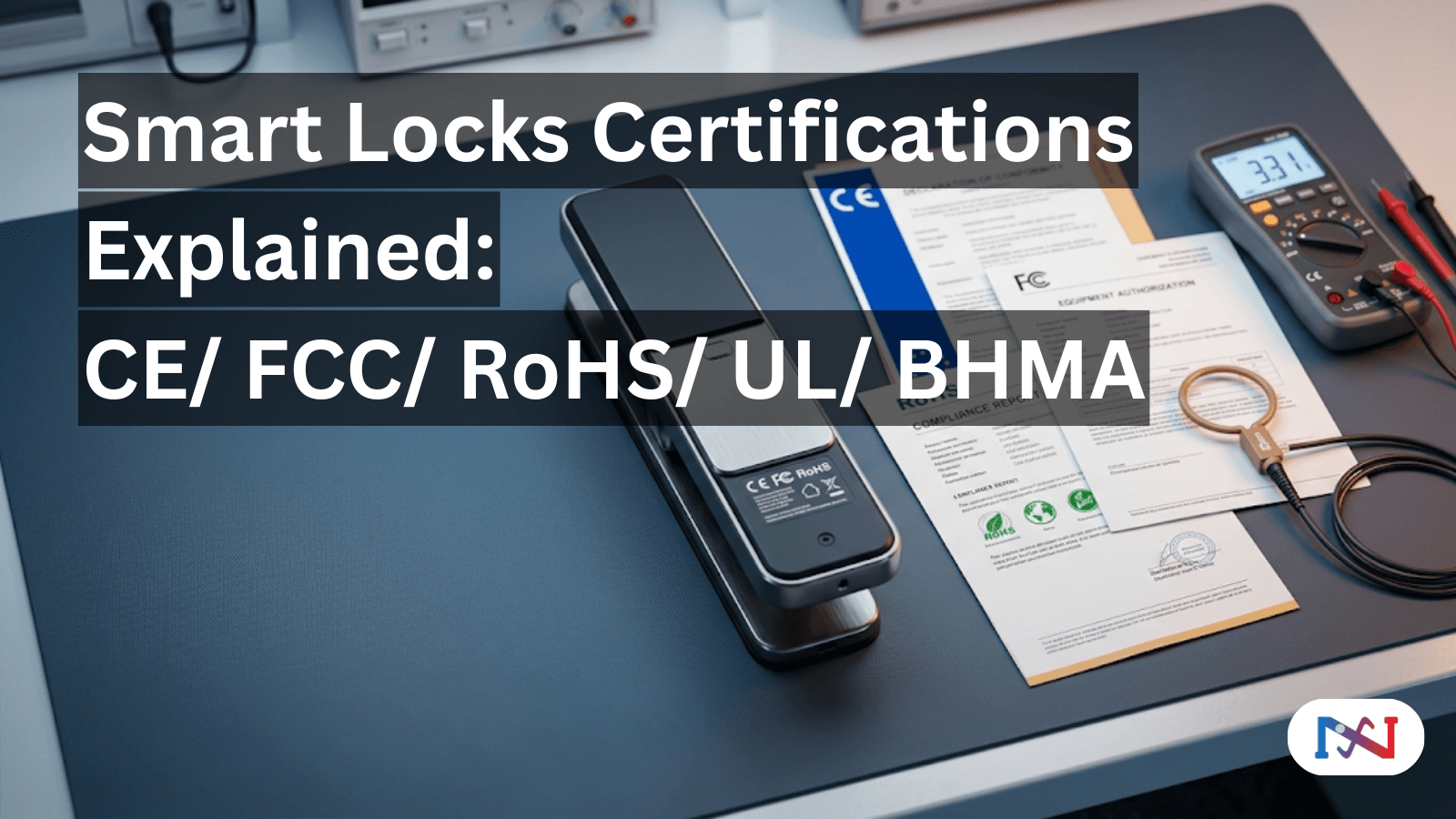
Smart locks are electronic devices containing wireless communication modules (Bluetooth 5.0, Wi-Fi 2.4GHz, Zigbee), biometric sensors, motorized lock mechanisms, and battery power systems. This classification places them under electromagnetic compatibility (EMC), radio frequency (RF), product safety, and environmental compliance requirements in every major import market. The baseline certifications for international B2B trade are CE marking (EU — covering EMC Directive 2014/30/EU, Low Voltage Directive 2014/35/EU, and Radio Equipment Directive 2014/53/EU), FCC Part 15 authorization (US — mandatory for wireless electronic devices), and RoHS compliance (Directive 2011/65/EU — restriction of hazardous substances). Additional standards include UL 294 (US access control equipment), ANSI/BHMA A156.40 (US mechanical performance grading), IP67/IPX6 (water and dust protection), and regional certifications (UKCA, SASO, ECAS). This guide explains each certification’s technical scope, regional applicability, testing requirements, and how certifications transfer between OEM/ODM manufacturing models. For import documentation and customs procedures, see our importing guide with customs and documentation.
Why Smart Lock Certifications Matter for B2B Buyers
Certifications serve three functions in B2B smart lock procurement. First, they determine legal market access — products without required certifications can be seized at customs, refused entry, or recalled after distribution. Second, they verify product safety — electromagnetic compatibility testing confirms the device does not interfere with other electronics, radio frequency testing confirms wireless modules operate within legal spectrum limits, and electrical safety testing confirms no shock, fire, or overheating hazards. Third, they provide commercial credibility — procurement managers, construction specifiers, and property developers routinely request certification documents during supplier evaluation.
Unlike traditional mechanical locks, smart locks combine electronics, wireless communication, biometric sensors, and battery power in a single device. This convergence triggers multiple regulatory frameworks simultaneously: electrical product safety, electromagnetic emissions, radio spectrum usage, and environmental substance restrictions. A single smart lock may need to comply with 3–5 different directives or standards depending on the target market.
Global Certification Reference Table
The following table provides a structured reference of the certifications most relevant to smart lock B2B trade. Each entry includes the specific directive or standard number, regional scope, and what it tests.
| Certification | Directive / Standard | Region | Scope | Mandatory? |
|---|---|---|---|---|
| CE — EMC | Directive 2014/30/EU; EN 55032, EN 55035 | EU / EEA | Electromagnetic emissions and immunity | Yes — for EU market entry |
| CE — LVD | Directive 2014/35/EU; EN 62368-1 | EU / EEA | Electrical safety (products 50–1000V AC) | Yes — voltage-dependent |
| CE — RED | Directive 2014/53/EU | EU / EEA | Radio equipment (Bluetooth, Wi-Fi, Zigbee) | Yes — for wireless devices |
| FCC Part 15 | 47 CFR Part 15 | United States | Radio frequency emissions from wireless devices | Yes — for US market |
| RoHS | Directive 2011/65/EU (amended 2015/863/EU) | EU / global | Restriction of 10 hazardous substances | Yes — for EU; widely expected elsewhere |
| UL 294 | UL 294 (7th Ed.) | United States / Canada | Access control system equipment safety | Optional — often specified on commercial projects |
| ANSI/BHMA A156.40 | A156.40 | United States / Canada | Smart lock mechanical performance grading (Grade 1/2/3) | Optional — specified in construction projects |
| IP67 / IPX6 | IEC 60529 | International | Dust and water ingress protection | Not mandatory — but expected for outdoor/exterior use |
| UKCA | UK regulations (mirrors CE) | Great Britain | Product safety, EMC, radio equipment | Yes — replaced CE for GB market |
| GB4943.1-2022 | GB4943.1-2022 | China (domestic) | Safety of electronic equipment | Yes — for China domestic market |
| SASO | SASO standards | Saudi Arabia | Product safety and quality | Yes — for Saudi market entry |
| ECAS | ECAS scheme | UAE | Conformity assessment for electronic products | Yes — for UAE market entry |
CE Marking: European Union Compliance
CE marking is a mandatory conformity assessment for electronic products placed on the EU and EEA market. For smart locks, CE compliance typically requires conformity with three directives simultaneously.
The Electromagnetic Compatibility Directive (2014/30/EU) ensures the device does not generate electromagnetic interference that could disrupt other electronic equipment, and that it functions correctly in the presence of external electromagnetic fields. Testing follows EN 55032 (emissions) and EN 55035 (immunity) standards. This is relevant because smart locks operate alongside Wi-Fi routers, Bluetooth devices, and building management electronics — uncontrolled emissions could cause connectivity issues or device malfunctions.
The Low Voltage Directive (2014/35/EU) addresses electrical safety for products operating between 50–1000V AC or 75–1500V DC. Battery-powered smart locks operating below these thresholds may not fall directly under LVD scope, but safety testing against EN 62368-1 (audio/video, information, and communication technology equipment safety) is standard practice for demonstrating compliance.
The Radio Equipment Directive (2014/53/EU, or RED) applies to any smart lock containing Bluetooth, Wi-Fi, Zigbee, NFC, or other wireless communication modules. RED covers radio spectrum usage, electromagnetic compatibility, and health and safety requirements. This is the most critical CE directive for smart locks because virtually all modern models include at least Bluetooth connectivity for app-based access management.
CE marking requires a Declaration of Conformity (DoC) issued by the manufacturer, supported by test reports from an accredited laboratory. The DoC must reference the specific directives, harmonized standards, and product configurations tested.
FCC Part 15: United States Wireless Compliance
FCC authorization is mandatory for any electronic device sold in the United States that emits radio frequency energy. Smart locks with Bluetooth 5.0, Wi-Fi 2.4GHz, Zigbee, or NFC modules require FCC Part 15 certification under 47 CFR Part 15 (Code of Federal Regulations, Title 47, Part 15 — Radio Frequency Devices).
FCC certification evaluates radio frequency emissions to ensure the device operates within permitted frequency bands and power limits without causing harmful interference to other wireless systems. The FCC assigns a unique FCC ID to each certified product configuration. This FCC ID must appear on the product label or be accessible through the device’s electronic display (e-labeling is accepted for devices with limited surface area).
Two certification pathways exist under Part 15. Certification (formerly Type Acceptance) is required for intentional radiators — devices that intentionally transmit radio signals, including Bluetooth and Wi-Fi modules in smart locks. Supplier’s Declaration of Conformity (SDoC) applies to unintentional radiators — devices that emit RF energy incidentally.
Buyers can verify FCC certification at the FCC Equipment Authorization database (apps.fcc.gov/oetcf/eas/reports/GenericSearch.cfm) by searching the product’s FCC ID. The database entry shows the product model, frequency bands tested, test laboratory, grant date, and authorized power output.
Section 301 tariffs may apply to Chinese-origin electronics imported into the US, adding tariff surcharges beyond the standard MFN duty rate. As of 2026, smart locks classified under HTS 8301.40 face combined tariff rates that significantly impact landed cost. Consult a customs broker for current Section 301 applicability.
RoHS: Environmental Substance Restrictions
The Restriction of Hazardous Substances Directive (RoHS, 2011/65/EU as amended by Delegated Directive 2015/863/EU) restricts the use of ten hazardous substances in electrical and electronic equipment. The restricted substances include lead (Pb), mercury (Hg), cadmium (Cd), hexavalent chromium (Cr6+), polybrominated biphenyls (PBB), polybrominated diphenyl ethers (PBDE), and four phthalates (DEHP, BBP, DBP, DIBP) added under the 2015 amendment.
RoHS compliance is mandatory for EU market entry and has become a de facto global quality benchmark — importers in North America, Middle East, and Asia increasingly request RoHS documentation as standard. The manufacturer provides a RoHS test report documenting material composition analysis of the finished product and its subcomponents, including PCB solder, cable insulation, housing pigments, and battery chemistry.
IP Ratings: Water and Dust Protection (IPX6, IP67)
IP (Ingress Protection) ratings, defined by IEC 60529, classify the degree of protection a device provides against solid objects (dust) and liquids (water). The IP rating consists of two digits — the first indicates solid particle protection (0–6), the second indicates liquid ingress protection (0–9K).
For smart locks, the most commonly referenced ratings are IP67 (complete dust protection + temporary immersion in water up to 1 meter for 30 minutes) and IPX6 (high-pressure water jets from any direction at 100 liters per minute). The “X” in IPX6 indicates that the dust protection digit is not rated — only the water resistance is tested.
IP67 or IPX6 certification is not a legal market access requirement like CE or FCC. However, it is a critical specification for smart locks installed on exterior doors, covered patios, semi-exposed commercial entrances, or in coastal and tropical climates where humidity and rain exposure are expected. Models like the SU7 face recognition lock carry IP67 water and dust protection across the Nice Smart product line.
Ask the manufacturer for the IP rating test report issued by an accredited laboratory — not just the IP rating claim in marketing materials. The test report documents the specific test conditions (water flow rate, pressure, duration) and confirms the rating applies to the actual production configuration.
UL 294 and ANSI/BHMA Grading: North American Commercial Standards
UL 294 is a safety standard for access control system equipment published by Underwriters Laboratories. While not universally mandatory, UL 294 is frequently specified by architects, construction project managers, and commercial building developers in the United States and Canada for electronic access control installations. UL 294 evaluates electrical safety, environmental endurance, attack resistance, and standby power performance of electronic locking devices.
ANSI/BHMA A156.40 is the American National Standards Institute / Builders Hardware Manufacturers Association standard for commercial smart locks. It establishes three performance grades. Grade 1 is the highest — rated for high-frequency commercial use (800,000+ cycle life), maximum security, and institutional environments such as hospitals, government buildings, and university campuses. Grade 2 covers medium-duty commercial and heavy residential applications (400,000+ cycle life). Grade 3 covers light residential use (200,000+ cycle life).
For B2B buyers targeting North American commercial projects, the question is whether the project specification requires UL or BHMA grading. Many commercial construction projects include UL or BHMA requirements in the door hardware specification, making these certifications a practical necessity for winning project bids — even though they are not legally mandated by government regulation.
Not all Chinese smart lock manufacturers hold UL or BHMA certifications — these are expensive and time-consuming to obtain. An honest manufacturer will clearly state which certifications are currently in place and which can be coordinated with accredited labs for specific market requirements. Nice Smart currently holds CE, FCC Part 15, RoHS, IPX6, and GB4943.1-2022 certifications, with UL and BHMA testing support available on a project basis through OEM and ODM manufacturing services.
AES Encryption and Wireless Security Standards
Beyond hardware safety certifications, smart lock security also depends on data encryption and wireless communication protocols. While not a “certification” in the regulatory sense, AES (Advanced Encryption Standard) encryption is the security benchmark for smart lock data transmission and RFID card authentication.
AES-128 encryption is the minimum standard for securing Bluetooth and Wi-Fi communication between the smart lock and the mobile app. RFID card systems in hotel-grade locks use AES encryption for card authentication — preventing unauthorized card cloning. The SU7-03 RFID hotel lock implements AES-encrypted 13.56MHz Mifare card authentication across its hierarchical card management system (master, floor, building, guest, and emergency cards).
For B2B buyers specifying smart locks for commercial, hotel, or government deployments, confirm the encryption standard used for wireless communication (BLE pairing, app-to-lock data transfer) and for RFID card authentication. AES-128 is the baseline; AES-256 is available in some high-security implementations.
How Certifications Transfer in OEM vs ODM Manufacturing
A critical consideration for B2B buyers placing OEM or ODM orders is whether existing certifications apply to the branded product or whether new testing is required. This directly affects project timeline and certification costs.
OEM orders (existing hardware, custom branding). When the OEM order uses the manufacturer’s existing hardware platform — same PCB, same wireless modules, same electronic architecture — CE, FCC, and RoHS certifications transfer to the private label product without retesting. The manufacturer provides certification documents and test reports that cover the hardware platform. Logo engraving, packaging changes, firmware language configuration, and surface finish selection do not affect certification validity because the electronic and wireless design remains unchanged.
ODM orders (custom hardware design). When the ODM order modifies the electronic design — new wireless module, different antenna configuration, changed PCB layout, different battery chemistry — new certification testing is required. The manufacturer coordinates testing with accredited laboratories (SGS, TÜV, Intertek, Bureau Veritas), manages the application process, and provides the test reports. Certification testing costs and timelines should be budgeted as part of the ODM project plan. See our manufacturing cost breakdown for investment considerations.
This distinction is one of the primary cost and timeline advantages of the OEM model for buyers entering new markets — certified products can ship within 7–25 business days without certification delays. For a detailed comparison, see our OEM vs ODM manufacturing guide.
How to Verify a Manufacturer’s Certifications
Certification claims should always be verified before committing to a B2B order. The verification process involves four steps.
Request the actual certification documents — not logos or marketing images. Ask for the Declaration of Conformity (CE), FCC Grant of Authorization (FCC), and laboratory test reports (RoHS, IP rating, safety). Each document should display the product model number, testing laboratory name, test report reference number, applicable standards, and date of issue.
Cross-reference certification numbers against issuing body databases. FCC IDs are searchable at apps.fcc.gov. CE test reports should reference an accredited testing laboratory verifiable through the national accreditation body (e.g., DAkkS in Germany, UKAS in the UK). Ask for the laboratory’s ISO/IEC 17025 accreditation number.
Confirm model consistency — the exact product model on the certificate must match the product being ordered. If the manufacturer has revised the wireless module, PCB design, or battery system since the certificate was issued, the certification may not apply to the current production configuration.
Evaluate the testing laboratory — certificates from internationally recognized laboratories (SGS, TÜV, Intertek, Bureau Veritas) carry more weight than certificates from unknown facilities. For an overview of Nice Smart’s current certifications and test documentation, see Nice Smart certifications and compliance documentation.
For a complete framework on evaluating manufacturers beyond certifications, refer to our manufacturer evaluation checklist.
Frequently Asked Questions About Smart Lock Certifications
What certifications do smart locks need for international export?
At minimum: CE marking (EU — EMC Directive 2014/30/EU, Radio Equipment Directive 2014/53/EU), FCC Part 15 (US — mandatory for Bluetooth/Wi-Fi devices), and RoHS (Directive 2011/65/EU). Additional certifications by market include UKCA (Great Britain), UL 294 (US commercial), ANSI/BHMA A156.40 (US mechanical grading), SASO (Saudi Arabia), and ECAS (UAE). IP67 or IPX6 water resistance is expected for exterior installations.
What is the difference between IP67 and IPX6 for smart locks?
Both are defined by IEC 60529. IP67 means complete dust protection (6) plus protection against temporary immersion in water up to 1 meter for 30 minutes (7). IPX6 means protection against high-pressure water jets from any direction (6) but without a rated dust protection digit (X). For smart locks on exterior doors, either rating provides adequate water protection. IP67 provides the additional assurance of full dust sealing.
What is ANSI/BHMA Grade 1 for smart locks?
ANSI/BHMA A156.40 Grade 1 is the highest performance grade for commercial smart locks in North America. It requires 800,000+ cycle life testing, maximum security resistance, and suitability for high-frequency institutional use (hospitals, government buildings, universities). Grade 2 covers medium-duty commercial (400,000+ cycles). Grade 3 covers residential use (200,000+ cycles). These grades are commonly specified in US commercial construction projects.
Do CE and FCC certifications transfer to OEM-branded smart locks?
Yes — when the OEM order uses the manufacturer’s existing hardware platform without electronic modifications (same PCB, same wireless modules, same antenna design). The manufacturer provides certification documents covering the hardware platform. Logo engraving, packaging, and firmware language changes do not affect certification validity. If the OEM order modifies electronics, new testing is required.
How do I verify if a smart lock’s FCC certification is legitimate?
Search the product’s FCC ID at the FCC Equipment Authorization database (apps.fcc.gov). The database entry shows the certified product model, frequency bands, test laboratory, grant date, and authorized power output. The FCC ID on the product label must match the database record, and the product configuration must match the certified configuration.
What does RoHS compliance mean for smart locks?
RoHS (Directive 2011/65/EU, amended by 2015/863/EU) restricts ten hazardous substances in electronic products: lead, mercury, cadmium, hexavalent chromium, PBB, PBDE, and four phthalates (DEHP, BBP, DBP, DIBP). RoHS compliance is mandatory for EU market entry and widely expected by importers globally. The manufacturer provides a test report documenting material analysis of the finished product and subcomponents.
Do hotel smart locks need different certifications than residential locks?
Hotel locks require the same baseline certifications (CE, FCC, RoHS) as residential models. However, commercial hospitality deployments may additionally specify UL 294 (access control equipment safety), ANSI/BHMA grading (mechanical performance), and fire-rated door compatibility. RFID hotel locks should also demonstrate AES-encrypted card authentication for security compliance.
What is AES encryption in smart locks?
AES (Advanced Encryption Standard) is the security standard used to encrypt data transmission between the smart lock and the mobile app (via Bluetooth or Wi-Fi) and to authenticate RFID/IC cards. AES-128 is the baseline for consumer and commercial smart locks. Hotel-grade RFID locks use AES encryption for card authentication to prevent unauthorized card cloning. AES is not a regulatory certification but a security specification that B2B buyers should verify.
Need certification documents for your market? Nice Smart provides CE, FCC Part 15, RoHS, IPX6, and GB4943.1-2022 certification documents and test reports with every B2B order. UL and BHMA testing coordination is available for commercial project requirements. Request certification documents and test reports or reach us via WhatsApp.