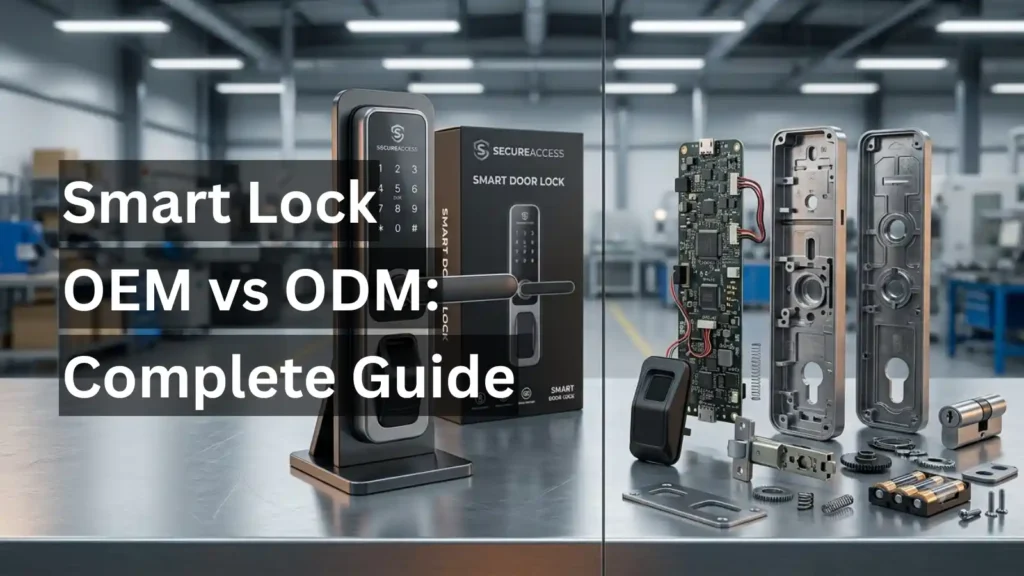
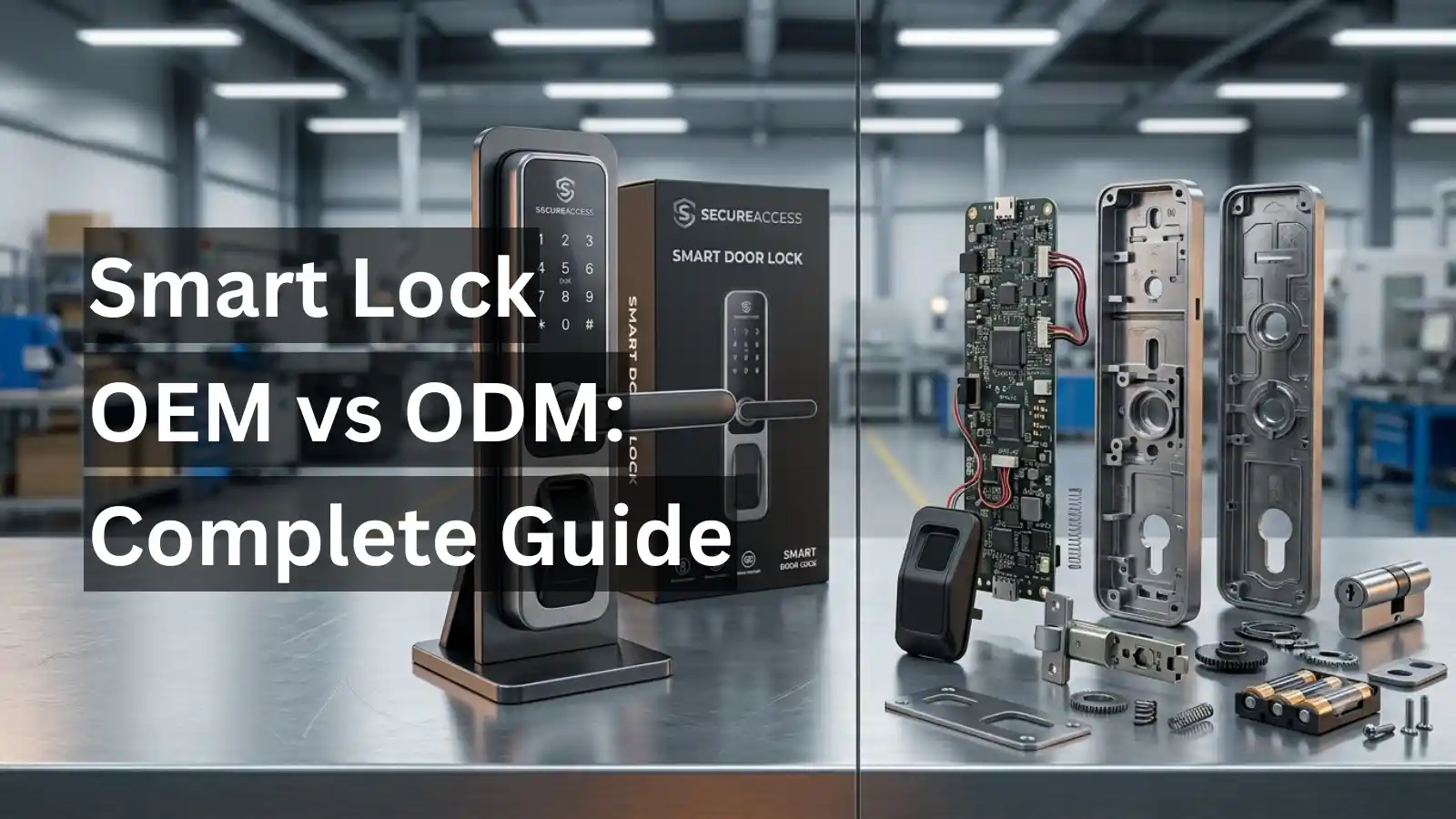
OEM (Original Equipment Manufacturing) smart locks are produced using existing hardware platforms customized with the buyer’s brand logo, packaging, firmware settings, and mechanical adaptations. ODM (Original Design Manufacturing) smart locks are designed and engineered from scratch by the factory based on the buyer’s specifications, including new industrial design, PCB layout, mold development, and firmware programming. OEM projects typically require 20–100 unit MOQs with 7–25 day lead times, while ODM projects require 300–500 unit MOQs with 8–12 week development cycles. This guide covers the technical, commercial, and strategic differences between both models to help importers, distributors, and project developers select the right manufacturing path. For a detailed overview of available customization options, see Nice Smart’s OEM and ODM manufacturing services.
What Is Smart Lock OEM vs ODM Manufacturing?
The terms OEM and ODM define two distinct manufacturing relationships between a smart lock factory and its B2B buyer. The distinction determines who owns the product design, how much customization is possible, what investment is required, and how quickly the product reaches market. Understanding this distinction is the first decision any importer or distributor must make before engaging a smart lock manufacturer.
OEM – Original Equipment Manufacturing
In an OEM arrangement, the smart lock manufacturer produces locks using its existing, proven hardware platform. The buyer customizes the product with their own brand identity — logo engraving, packaging design, firmware language settings, app branding, and finish color. The underlying hardware (PCB, fingerprint sensor, motor, lock body) remains the manufacturer’s tested and certified design.
OEM is the fastest and most cost-effective route to market for distributors and brands that want branded products without investing in hardware engineering. The buyer gets a certified, production-ready smart lock with their branding applied. The manufacturer handles assembly, quality control, and certification compliance.
A smart lock OEM manufacturer like Nice Smart typically offers six layers of OEM customization: logo engraving, packaging design, firmware and app configuration, surface finish selection, mechanical adaptation for regional door standards, and certification transfer documentation.
ODM – Original Design Manufacturing
In an ODM arrangement, the manufacturer designs and engineers a new smart lock product from concept to production based on the buyer’s specifications. This includes industrial design, 3D CAD modeling, PCB engineering, firmware development, CNC mold fabrication, pilot production, and certification coordination.
ODM is the path for brands or technology companies that need a product not available in any existing catalog — a unique form factor, proprietary access method, custom wireless protocol stack, or integration with a specific building management system. The buyer defines the requirements; the factory’s R&D team executes the engineering.
ODM projects require significantly higher investment and longer timelines than OEM. However, the buyer receives a product that is engineered to their exact specifications and not available to competing distributors sourcing from the same factory.
OEM vs ODM Smart Lock Manufacturing: Side-by-Side Comparison
| Factor | OEM Smart Lock | ODM Smart Lock |
|---|---|---|
| Hardware Design | Manufacturer’s existing platform | Custom design to buyer’s specifications |
| Design Ownership | Manufacturer retains hardware IP | Buyer owns the custom design (per contract) |
| Customization Scope | Branding, packaging, firmware, finish, mechanical fit | Full — industrial design, PCB, firmware, mold |
| Typical MOQ | 20–100 units | 300–500 units (includes mold investment) |
| Lead Time | 7–25 business days | 8–12 weeks (incl. prototyping and tooling) |
| Upfront Investment | Low — no engineering or tooling costs | Higher — mold development, R&D, certification |
| Product Exclusivity | Limited — same base hardware available to others | High — unique product per contract terms |
| Certifications | CE/FCC/RoHS transfer with existing hardware | New certification testing may be required |
| Time to First Sale | 2–4 weeks from order confirmation | 3–4 months from project kickoff |
| Best For | Distributors, wholesalers, market testers | Brands building proprietary product lines |
OEM Smart Lock Customization: Six Layers of Branding and Engineering
A common misconception is that OEM means only adding a logo to a generic product. In practice, a capable smart lock OEM manufacturer offers multiple customization layers that transform a standard product into a market-ready branded solution. Nice Smart provides six distinct customization services on its existing product line, each applicable independently or in combination.
Logo and Brand Engraving
Laser engraving or pad printing applies the buyer’s company logo, brand name, and model number directly onto the lock body, interior panel, or both. For products with dedicated branding zones — such as the SU7 face recognition smart door lock or the S9 glass door lock with its custom logo area — the manufacturer integrates branding into the product’s visual design rather than treating it as an afterthought.
Packaging and Manual Design
Custom retail or industrial packaging carries the buyer’s brand identity, product photography, multilingual user manuals, warranty cards, and installation guides. Manufacturers typically provide packaging layout templates, and some offer in-house design support. For distributors selling across multiple markets, multilingual manual production is handled as part of the packaging specification.
Firmware and App Configuration
Firmware-level customization includes UI language localization, voice prompt language selection, and app skin configuration. Smart locks running on the Tuya IoT platform support Tuya’s OEM app service, which allows the buyer’s brand to appear on a custom-branded mobile application. TTLock-based products support similar platform binding for Bluetooth and gateway-based access management. This layer determines how the end user experiences the product — the app they download, the interface language, and the voice prompts they hear during operation.
Finish and Color Options
Surface finish options include matte black, satin nickel, gold, silver, and bronze, applied via PVD coating or electroplating processes across zinc alloy and aluminium alloy housings. Finish selection affects both the product’s aesthetic positioning and its environmental durability. PVD-coated finishes provide superior scratch resistance and corrosion protection compared to standard electroplating, which matters for products deployed in coastal or humid climates.
Mechanical Adaptation for Regional Door Standards
Smart locks must physically fit the doors they are installed on. Door preparation standards vary by region — European DIN standard mortise pockets differ from American ANSI preparations, and door thickness ranges from 35mm to 120mm depending on the market. OEM mechanical adaptation adjusts the mortise body dimensions, spindle length, and handle orientation to match the buyer’s target market. This is particularly important for distributors serving markets with non-standard door configurations, such as the thick steel security doors common across the Middle East and South Asia.
Certification Transfer and Support
When the OEM order uses the same base hardware platform, existing CE, FCC Part 15, and RoHS certifications apply to the branded product without retesting. The manufacturer provides certification documentation and test reports for the buyer’s customs clearance and import compliance. If the OEM order modifies the electronic design — for example, adding a new wireless module or changing the antenna configuration — new certification testing is required, which the manufacturer coordinates with accredited testing laboratories.
ODM Smart Locks: Engineering a New Product From Concept to Production
ODM projects follow a structured development cycle that moves from concept through prototyping, testing, certification, and mass production. Nice Smart’s 6-person R&D engineering team executes the full ODM cycle in-house, specializing in biometric sensor integration, electronic mortise lock mechanisms, and IoT connectivity module development.
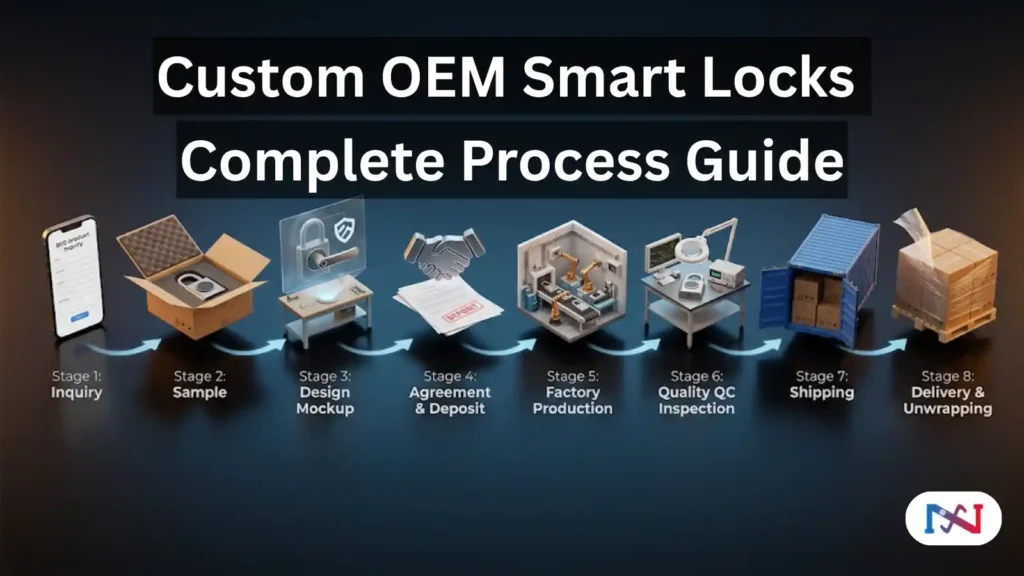
The standard ODM development process follows six stages. The first stage is project consultation and feasibility assessment, with the engineering team providing an initial response within 72 hours. The second is 3D CAD modeling and rapid prototyping, where the product’s industrial design is finalized and physical samples are produced for evaluation. The third stage covers PCB engineering and firmware development, supporting wireless protocols including Wi-Fi, Bluetooth 5.0, Zigbee, Sub-1G, and Thread. The fourth stage is CNC mold fabrication and pilot production of 50–100 units for field testing. The fifth is certification coordination with accredited labs for CE, FCC, RoHS, and any market-specific standards. The sixth stage is mass production with full quality control — incoming material inspection, in-line process checks, and final testing including 200,000-cycle handle durability tests, waterproof testing, and battery drain analysis.
ODM MOQs typically start at 300–500 units, which includes the mold development investment. Total development timelines range from 8–12 weeks depending on product complexity and certification requirements.
Cost Structure and Lead Time Comparison
The financial and timeline differences between OEM and ODM directly influence which model suits a buyer’s current business stage. The following comparison uses representative ranges based on typical smart lock manufacturing projects.
| Cost / Timeline Factor | OEM | ODM |
|---|---|---|
| Engineering / NRE Fees | None (existing platform) | Required — PCB design, firmware, industrial design |
| Mold / Tooling Investment | None (existing molds) | Required — CNC mold fabrication for housing and components |
| Certification Costs | Included (certification transfer) | New testing required for modified hardware |
| Minimum Order Quantity | 20–100 units | 300–500 units |
| Sample Availability | 3–5 business days from existing stock | 3D-printed prototype, then pilot run (50–100 units) |
| Production Lead Time | 7–25 business days | 8–12 weeks (incl. prototyping and tooling) |
| Payment Terms | 30% deposit, 70% before shipment (T/T) | 30% deposit, 70% before shipment (T/T) |
| Time to First Commercial Sale | 2–4 weeks | 3–4 months |
For distributors testing a new market, OEM’s low MOQ (starting from 20 units on select models) and 7-day lead time on standard models allow a first order to ship within weeks. For brands building proprietary products, ODM’s higher investment pays off through product exclusivity and long-term differentiation.
Standard payment terms across both models are 30% deposit upon order confirmation and 70% balance before shipment via T/T wire transfer. Established B2B partners with order history may qualify for flexible terms including 30-day net payment arrangements.
When to Choose OEM vs ODM: Decision Framework
The right manufacturing model depends on the buyer’s business stage, target market, volume expectations, and product strategy. The following framework maps common B2B buyer scenarios to the recommended approach.
| Business Scenario | Recommended Model | Rationale |
|---|---|---|
| New distributor entering the smart lock market | ODM | Low MOQ, fast time to market, minimal upfront investment |
| Established distributor expanding product line | OEM | Add branded products to existing catalog with proven hardware |
| Hotel chain deploying access control across properties | OEM | Standardized hardware with custom card management and PMS integration |
| Real estate developer equipping residential units | OEM | Consistent finish and branding across project-level volumes |
| Technology company building proprietary smart lock | ODM | Unique product design, custom firmware, proprietary app ecosystem |
| Testing demand in a new geographic market | ODM | Start with 20–50 units, validate demand before scaling |
| Security integrator needing custom access protocols | ODM | Custom firmware for proprietary access management systems |
Many successful B2B partners follow a phased approach: they start with OEM orders using existing models to test market demand, build sales channels, and establish their brand — then transition to ODM for proprietary product development once volumes justify the engineering investment. For industry-specific smart lock solutions across hotels, real estate, property management, and commercial buildings, the OEM model provides the fastest deployment path with proven hardware reliability.
How to Evaluate a Smart Lock OEM/ODM Factory
Not all smart lock manufacturers offer the same capabilities. When evaluating an OEM or ODM partner, B2B buyers should assess six critical areas that directly affect product quality, delivery reliability, and long-term partnership viability.
R&D engineering capacity: A factory with in-house R&D engineers (not outsourced design) can respond to customization requests faster, troubleshoot production issues, and iterate on firmware updates. Ask how many R&D engineers are on staff and what wireless protocols they have development experience with. Nice Smart maintains a 6-person R&D team with capabilities across Wi-Fi, Bluetooth 5.0, Zigbee, Sub-1G, and Thread.
Certification portfolio: Verify which certifications the manufacturer holds — not claims, but actual certificates with test report numbers. CE (European conformity), FCC Part 15 (US electromagnetic compliance), and RoHS (restriction of hazardous substances) are the baseline for international export. IPX6 water resistance certification matters for locks deployed in outdoor or semi-exposed installations. Ask whether certifications transfer to OEM-branded products or require retesting.
IoT platform support: The smart lock’s connectivity platform determines how end users manage access, how property managers monitor locks remotely, and which smart home ecosystems the product integrates with. A manufacturer supporting both Tuya IoT and TTLock platforms gives the buyer flexibility to serve different market segments — Tuya for residential and Airbnb deployments (Amazon Alexa, Google Home compatible), TTLock for hotel and commercial property management (PMS integration, gateway-based remote management).
Production capacity and lead times: Ask for specific numbers — monthly unit capacity, standard lead times, and custom order timelines. A factory producing 8,000+ units per month with 7-day standard lead times operates at a different reliability level than a factory quoting “4–6 weeks” on every order.
Quality control process: Request details on the QC workflow: incoming material inspection, in-line process checks, final functional testing. Ask specifically about durability testing — how many handle cycles are tested, whether waterproof testing is performed on every batch, and whether battery drain analysis is conducted.
MOQ flexibility: Factories requiring 500+ unit minimums exclude new distributors and market testers. A custom smart lock manufacturer offering MOQs from 20 units demonstrates confidence in product quality and willingness to support growing partners.
IoT Platform Integration in OEM and ODM Projects
The choice of IoT platform shapes the end user’s experience and the property manager’s operational capabilities. Two platforms dominate the global B2B smart lock market: Tuya IoT and TTLock. A smart lock OEM manufacturer supporting both platforms provides buyers with deployment flexibility across residential, hospitality, and commercial applications.
Tuya IoT: operates on Wi-Fi and Bluetooth connectivity. It supports the Tuya Smart app and offers an OEM app service that allows buyers to launch a custom-branded mobile application under their own name. Tuya-compatible smart locks integrate with Amazon Alexa, Google Home, and IFTTT, making them suitable for residential smart home ecosystems, Airbnb and short-term rental properties, and serviced apartment complexes.
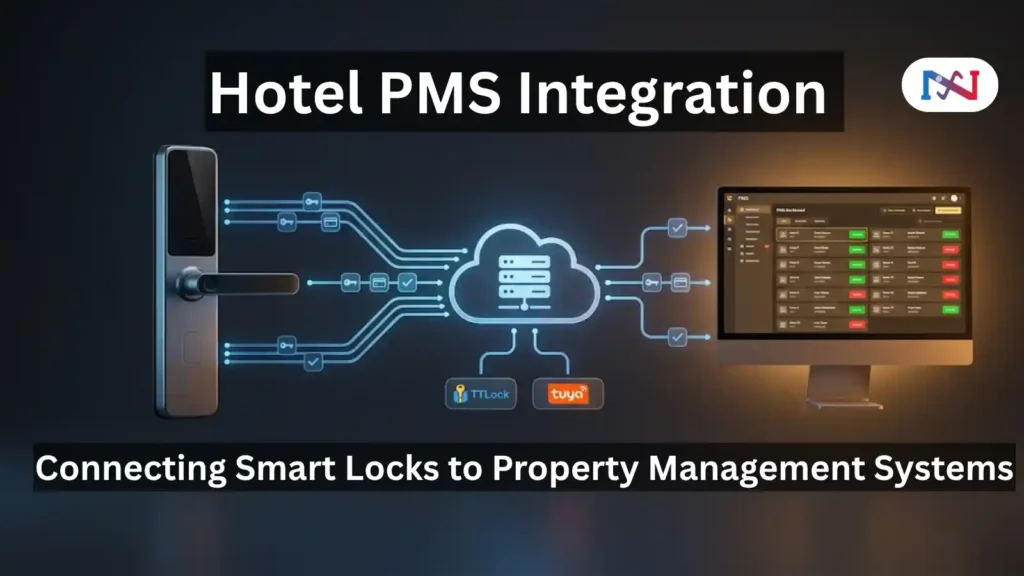
TTLock: operates on Bluetooth with optional gateway connectivity for remote management. It supports remote passcode generation, time-limited access scheduling, audit trail logging, and multi-property management dashboards. TTLock’s API enables integration with hotel property management systems (PMS) including Opera PMS and Cloudbeds. This makes TTLock the preferred platform for hotel deployments, co-working spaces, and property management companies that need centralized access control.
In OEM projects, platform selection is configured during the firmware customization stage. The buyer specifies whether the product ships with Tuya binding, TTLock binding, or both. In ODM projects, the platform architecture can be designed from the ground up — including custom SDK integration, proprietary app development, or hybrid connectivity stacks.
Products like the SU7-03 RFID hotel lock demonstrate TTLock integration for hotel deployments, with 13.56MHz Mifare card management, hierarchical card systems (master, floor, building, guest, emergency), and 500-card capacity per lock.
Frequently Asked Questions About Smart Lock OEM and ODM Manufacturing
What is the difference between smart lock OEM and ODM?
OEM (Original Equipment Manufacturing) uses the factory’s existing hardware designs, customized with the buyer’s branding, packaging, firmware, and finish options. ODM (Original Design Manufacturing) creates an entirely new product from the buyer’s specifications — including industrial design, PCB engineering, mold development, and firmware programming. OEM is faster and lower-cost (MOQ from 20 units, 7–25 day lead times). ODM delivers product exclusivity but requires higher investment (MOQ 300–500 units, 8–12 week timelines).
What is the minimum order quantity for OEM smart locks?
Standard OEM orders with logo engraving start from 20–50 units depending on the model. Full custom packaging and firmware configuration orders typically require 100–300 units. ODM projects with new mold development require 300–500 units minimum, which includes the tooling investment.
How long does OEM smart lock production take?
Standard OEM orders with existing models ship within 7–15 business days from order confirmation. Orders requiring custom packaging, firmware modification, or mechanical adaptation take 15–25 business days. ODM projects with new mold development require 8–12 weeks including prototyping, certification testing, and pilot production.
Do certifications transfer to OEM-branded smart locks?
CE, FCC Part 15, and RoHS certifications apply to the hardware platform and are valid for OEM orders that use the same base electronics and wireless modules. If the OEM order modifies the electronic design — such as adding a new antenna, wireless module, or sensor — new certification testing may be required. The manufacturer coordinates this process with accredited testing laboratories.
Can I order samples before placing a bulk OEM order?
Yes. Sample units from the existing smart lock product catalog ship within 3–5 business days. For ODM projects, 3D-printed prototypes can be produced for initial evaluation before committing to mold investment. Sample evaluation is standard practice before any bulk order commitment.
What payment terms does a smart lock OEM manufacturer accept?
Standard payment terms are 30% deposit upon order confirmation and 70% balance before shipment via T/T wire transfer. Established B2B partners with consistent order history may qualify for flexible payment arrangements including 30-day net terms. Payment terms are negotiated during the initial project consultation.
Can I private label smart locks from a China factory?
Yes. Smart lock private labeling is a standard OEM service. The factory applies the buyer’s brand through logo engraving, custom packaging, app branding, and firmware language configuration. The buyer receives a fully branded product without investing in hardware engineering. Private label orders follow the same MOQ and lead time structure as standard OEM orders — starting from 20 units with 7-day lead times on select models.
How do I start an OEM or ODM smart lock project?
The process begins with a project consultation where the buyer provides lock type requirements, estimated volume, target market, branding needs, and timeline. The manufacturer’s engineering team responds with a detailed proposal including product recommendations, customization options, pricing, and production schedule. To start a project discussion, contact our engineering team via email or WhatsApp for a response within 24 hours.
Ready to start your OEM or ODM smart lock project? Send us your requirements — lock type, volume estimate, target market, and branding needs. Our engineering team will provide a detailed proposal within 24 hours. Request an OEM/ODM quote or message us directly on WhatsApp.