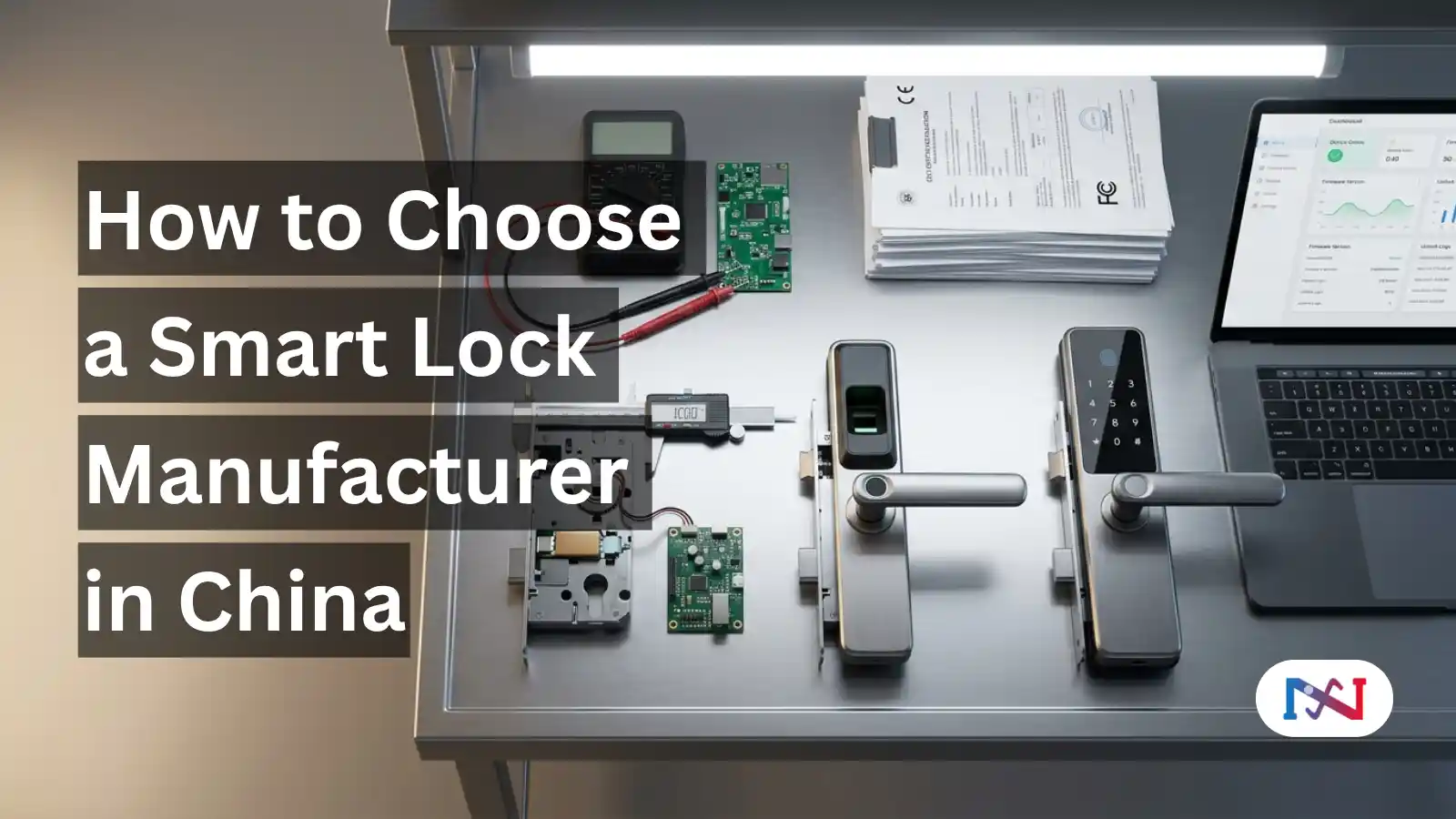
Choosing a smart lock manufacturer in China requires evaluation across seven procurement criteria: verified factory status (not trading company), international certifications (CE, FCC Part 15, RoHS at minimum), IoT platform compatibility (Tuya IoT and/or TTLock), monthly production capacity (benchmarked against your projected volume), quality control processes (incoming inspection, in-line checks, final testing), OEM/ODM customization scope, and commercial terms (MOQ, lead time, payment structure). China’s Guangdong Province – specifically Shenzhen, Zhongshan, and Foshan – is the primary manufacturing cluster for smart lock hardware, with Zhejiang (Wenzhou, Yongkang) as the secondary hub. The global smart lock market was valued at approximately USD 3.4–4.2 billion in 2026, growing at a CAGR of 15–20%, with Asia-Pacific accounting for over 31% of market share. This guide provides a structured checklist for B2B buyers – distributors, integrators, hotel operators, and developers — to evaluate and select a smart lock manufacturing partner in China.
Why China Dominates Smart Lock Manufacturing
China produces the majority of the world’s smart lock hardware, concentrated in two provincial manufacturing clusters. Guangdong Province – home to Shenzhen, Zhongshan, Foshan, and Guangzhou — provides the deepest electronics supply chain, with vertically integrated access to semiconductor fingerprint sensor fabrication, zinc alloy die-casting, PCB SMT assembly, and IoT module production within a 100-kilometer radius. Shenzhen alone hosts hundreds of smart lock manufacturers ranging from 20-person workshops to 500+ employee factories. Zhejiang Province – centered around Wenzhou and Yongkang – is the traditional lock manufacturing hub, with stronger capabilities in mechanical lock bodies, stainless steel hardware, and traditional door lock mechanisms now transitioning to electronic integration.
For B2B importers, the question is not whether to source from China – it is how to identify a reliable, certified, and technically capable manufacturing partner among thousands of factories competing for export orders. The following checklist provides the evaluation framework.
Checklist Step 1: Verify Factory Status – Manufacturer vs Trading Company
The single most important verification in Chinese smart lock sourcing is confirming that the supplier is an actual manufacturer with its own production facility — not a trading company reselling products from multiple factories. Trading companies add margin without adding engineering value, cannot support OEM firmware customization or mechanical adaptation, and create supply chain risk when their factory relationships change.
How to verify factory status:
Request the business license (营业执照 / Yingye Zhizhao) and check the registered business scope. A manufacturer’s scope will list “生产” (production/manufacturing) and “研发” (research and development). A trading company’s scope lists “贸易” (trade) or “销售” (sales) without production activities.
Ask for factory photos and video — not marketing renders. A real factory will show its production floor, SMT assembly line, QC stations, component storage, and finished goods packaging area. Request a live video call walking through the facility. Trading companies will show a showroom or office, not a production line.
Check the factory address against satellite imagery. A legitimate smart lock manufacturer occupies an industrial park or factory building with loading docks and production infrastructure — not a commercial office tower.
Verify on third-party platforms. Cross-reference the company name on Alibaba’s verified manufacturer badges, Made-in-China factory verification reports, or request a third-party audit report (SGS, Bureau Veritas, or TÜV factory inspection).
Ask technical questions that only a manufacturer can answer: “What is the FAR/FRR rate on your fingerprint sensor module?” “Which chipset runs your Bluetooth 5.0 connectivity?” “What is the cycle-life test count on your mortise lock body?” A manufacturer’s engineering team answers these immediately. A trading company forwards them.
Checklist Step 2: Evaluate International Certifications
Certifications determine whether a smart lock can legally enter your target market. Without valid certifications, products may be seized at customs, fail import compliance checks, or expose the importer to product liability. Evaluate certifications on three levels.
Baseline certifications (required for most international markets): CE marking confirms conformity with EU safety directives — specifically the Low Voltage Directive (2014/35/EU) and Electromagnetic Compatibility Directive (2014/30/EU) for electronic door locks. FCC Part 15 certification is mandatory for any wireless electronic device sold in the United States, covering electromagnetic emissions from Wi-Fi, Bluetooth, and Zigbee modules. RoHS compliance (Directive 2011/65/EU) certifies that the product does not contain restricted hazardous substances including lead, mercury, and cadmium — required for EU market entry and increasingly expected in other regions.
Environmental protection certifications: IPX6 water resistance rating (high-pressure jet protection from any direction) is relevant for locks installed on exterior doors, covered patios, or in humid climates. IP67 (full dust protection plus temporary immersion) provides higher assurance for exposed installations. Ask for the specific IP rating test report, not just a marketing claim.
Market-specific certifications: UL 294 (access control system equipment) is relevant for the North American commercial market. BHMA/ANSI Grade 1, 2, or 3 ratings apply to mechanical lock durability and security in the US and Canadian markets. EN 14846 covers electromechanical lock standards in European commercial installations. Not all manufacturers hold these — understand which certifications your target market requires and verify that the manufacturer can provide them or coordinate testing.
Verification method: Request actual certification documents with test report numbers, not just logo images on a website. Cross-check certification numbers against the issuing body’s database (FCC ID search at fcc.gov, CE test reports from the named testing laboratory). A manufacturer confident in its certifications will provide these documents proactively as part of any B2B inquiry response.
Checklist Step 3: Assess IoT Platform and Connectivity Support
A smart lock’s IoT platform determines its remote management capabilities, app ecosystem, smart home compatibility, and property management system (PMS) integration. The platform choice directly affects which end markets the product can serve effectively.
Two platforms dominate the global B2B smart lock market:
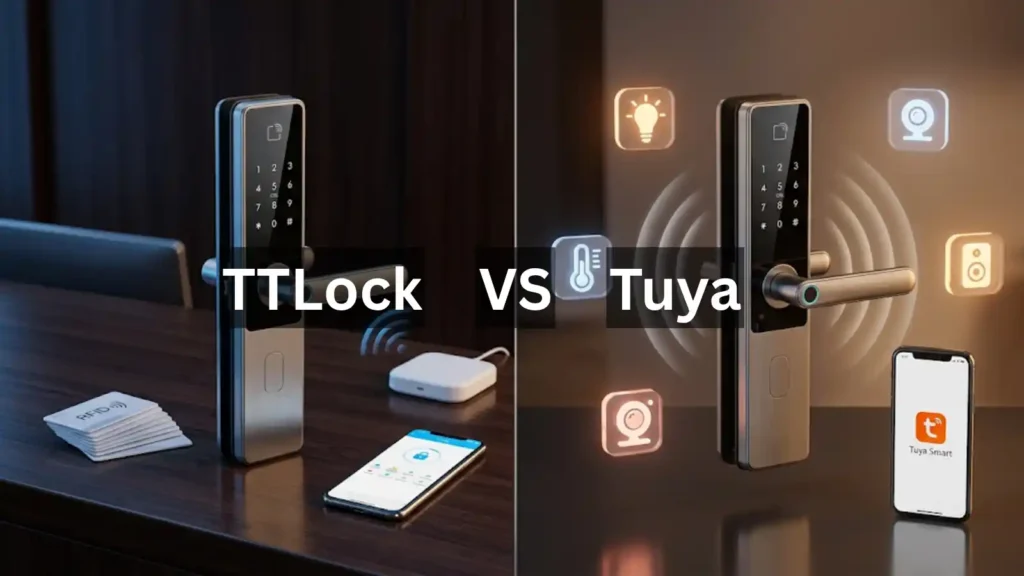
Tuya IoT is a cloud-based platform supporting Wi-Fi and Bluetooth connectivity. Products running on Tuya integrate with the Tuya Smart app (or a custom-branded OEM app through Tuya’s white-label service), Amazon Alexa, Google Home, and IFTTT. Tuya is the preferred platform for residential deployments, Airbnb and short-term rental properties, and smart home ecosystem integration. It offers the broadest consumer app ecosystem but has less granular access management features compared to TTLock.
TTLock operates on Bluetooth with optional gateway connectivity for remote access. TTLock supports remote passcode generation, time-limited access scheduling, multi-level access hierarchy, audit trail logging, and API-based integration with hotel PMS platforms including Opera PMS and Cloudbeds. TTLock is the preferred platform for hotel deployments, co-working spaces, multi-tenant commercial buildings, and property management companies requiring centralized access control.
A smart lock manufacturer in China that supports both Tuya and TTLock platforms provides buyers with deployment flexibility across multiple market segments — residential, hospitality, and commercial — without switching suppliers. Ask whether platform binding is configured at the firmware level during production or whether it requires different hardware SKUs. Dual-platform capability from a single hardware platform is a strong indicator of engineering sophistication.
Additional connectivity considerations include the supported wireless protocols (Wi-Fi 2.4GHz, Bluetooth 5.0, Zigbee 3.0, NFC, Sub-1G, Thread), whether the manufacturer has development experience with Matter-over-Thread for future smart home interoperability, and whether the factory can bind products to the buyer’s own Tuya OEM app during production.
Checklist Step 4: Benchmark Production Capacity and Lead Times
Production capacity determines whether a factory can reliably fulfill orders on schedule as the buyer’s business scales. Ask for specific numbers and benchmark them against industry standards.
Monthly production capacity: A mid-sized smart lock manufacturer in Shenzhen typically produces 3,000–10,000 units per month. Factories producing 8,000+ units per month can support both standard catalog orders and custom OEM runs simultaneously without production conflicts. Factories claiming 50,000+ monthly capacity are likely aggregating output across multiple subcontracted facilities — request clarification on whether production is in-house or outsourced.
Standard lead times: Production-ready models with no customization should ship within 5–10 business days. OEM orders with logo engraving and packaging customization should complete within 15–25 business days. ODM projects with new tooling should provide 8–12 week timelines including prototyping, testing, and pilot production. If a factory quotes 6–8 weeks for a standard order, investigate whether they manufacture in-house or source from another factory.
Production line infrastructure: Ask whether the factory operates its own SMT (Surface Mount Technology) line for PCB assembly or outsources board population. In-house SMT assembly provides faster iteration, better quality control, and the ability to support firmware customization without coordinating with external board houses. Ask about die-casting capabilities for zinc alloy or aluminium alloy lock housings — manufacturers with in-house metal forming can control material quality and surface finish consistency.
Sample availability: A genuine manufacturer maintains inventory of standard models and can ship evaluation samples within 3–5 business days. If samples require “2–3 weeks,” the supplier may be ordering from another factory. Sample turnaround time is a reliable proxy for factory status.
For reference, Nice Smart’s Shenzhen facility produces 8,000+ units per month across 30+ smart lock models, with 7-day lead times on standard orders and 3–5 day sample shipments from existing stock. These benchmarks can serve as a comparison baseline when evaluating other manufacturers.
Checklist Step 5: Audit the Quality Control Process
Quality control separates professional manufacturers from assembly shops. A structured QC process catches defects before shipment, reducing warranty claims, return rates, and damage to the buyer’s brand reputation. Evaluate QC across four stages.
Incoming material inspection (IQC): The factory should test components upon receipt from suppliers — fingerprint sensor modules checked for recognition accuracy, zinc alloy castings inspected for porosity and dimensional tolerance, PCBs tested for solder joint integrity, and batteries verified for capacity and discharge characteristics. Ask whether the factory has a dedicated IQC station and what percentage of incoming components are sampled.
In-line process checks (IPQC): During assembly, process inspectors should verify correct wiring harness connections, motor alignment in mortise lock bodies, touchscreen calibration, and firmware flashing success rates. Ask whether the factory uses go/no-go gauges for mechanical fit verification or relies on visual inspection alone.
Final quality testing (FQT): Every finished smart lock should undergo functional testing before packaging. The minimum test scope for a professional smart lock manufacturer includes fingerprint enrollment and recognition verification across all stored positions, PIN code entry and electronic unlock cycle testing, RFID/IC card read-range verification, Bluetooth pairing and app connectivity confirmation, mechanical key backup function check, auto-lock mechanism timing verification, tamper alert trigger testing, and battery voltage measurement under load.
Durability and environmental testing: Ask about long-term reliability testing applied on a batch basis. Handle cycle testing (200,000+ open/close cycles simulates 10+ years of daily use), IPX6 or IP67 waterproof testing under pressurized water jets, and battery drain analysis under continuous standby conditions are standard tests for locks intended for hotel and commercial deployment. Ask for test reports, not just claims.
Checklist Step 6: Evaluate OEM/ODM Customization Capability
Customization capability determines whether the manufacturer can support the buyer’s growth from initial market entry through to proprietary product development. Evaluate both OEM and ODM readiness.
OEM customization depth: Ask what specific OEM services the factory provides and at what MOQ each becomes available. A well-equipped factory should offer logo engraving (laser or pad printing), custom packaging design, firmware language and voice prompt configuration, app branding through Tuya OEM app service or TTLock platform binding, surface finish selection (PVD coating, electroplating across matte black, satin nickel, gold, silver, bronze), and mechanical adaptation for European DIN, American ANSI, or regional door standards. For a detailed comparison of OEM versus ODM capabilities and when each model is appropriate, refer to our OEM vs ODM smart lock manufacturing guide.
ODM engineering resources: Ask how many R&D engineers are on staff and what their specializations are. A factory with 5–10 R&D engineers covering mechanical design, PCB layout, firmware development, and IoT connectivity integration can execute ODM projects in-house. Factories with fewer than 3 engineers may outsource critical development stages, which introduces coordination delays and IP risk. Request examples of previous ODM projects — even without disclosing client names, the manufacturer should be able to describe the scope and timeline of completed custom development programs.
MOQ flexibility: MOQ requirements reveal a manufacturer’s confidence and market positioning. Factories requiring 500+ unit minimums for basic OEM orders limit access for new distributors testing markets. A manufacturer offering MOQs from 20 units on select models and 50 units on most product lines demonstrates both production flexibility and willingness to build long-term partnerships through low-barrier entry. Nice Smart supports OEM and ODM smart lock manufacturing services with MOQs starting from 20 units for standard OEM and 300–500 units for full ODM development.
Checklist Step 7: Review Product Range and Application Coverage
A manufacturer’s product catalog breadth indicates engineering depth and market versatility. Buyers who source from a single manufacturer for multiple lock types reduce supply chain complexity, maintain consistent branding, and simplify after-sales support.
Evaluate whether the manufacturer covers the following product categories relevant to B2B deployments:
Smart mortise/handle door locks with fingerprint, PIN code, IC card, and app access — the highest-volume category for residential and commercial projects. Models like the SU7 dual-camera face recognition lock represent the premium tier with 3D structured-light facial recognition, 4″ IPS display, and video intercom capabilities.
RFID card-only hotel locks designed for hospitality deployments with 13.56MHz Mifare card management, hierarchical card systems, and PMS integration. The SU7-03 RFID hotel lock demonstrates this category with 500-card capacity and AES encryption.
Smart glass door locks for commercial offices, retail spaces, and interior partitions. Smart cabinet locks for hotel locker rooms, co-working storage, and gym facilities. Smart padlocks and U-locks for warehouses, utility access, and asset protection. Smart knob and handle locks for interior doors requiring light-duty access control.
A manufacturer offering industry-specific access control solutions across hotels, real estate, property management, and commercial buildings — supported by a catalog of 30+ models — can serve as a single-source partner for multi-application projects.
Checklist Step 8: Confirm Commercial Terms and Support Structure
Commercial terms affect total procurement cost and operational risk beyond the unit price. Evaluate the following before committing to a manufacturing partner.
Payment terms: Standard B2B terms in Chinese smart lock manufacturing are 30% deposit upon order confirmation and 70% balance before shipment via T/T (telegraphic transfer) wire payment. Some manufacturers offer flexible terms for established partners, including 30-day net payment arrangements after the first 2–3 successful orders. Avoid any factory demanding 100% prepayment on a first order — this eliminates the buyer’s leverage on quality and delivery compliance.
Warranty coverage: Standard B2B warranty in this industry is 24 months from delivery date, covering manufacturing defects in materials and workmanship. Extended warranty up to 36 months should be available for project-level orders (500+ units). Confirm whether the factory stocks spare parts and replacement units for rapid fulfillment during the warranty period.
Shipping terms: Confirm available Incoterms — FOB Shenzhen is standard, with CIF and DDP options for buyers who prefer delivered pricing. Ask about packaging standards for international shipping (individual box packaging versus bulk pallet loading) and whether the factory handles export documentation including commercial invoice, packing list, and certificate of origin.
Communication and account management: Evaluate response time during the inquiry stage — this predicts post-sale support quality. A manufacturer that responds within 24 hours during pre-sale will typically maintain that responsiveness during production updates and after-sales troubleshooting. Ask whether a dedicated account manager will be assigned and through which channels (WhatsApp, email, video call). English-language technical support is essential for international B2B transactions.
Intellectual property protection: For OEM orders with proprietary packaging and branding, request a non-disclosure agreement (NDA) before sharing design files. For ODM projects involving custom hardware design, ensure the contract specifies design ownership, exclusivity terms, and territorial restrictions. A reputable manufacturer will have standard IP protection clauses and will not object to reasonable confidentiality requirements.
Red Flags When Evaluating Smart Lock Manufacturers in China
Experience in this industry reveals consistent warning signs that indicate a supplier may not be a reliable long-term partner. Watch for these red flags during your evaluation process.
The factory cannot provide certification test reports with verifiable report numbers — only logo images or self-declared compliance statements. Genuine CE, FCC, and RoHS certifications come with detailed test reports from accredited laboratories (SGS, TÜV, Intertek, BV) that can be independently verified.
Sample lead times exceed 10 business days for standard catalog products. This strongly suggests the “manufacturer” is sourcing from another factory and does not control inventory or production scheduling.
The factory refuses or deflects live video calls showing the production floor. Every legitimate manufacturer with export ambitions understands that international buyers require visual verification of production facilities.
Pricing is significantly below market range without clear justification. In smart lock manufacturing, material costs (zinc alloy housing, semiconductor fingerprint sensor, PCB, battery, lock body mechanism) create a price floor. Prices substantially below this floor indicate compromised materials, skipped QC steps, or uncertified components.
The supplier claims certifications they do not actually hold. Ask for UL or BHMA documents specifically — these are expensive and time-consuming to obtain, and many Chinese smart lock factories do not hold them. An honest manufacturer will clearly state which certifications are in place and which can be coordinated for the buyer’s market.
All communication is handled by sales staff with no access to engineering personnel. A manufacturer’s technical team should be accessible for specification discussions, customization feasibility assessment, and firmware configuration questions. If every technical question is answered with “let me check and get back to you” over multiple days, the sales team may be communicating with a separate factory.
Procurement Decision Summary
| Evaluation Criteria | Minimum Acceptable Standard | Strong Indicator |
|---|---|---|
| Factory verification | Business license with production scope; factory photos | Third-party audit report (SGS/TÜV); live video walk-through |
| Certifications | CE + FCC + RoHS with verifiable test reports | IPX6/IP67 + GB4943 + willingness to coordinate UL/BHMA |
| IoT platform | Tuya OR TTLock support | Dual-platform (Tuya + TTLock); OEM app white-label capability |
| Production capacity | 3,000+ units/month; 15-day standard lead time | 8,000+ units/month; 7-day standard lead time; in-house SMT |
| Quality control | Final functional testing before shipment | 4-stage QC (IQC, IPQC, FQT, durability); 200,000-cycle testing |
| OEM/ODM capability | Logo engraving + basic packaging | 6-layer OEM customization; in-house R&D (5+ engineers); ODM from concept |
| Product range | Mortise locks + 1-2 other categories | 30+ models across mortise, glass, cabinet, padlock, hotel RFID |
| MOQ | 100 units or less for standard OEM | 20 units on select models; flexible for market testing |
| Sample turnaround | Within 7 business days | 3–5 business days from existing stock |
| Communication | Email response within 48 hours | 24-hour response via WhatsApp + email; assigned account manager |
Frequently Asked Questions About Choosing a Smart Lock Manufacturer in China
Request the business license and check for “生产” (production) in the registered scope. Ask for a live video call showing the production floor, SMT line, and QC stations. Cross-reference the factory address with satellite imagery to confirm industrial facilities. Request sample units — a real manufacturer ships from existing stock within 3–5 business days.
What certifications should a smart lock manufacturer in China have?
At minimum: CE (European conformity), FCC Part 15 (US electromagnetic compliance for wireless devices), and RoHS (restriction of hazardous substances). For outdoor or humid-climate installations, IPX6 or IP67 water resistance certification adds assurance. For North American commercial projects, UL 294 and BHMA/ANSI grading may be required. Always request actual test reports with verifiable report numbers, not just certification logos.
What is a good production capacity for a smart lock factory in China?
A mid-sized Shenzhen-based smart lock manufacturer typically produces 3,000–10,000 units per month. For B2B buyers planning regular orders, a factory producing 8,000+ units monthly can support both standard catalog fulfillment and custom OEM runs without production conflicts. Factories claiming 50,000+ monthly capacity should be asked whether production is in-house or distributed across subcontractors.
Should I choose a manufacturer that supports Tuya, TTLock, or both?
It depends on your target market. Tuya IoT is preferred for residential, Airbnb, and smart home ecosystem deployments (Alexa, Google Home compatible). TTLock is preferred for hotels, co-working spaces, and property management requiring centralized access control and PMS integration. A manufacturer supporting both platforms provides the broadest market flexibility from a single supply chain.
What MOQ should I expect from a smart lock manufacturer in China?
MOQs vary by manufacturer and customization scope. Standard OEM orders with logo engraving typically start from 20–100 units. Full custom packaging and firmware orders require 100–300 units. ODM projects with new mold development require 300–500 units. Manufacturers offering MOQs below 50 units for standard OEM demonstrate production flexibility suited to growing distributors and market testing.
How long should a standard smart lock order take from China?
Standard catalog products with no customization should ship within 7–10 business days. OEM orders with logo engraving and custom packaging take 15–25 business days. ODM projects with new tooling require 8–12 weeks. If a factory quotes 6+ weeks for a standard order, they may be sourcing from another manufacturer rather than producing in-house.
What is the typical payment structure for smart lock orders from China?
Standard terms are 30% deposit upon order confirmation and 70% balance before shipment via T/T wire transfer. Established partners with order history may qualify for 30-day net payment terms. Avoid manufacturers requiring 100% prepayment on first orders — this removes quality and delivery leverage for the buyer.
Can I visit a smart lock factory in Shenzhen before placing an order?
Yes, and it is recommended for orders exceeding 500 units or for establishing a long-term OEM/ODM partnership. Most Shenzhen-based smart lock manufacturers welcome factory visits and can arrange airport pickup, production floor tours, sample testing demonstrations, and project consultation meetings. If an in-person visit is not feasible, request a live video walk-through of the production facility as an alternative. To arrange a factory visit or virtual tour, request a factory profile and product samples from our team.
Evaluating smart lock manufacturers for your next project? Nice Smart’s Shenzhen factory is open for virtual tours, sample evaluation, and project consultation. View Nice Smart’s manufacturing facility and certifications, or request a factory profile and product samples to start your evaluation. WhatsApp: +86-189-2873-3871.