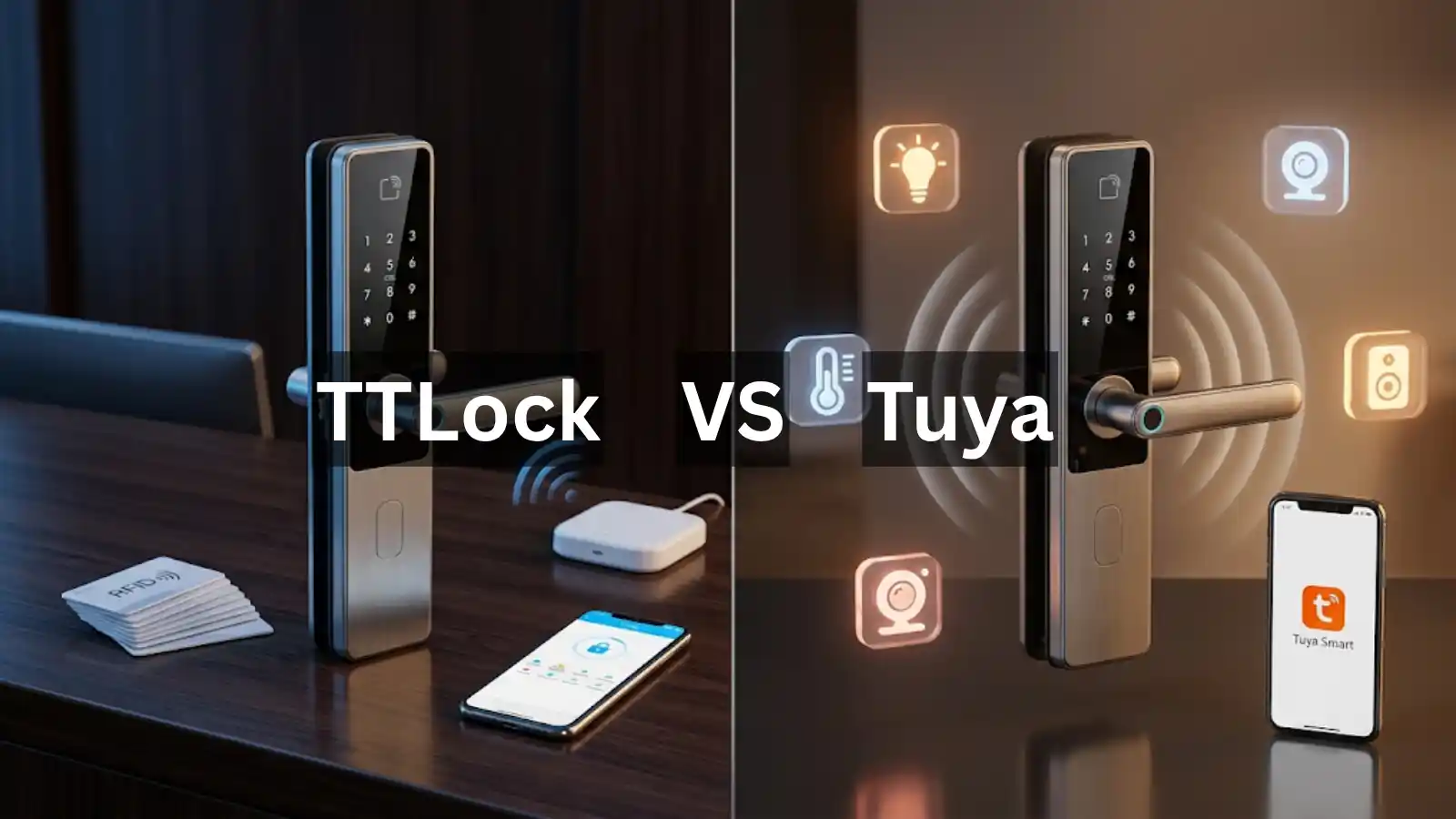
Tuya and TTLock are the two dominant IoT platforms for smart lock hardware manufactured in China. TTLock is a Bluetooth-first access control platform with gateway-based remote management, purpose-built for door lock operations — including passcode generation, time-bounded access, hierarchical card management, and hotel PMS integration via RESTful API. Tuya is a broad IoT cloud platform supporting Wi-Fi, Bluetooth, and Zigbee connectivity across 1,000+ device categories, with smart home ecosystem compatibility (Amazon Alexa, Google Home, IFTTT) and OEM white-label app services. For hotel and commercial deployments requiring centralized access control, TTLock provides deeper lock-specific management features. For Airbnb, serviced apartments, and properties that benefit from smart home ecosystem integration, Tuya offers broader connectivity and automation capabilities. Most smart lock hardware manufactured in China — including the Nice Smart product line — supports both platforms, allowing buyers to specify their preferred platform at the point of order. This guide compares Tuya and TTLock from the B2B procurement perspective: connectivity architecture, PMS integration, OEM firmware options, deployment planning, and platform selection by project type. For a broader overview of hospitality hardware options, see our guides to smart lock solutions for hotels and hotel and hospitality smart lock solutions.
What Are Tuya and TTLock?
Tuya and TTLock are not lock manufacturers — they are IoT software platforms that smart lock manufacturers integrate into their hardware during production. When a buyer orders locks from a factory, specifying “Tuya” or “TTLock” determines which app ecosystem, cloud infrastructure, and API framework the lock will operate on. The hardware (lock body, fingerprint sensor, RFID reader, motor mechanism) remains identical regardless of platform — the difference is in the firmware, wireless module configuration, and cloud backend.
Understanding this distinction is critical for B2B buyers: you are not choosing between two lock brands, you are choosing the operating system that will govern how your locks are managed, how credentials are issued, how access data is logged, and what third-party systems (PMS, smart home platforms, building management) the locks can integrate with.
TTLock: Access Control Specialist
TTLock is developed by Sciener (Shenzhen Sciener Technology Co., Ltd.), founded in 2012. The platform is purpose-built for door lock and access control applications. TTLock uses Bluetooth Low Energy (BLE 5.0) as its primary communication protocol between the lock and the user’s smartphone, with optional Wi-Fi or Ethernet gateways that bridge the Bluetooth lock to the internet for remote management. The TTLock ecosystem includes a consumer mobile app (TTLock App), a web-based management portal for multi-lock operations, a developer API (RESTful) for PMS and third-party integration, and gateway hardware that enables cloud connectivity. TTLock supports passcode management (permanent, timed, one-time, and recurring codes), eKey sharing via the app, IC card enrollment (13.56MHz Mifare), fingerprint registration, and hierarchical access permissions — features designed specifically for property management, hotel operations, and multi-tenant access control.
Tuya: IoT Ecosystem Platform
Tuya Smart (NYSE: TUYA) was founded in 2014 in Hangzhou, China, and operates as a global IoT cloud development platform serving over 410,000 developers and 1,000+ device categories — including smart locks, lighting, HVAC controls, cameras, sensors, and appliances. Tuya-connected smart locks communicate via Wi-Fi (direct cloud connectivity without gateway), Bluetooth (with Tuya gateway or hub), or Zigbee (with Zigbee hub), depending on the module configured during manufacturing. The Tuya ecosystem includes the Tuya Smart app (and the identical Smart Life app), an OEM app service for white-label branded apps, cloud API and MQTT protocol for developer integration, and compatibility with Amazon Alexa, Google Home, Apple HomeKit (via Matter), Samsung SmartThings, and IFTTT. Tuya’s strength is ecosystem breadth: a Tuya-connected lock can trigger automation routines with other Tuya-connected devices (lights on when door unlocks, thermostat adjusts, security cameras change mode).
Technical Comparison: Tuya vs TTLock for B2B Deployments
The following table compares the two platforms across the specifications that matter for hotel operators, property managers, distributors, and system integrators evaluating smart lock hardware for project-scale deployments.
| Specification | TTLock | Tuya |
|---|---|---|
| Developer / parent company | Sciener Technology (Shenzhen, est. 2012) | Tuya Smart (Hangzhou, est. 2014, NYSE: TUYA) |
| Primary protocol | Bluetooth Low Energy (BLE 5.0) | Wi-Fi, Bluetooth, Zigbee (module-dependent) |
| Remote access method | BLE → TTLock Gateway → Wi-Fi/Ethernet → Cloud | Wi-Fi direct to cloud (or BLE → Tuya Hub → Cloud) |
| Gateway requirement | Required for remote/cloud access | Not required for Wi-Fi models; required for BLE/Zigbee models |
| Gateway coverage | ~10–15 locks per gateway (15m BLE range) | N/A for Wi-Fi; hub-dependent for BLE/Zigbee |
| Cloud API | RESTful API + webhook callbacks | Cloud API + MQTT protocol + OpenAPI |
| PMS integration | Native API for Opera PMS, Cloudbeds, Little Hotelier, Hospitable | Via Tuya Cloud API; requires custom integration or middleware |
| Passcode types | Permanent, timed, one-time, recurring, dynamic offline | Permanent, timed, one-time, dynamic |
| eKey / app sharing | Yes — time-bounded, per-lock | Yes — device sharing with permission levels |
| IC card management | Hierarchical (master, floor, building, guest, emergency) | Basic (add/remove per lock) |
| Access log storage | Local (on lock) + cloud sync via gateway | Cloud-based (Wi-Fi) or local + hub sync (BLE/Zigbee) |
| Smart home ecosystem | Lock-only (no cross-device automation) | Full ecosystem: Alexa, Google Home, IFTTT, Matter, SmartThings |
| OEM app service | Custom-branded app available via Sciener SDK | White-label app via Tuya OEM App program |
| Voice assistant support | Alexa, Google Assistant (basic lock/unlock + status) | Alexa, Google Assistant, Siri (Matter models), full automation |
| Encryption | AES-128 | AES-256 (data in transit), TLS 1.2+, IoXt Alliance certified |
| Offline operation | Full — BLE, PIN, fingerprint, IC card, mechanical key | Full — PIN, fingerprint, IC card, mechanical key (Wi-Fi locks revert to local) |
| Developer documentation | TTLock Open API (English) | Tuya Developer Platform (multi-language, extensive SDK) |
| Subscription fees | None (all features free) | None for core features; optional cloud video storage if camera-equipped |
| Best suited for | Hotels, managed properties, rental portfolios, multi-lock operations | Serviced apartments, Airbnb, smart homes, ecosystem-integrated properties |
Connectivity Architecture: How Each Platform Connects Locks to the Cloud
The most consequential difference between Tuya and TTLock for B2B deployments is connectivity architecture — how the lock communicates with the management platform and how that architecture scales across a property.
TTLock: Bluetooth + Gateway Architecture
TTLock operates on a hub-and-spoke model. Each lock communicates via Bluetooth 5.0 with a nearby TTLock gateway device. The gateway connects to the property’s Wi-Fi or Ethernet network and bridges the lock’s Bluetooth signal to the TTLock cloud. This architecture means every lock requires a gateway within Bluetooth range (approximately 15 meters / 50 feet line-of-sight) for remote management capabilities — including remote lock/unlock, cloud-based access logging, and passcode generation from outside Bluetooth range.
For hotel deployments, gateway planning is a critical infrastructure step. A 100-room hotel with 120 lock points requires approximately 10–15 gateways, depending on corridor layout, wall construction, and Bluetooth signal propagation. Each gateway needs a power outlet and Wi-Fi connectivity. Gateway hardware costs approximately $30–$50 per unit at factory-direct pricing.
The advantage of this architecture is power efficiency. Because the lock itself only communicates via Bluetooth (low energy consumption), battery life is significantly longer than Wi-Fi-connected alternatives — typically 10,000–12,000 operations per battery cycle on 4× AA batteries, translating to 10–14 months under typical hotel usage patterns.
Tuya: Wi-Fi Direct or Hub-Based Architecture
Tuya-connected locks can be configured with Wi-Fi modules during manufacturing, enabling direct cloud connectivity without gateway hardware. The lock connects to the property’s 2.4GHz Wi-Fi network and communicates directly with the Tuya cloud — providing remote access, real-time notifications, and API connectivity out of the box. This eliminates gateway infrastructure entirely, simplifying deployment for scattered properties (multiple Airbnb units across a city, for example) where installing gateway hardware at each location is impractical.
The trade-off is power consumption. Wi-Fi radios draw significantly more current than Bluetooth, reducing battery life to approximately 6–8 months per battery cycle under typical usage — roughly 40% shorter than Bluetooth-only configurations. For properties with access to wired power at each lock location, this trade-off is manageable. For battery-powered installations, the more frequent battery replacements add ongoing maintenance overhead.
Tuya also supports Bluetooth-only and Zigbee-connected lock configurations that use a Tuya hub or gateway — similar to the TTLock architecture — for properties that prefer the battery life benefits of low-power wireless while maintaining cloud connectivity.
PMS Integration: Connecting Locks to Hotel Management Software
For hotel and managed property deployments, PMS integration determines how automatically and efficiently guest access credentials are managed. The difference between a manually encoded keycard workflow and an automated PMS-linked system can represent hours of front-desk labor per day in a busy property. For a detailed breakdown of hotel PMS integration architecture, see our hotel access control systems guide.
TTLock PMS Integration
TTLock provides a documented RESTful API (TTLock Open Platform) with webhook callback support that enables direct integration with hotel PMS software. The API supports the following operations relevant to hospitality: generating and revoking time-bounded passcodes linked to reservation dates, issuing and managing IC card credentials, remote lock/unlock commands, access log retrieval with timestamps and credential types, lock battery status monitoring, and firmware update management. TTLock has established native integrations with hospitality-focused platforms including Opera PMS (Oracle), Cloudbeds, Little Hotelier, Hospitable (formerly Smartbnb), and Operto. For PMS platforms without native integration, the API documentation is sufficiently detailed for a mid-level developer to build custom middleware.
TTLock’s API architecture is webhook-driven — the PMS sends a reservation event to the TTLock API, which triggers credential creation at the lock level. This event-driven model aligns with the standard hotel check-in/check-out workflow and minimizes latency between guest arrival and credential availability.
Tuya PMS Integration
Tuya’s integration path uses the Tuya Cloud API with MQTT protocol and OAuth 2.0 authentication. The API supports device control commands (lock/unlock), temporary password generation, device status queries, and scene/automation triggers. Tuya’s API is broader in scope than TTLock’s (covering all Tuya device categories, not just locks), which provides flexibility for properties integrating locks alongside other smart building devices (lighting, HVAC, sensors) but requires more targeted implementation for lock-specific workflows.
Tuya does not maintain the same depth of native PMS integrations as TTLock in the hospitality vertical. Properties using Tuya-connected locks for PMS integration typically require custom API development or middleware — either built in-house or through a Tuya development partner. For smaller operations (under 50 units) that rely on the Tuya Smart app for manual management rather than PMS automation, this limitation may not be relevant.
OEM Firmware and White-Label App Options
For distributors, hotel chains, and brands ordering smart locks under their own label, the platform choice affects firmware configuration and app branding options. When placing an OEM order with a manufacturer like Nice Smart, the platform is specified as part of the OEM firmware configuration services, alongside other customizations such as UI language, voice prompts, and wireless module selection.
| OEM Feature | TTLock | Tuya |
|---|---|---|
| Platform binding | Lock firmware binds to TTLock cloud at production | Lock firmware binds to Tuya cloud at production |
| White-label app | Available via Sciener SDK (custom app development) | Available via Tuya OEM App program (template-based, faster deployment) |
| App branding | Custom logo, colors, splash screen — requires SDK development | Custom logo, colors, splash screen — configurable via Tuya IoT Platform console |
| App store listing | Client’s own app store listing (requires developer account) | Can use Tuya Smart app OR publish branded app |
| Development effort | Medium-high (SDK integration, custom development) | Low-medium (template-based OEM app, minimal coding) |
| Time to market | 4–8 weeks for custom app | 2–4 weeks for OEM app |
| Platform switching | Not possible post-production (firmware-locked) | Not possible post-production (firmware-locked) |
A critical consideration: once a lock is manufactured with TTLock or Tuya firmware, the platform cannot be changed in the field. The wireless module, firmware stack, and cloud binding are set during production. This makes the platform decision a permanent specification for each production batch. For buyers who want the flexibility to evaluate both platforms, ordering a sample batch on each platform before committing to bulk production is the recommended approach. For a detailed overview of how OEM vs ODM manufacturing works, see our manufacturing guide.
Dual-Platform Hardware: Why Most China-Manufactured Locks Support Both
Most smart lock manufacturers in China — including Nice Smart — design their hardware to be platform-agnostic at the PCB level. The lock’s mainboard includes a socket or solder pad for a wireless module that can be populated with either a TTLock module (Sciener chipset) or a Tuya module (Tuya-certified Wi-Fi or Bluetooth chipset) during production. The mechanical lock body, fingerprint sensor, RFID reader, motor mechanism, keypad, and housing are identical regardless of which platform module is installed.
This means the platform is a configuration choice at the order stage, not a hardware limitation. The Nice Smart K9 multi-access smart lock, for example, supports both TTLock and Tuya app connectivity via Bluetooth, with optional Wi-Fi modules. The buyer specifies the preferred platform when placing the order, and the factory configures the appropriate firmware and wireless module during assembly. The SU7-03 RFID hotel lock follows the same model — available on either platform, with TTLock being the more common specification for traditional hotel deployments due to its deeper access control feature set.
Browse the full product catalog to review which models support dual-platform configuration.
Platform Selection by Project Type
The right platform depends on the operational model of the property, not just the lock hardware. The following recommendations are based on deployment architecture requirements, management workflow, and integration needs for each project category.
| Project Type | Recommended Platform | Primary Reason |
|---|---|---|
| Full-service hotel (50+ rooms) | TTLock | Hierarchical card management, PMS API integration, gateway-based centralized control |
| Boutique hotel (10–50 rooms) | TTLock or Tuya | TTLock for PMS integration; Tuya if smart room automation is a guest-facing feature |
| Airbnb / short-term rental portfolio | Tuya (Wi-Fi) or TTLock | Tuya Wi-Fi for scattered properties (no gateway per location); TTLock for PMS-automated code generation |
| Serviced apartments / co-living | Tuya | Smart home ecosystem integration (lighting, HVAC, sensors), guest-facing automation |
| Residential real estate development | Tuya | Smart home value proposition for property marketing, Alexa/Google compatibility |
| Commercial office / co-working | TTLock | Multi-tenant access permissions, scheduled access windows, audit trail logging |
| Mixed-use property (hotel + apartments + retail) | Both (zone-specific) | TTLock for hotel guest rooms; Tuya for apartment units with smart home packages |
| Distributor building product line | Both (SKU variants) | Offer TTLock SKU for property management clients, Tuya SKU for smart home retail |
Hotels and Managed Properties: Why TTLock Dominates
For traditional hotel operations where front-desk staff issue credentials, housekeeping requires floor-level access, and management needs centralized audit trails, TTLock’s purpose-built access control features provide operational advantages that Tuya’s broader ecosystem does not match. TTLock’s hierarchical IC card system (master, floor, building, guest, emergency cards) mirrors the established hotel credential hierarchy. The web-based management portal supports multi-property administration from a desktop — a necessity for hotel groups managing multiple locations. And the API’s native integration with hospitality PMS platforms reduces the development effort required to automate the check-in-to-credential workflow. For a complete guide to hotel access control hardware selection, see our smart lock solutions for hotels article.
Airbnb, Serviced Apartments, and Smart Homes: Where Tuya Excels
For properties where the guest experience extends beyond the door — where unlocking the room also triggers lighting scenes, adjusts the thermostat, and disarms the security system — Tuya’s cross-device automation delivers functionality that TTLock cannot replicate natively. Tuya-connected locks can serve as triggers in automation routines: “when door unlocks, set living room lights to 60% and thermostat to 23°C.” This type of integrated smart room experience is increasingly expected in premium serviced apartments and tech-forward Airbnb listings. Tuya’s OEM app service also enables faster white-label app deployment for brands that want a customer-facing branded app without the development overhead of building one from scratch.
The Wi-Fi direct connectivity model is particularly advantageous for scattered rental portfolios where installing and maintaining gateway hardware at each property creates logistical overhead. A property manager with 30 Airbnb units across a city can manage all locks from the Tuya app or a PMS integration without deploying 30 separate gateway devices — each lock connects directly to the unit’s existing Wi-Fi network.
Deployment Considerations: Gateway Planning, Battery Life, and Certification
Gateway Infrastructure for TTLock Deployments
TTLock gateway placement requires planning based on Bluetooth range, wall construction, and lock density. In a typical hotel corridor with drywall or plasterboard construction, a single gateway covers approximately 8–12 locks across a 15-meter radius. Concrete, brick, or steel-framed walls reduce effective range to 6–8 locks per gateway. Each gateway needs a 110V/220V power outlet and access to the property’s 2.4GHz Wi-Fi network (5GHz is not supported by most gateway models).
| Property Size | Estimated Lock Points | Gateways Required (TTLock) | Gateway Hardware Cost |
|---|---|---|---|
| Boutique hotel (20 rooms) | 25–30 | 3–4 | $90–$200 |
| Mid-scale hotel (100 rooms) | 120–140 | 12–18 | $360–$900 |
| Full-service hotel (300 rooms) | 350–400 | 35–50 | $1,050–$2,500 |
| Airbnb portfolio (20 scattered units) | 20–25 | 20–25 (one per location) | $600–$1,250 |
The Airbnb row illustrates why Tuya Wi-Fi locks are often preferred for scattered rental portfolios — the per-property gateway cost and maintenance overhead adds up quickly when each location requires its own gateway.
Battery Life Comparison by Platform
| Configuration | Power Source | Estimated Battery Life | Annual Battery Replacements |
|---|---|---|---|
| TTLock (Bluetooth only) | 4× AA batteries | 10,000–12,000 operations (~10–14 months) | 1× |
| Tuya (Wi-Fi direct) | 4× AA batteries | 6,000–8,000 operations (~6–8 months) | 1.5–2× |
| Tuya (Bluetooth + hub) | 4× AA batteries | 10,000–12,000 operations (~10–14 months) | 1× |
| Tuya (Wi-Fi direct) | Li-ion rechargeable (3800–4200mAh) | 8,000–10,000 operations (~8–12 months) | 0 (recharge via USB-C) |
For a 200-room hotel, the difference between annual and semi-annual battery replacement across all locks represents significant maintenance labor. This is one reason TTLock’s Bluetooth architecture remains dominant in hotel deployments despite requiring gateway infrastructure.
Certification and Compliance Across Both Platforms
CE, FCC, and RoHS certifications apply to the hardware — they are independent of which platform firmware is installed. A Nice Smart K9 lock carries the same CE (Directive 2014/30/EU), FCC Part 15, RoHS (Directive 2011/65/EU), and IP67 (IEC 60529) certifications whether configured for TTLock or Tuya. The wireless module itself must also be certified — both TTLock (Sciener) and Tuya provide pre-certified wireless modules that are included in the lock’s overall certification scope. For a complete breakdown of certification requirements by export market, see our guide to smart lock certifications for export.How to Specify Platform When Ordering from a Manufacturer
When placing a B2B smart lock order with a Chinese manufacturer, the platform is one of several firmware-level specifications confirmed during the order process. The standard workflow:
- Select hardware model(s) from the manufacturer’s catalog based on form factor, access methods, materials, and certifications required.
- Specify platform preference: TTLock or Tuya. If evaluating both, request sample units on each platform for testing before bulk commitment.
- Confirm connectivity module: Bluetooth only, Wi-Fi + Bluetooth, or Zigbee (Tuya only). This affects hardware cost, battery life, and deployment architecture.
- Specify any OEM firmware customization: UI language, voice prompt language, app binding (manufacturer’s default app or your branded OEM app), and default settings.
- Confirm order quantity, lead time, and delivery schedule. Standard models with either platform ship within 7 business days. Custom firmware configurations require 15–25 business days.
Nice Smart supports both TTLock and Tuya across the product line. Mixed-platform orders are supported — for example, a hotel project might order SU7-03 units on TTLock firmware for guest room doors and K9 units on Tuya firmware for apartment-style suites within the same property. For detailed guidance on the ordering process, see our article on importing smart locks from China.
Frequently Asked Questions About Tuya and TTLock
What is the main difference between Tuya and TTLock?
TTLock is a specialized access control platform built exclusively for smart lock management, using Bluetooth connectivity with gateway-based remote access. Tuya is a broad IoT ecosystem platform supporting 1,000+ device categories, with Wi-Fi, Bluetooth, and Zigbee connectivity options and cross-device automation capabilities. TTLock provides deeper lock-specific management features (hierarchical card systems, hospitality PMS integrations, multi-property web portal). Tuya provides broader ecosystem integration (smart home automation, voice assistants, white-label app services). The lock hardware is typically identical — the platform determines the software, connectivity, and management experience.
Can a smart lock support both Tuya and TTLock simultaneously?
No. A smart lock is configured with either TTLock or Tuya firmware during manufacturing, and the platform cannot be switched after production. The wireless module and cloud binding are set at the factory level. However, most lock models from Chinese manufacturers are available on either platform as a configuration option at the order stage. Buyers can order sample units on both platforms for evaluation before specifying the platform for bulk production.
Which platform is better for hotels?
TTLock is generally better suited for traditional hotel operations. Its hierarchical IC card management (master, floor, building, guest, emergency cards), native PMS integrations (Opera, Cloudbeds, Little Hotelier), web-based multi-lock administration portal, and Bluetooth architecture (longer battery life) align with the operational requirements of managed hospitality properties. Tuya may be preferred for boutique hotels or serviced apartments where smart room automation (lighting, HVAC, security triggered by lock events) is part of the guest experience.
Which platform is better for Airbnb and short-term rentals?
Both platforms work for short-term rentals, but the choice depends on operational model. TTLock excels at automated passcode management — generating, sending, and expiring codes linked to reservation dates through PMS integrations with Hospitable, Operto, and Enso Connect. Tuya Wi-Fi locks are advantageous for scattered rental portfolios because they eliminate gateway hardware at each property — each lock connects directly to the unit’s existing Wi-Fi network. For operators managing fewer than 10 units manually, either platform provides adequate temporary passcode functionality.
Does Tuya smart lock work with Alexa and Google Home?
Yes. Tuya-connected smart locks support Amazon Alexa and Google Assistant for voice control — including status queries (“Is the front door locked?”) and lock commands. Matter-compatible Tuya locks additionally support Apple HomeKit (Siri) and Samsung SmartThings. TTLock also supports Alexa and Google Assistant for basic lock/unlock and status commands, but does not support Apple HomeKit or cross-device automation routines through voice platforms.
Is Tuya Smart the same as Smart Life?
Yes. Tuya Smart and Smart Life are functionally identical apps operated by Tuya, using the same cloud backend and device compatibility. Devices paired with one app are accessible from the other. Some manufacturers bundle their locks with the Smart Life app branding, while others use Tuya Smart — the underlying platform and functionality are the same.
Are Tuya and TTLock smart locks secure?
Both platforms use industry-standard encryption. TTLock uses AES-128 encryption for data communication between the lock, app, and cloud. Tuya uses AES-256 encryption for data in transit with TLS 1.2+ for cloud communication, and holds IoXt Alliance certification (a consumer IoT security framework). Both platforms support two-factor authentication for app accounts. All Nice Smart locks additionally include mechanical key backup, tamper alert notifications, and automatic keypad lockout after repeated failed attempts — security features that operate at the hardware level regardless of platform.
What happens if the internet goes down? Do the locks still work?
Yes. Both TTLock and Tuya smart locks continue to operate offline using all local access methods — fingerprint, PIN code, IC card, and mechanical key. Bluetooth-based app unlocking also works within range (approximately 10–15 meters) without internet connectivity. What stops working during an internet outage is remote access (controlling the lock from outside Bluetooth range), cloud-based passcode generation, push notifications, and access log synchronization. Local access logging continues on the lock’s internal memory and syncs to the cloud when connectivity is restored.
Need help specifying the right platform for your project? Nice Smart supports both Tuya and TTLock across the full product line, with mixed-platform orders available for properties that require different configurations across zones. Whether you need TTLock-configured RFID locks for a hotel project or Tuya Wi-Fi smart locks for a serviced apartment portfolio, our engineering team can recommend the right platform and hardware combination for your deployment. Request project-level pricing with platform specification or contact our solutions team via WhatsApp.