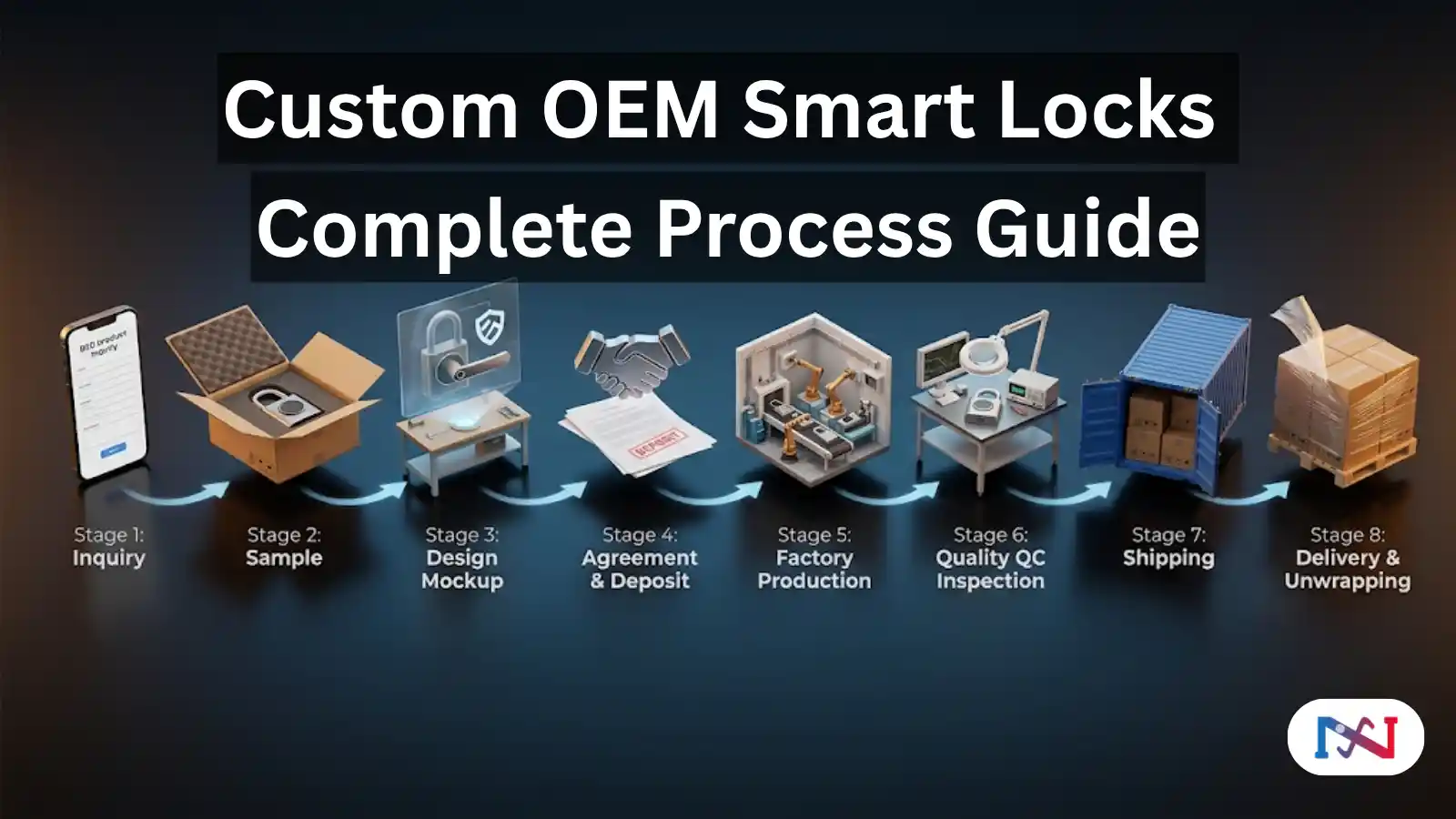
Ordering custom smart locks from a manufacturer follows an eight-stage process: initial inquiry and requirements gathering, sample evaluation, customization specification (logo, packaging, firmware, finish), quotation and order confirmation with deposit payment, production, quality control inspection, shipping and logistics, and delivery with after-sales support setup. The complete cycle from first inquiry to delivered goods takes approximately 3–6 weeks for standard OEM orders (existing models with branding customization) and 10–16 weeks for ODM orders (new product development with mold tooling). Payment terms are typically 30% deposit upon order confirmation and 70% balance before shipment via T/T wire transfer. This guide documents each stage in detail — what happens, what the buyer provides, what the manufacturer delivers, what documents are exchanged, and the typical timeline — so that first-time and experienced B2B buyers can manage the procurement process with full visibility. For background on the difference between OEM and ODM manufacturing models, see our OEM vs ODM manufacturing guide.
Before You Order: Pre-Qualification Checklist
Before contacting a manufacturer, prepare the following information to ensure the inquiry process moves efficiently. Manufacturers respond faster and more accurately to structured inquiries than to open-ended “tell me about your products” messages.
| Item to Prepare | Why the Manufacturer Needs It | If You Don’t Have It Yet |
|---|---|---|
| Target market / destination country | Determines which certifications are required (CE, FCC, RoHS) and which door standards apply | State the countries you plan to sell in — the manufacturer will advise on certification requirements |
| Product type(s) needed | Narrows the catalog to relevant models (mortise, deadbolt, glass door, cabinet, hotel RFID) | Browse the manufacturer’s complete product catalog and shortlist 2–4 models of interest |
| Access methods required | Specifies the hardware configuration (fingerprint, PIN, IC card, face recognition, app) | Refer to our smart lock specifications reference to understand the options |
| Platform preference (TTLock or Tuya) | Determines firmware and wireless module configuration at the factory — cannot be changed post-production | See our Tuya vs TTLock comparison or request samples on both platforms |
| Estimated order quantity | Determines pricing tier, MOQ eligibility, and lead time | Start with a range (e.g., “50–100 units initially, scaling to 500/month”) |
| OEM customization scope | Determines whether the order is standard (no customization), light OEM (logo only), or full OEM (logo + packaging + firmware + finish) | Decide if you want manufacturer branding or your own brand — see our private label branding guide |
| Timeline / urgency | Helps the manufacturer prioritize and plan production capacity allocation | State when you need the goods delivered (not just ordered) |
Having this information ready before the first inquiry call or email reduces the back-and-forth from weeks to days and signals to the manufacturer that you are a qualified buyer with a real project — which typically results in faster response times and more attentive account management.
Stage 1: Initial Inquiry and Requirements Gathering
Timeline: Day 1–3
What happens: You contact the manufacturer via their inquiry form, email, or WhatsApp with your project requirements. The manufacturer’s sales or account management team reviews your inquiry and responds with initial product recommendations, pricing indication, MOQ confirmation, and lead time estimate.
What you provide: The information from the pre-qualification checklist above — target market, product types, quantities, customization scope, and timeline.
What the manufacturer provides: Product recommendations based on your requirements, a preliminary pricing indication (subject to final quotation after specifications are confirmed), MOQ requirements for each model and customization tier, estimated lead time, and a catalog or spec sheets for the recommended models.
Nice Smart response time: Within 24 business hours for initial inquiry response. Product recommendations and preliminary pricing typically provided within 48 hours of receiving complete requirements.
Buyer action: Review the product recommendations. Shortlist 1–3 models for sample evaluation. Confirm interest in proceeding to the sample stage.
Stage 2: Sample Order and Evaluation
Timeline: Day 3–15 (3–5 days for sample preparation + shipping transit time)
What happens: The manufacturer ships sample units of the shortlisted models for physical evaluation. Samples are standard production units (manufacturer branding, default firmware) — not custom-branded. The purpose is to verify build quality, test all access methods, confirm door compatibility, and evaluate the platform experience (TTLock or Tuya app) before committing to a bulk order.
What you provide: Shipping address, preferred shipping method (express courier is standard for samples — DHL, FedEx, UPS), and sample payment. Sample units are typically charged at unit cost plus shipping — some manufacturers offer free samples for qualified projects with the cost deducted from the first bulk order.
What the manufacturer provides: 2–5 sample units of shortlisted models, shipped within 3–5 business days. Each sample includes the lock hardware (front panel + rear panel + lock body + mounting hardware), mechanical keys, IC cards (for RFID models), installation template and documentation, and access to the TTLock or Tuya app for connectivity testing.
Evaluation checklist during sample testing:
| Test | What to Verify | Accept If |
|---|---|---|
| Build quality | Weight, finish uniformity, seam alignment, handle rigidity, glass panel clarity | Solid construction with no visible defects, uniform finish across surfaces |
| Fingerprint enrollment | Enroll 5–10 fingerprints, test recognition from multiple angles | Recognition in <0.5s, consistent acceptance, no false rejections on enrolled fingers |
| PIN code operation | Create permanent, timed, and one-time codes via app, test entry on keypad | All code types generate and function correctly, keypad responsive to touch |
| IC card pairing | Register 3–5 IC cards, verify read range, test unregistered card rejection | Cards read within 2–3cm, unregistered cards rejected, no false accepts |
| App connectivity | Pair via Bluetooth, test remote operations (lock/unlock, code generation, access log) | Stable Bluetooth connection within 10m, app functions operate as documented |
| Door installation | Install on a representative door (or measure cutout compatibility) | Lock body fits standard mortise preparation, handle alignment correct |
| Mechanical key | Test key operation in locked and unlocked states | Smooth operation, key does not jam, lock/unlock reliable |
| Auto-lock | Close door, verify auto-lock engages within configured time | Bolt extends fully, latch sensor detects closed door position |
| Battery life baseline | Note battery level at start, monitor drain over 2–4 weeks of testing | Consistent with manufacturer’s operations-per-cycle specification |
Buyer action after evaluation: Confirm the model(s) for bulk order. Provide feedback on any specification adjustments needed. Proceed to customization specification if OEM branding is required.
Stage 3: Customization Specification
Timeline: Day 15–25 (concurrent with or immediately after sample evaluation)
What happens: For OEM-branded orders, you specify every customization element — logo placement, packaging design, firmware configuration, finish selection, and any mechanical adaptations. The manufacturer prepares design mockups and proofs for your approval before production begins.
Customization elements and what to provide:
| Customization | What You Provide | File Format | What the Manufacturer Does |
|---|---|---|---|
| Logo engraving | Vector logo file | AI, EPS, or SVG (minimum 300 DPI) | Prepares laser engraving template, sends proof image for approval |
| Packaging design | Brand guidelines (colors, fonts, imagery) or print-ready design | PDF or AI with bleed marks | Designs custom box, prints proof for approval (or uses your supplied design) |
| User manual | Brand name, support contact info, warranty terms, preferred language(s) | Text document or PDF | Produces branded manual in specified language(s) |
| Firmware / app | Platform choice (TTLock or Tuya), UI language, voice prompt language, app skin preference | Written specification | Configures firmware, binds to specified platform, sets language defaults |
| Finish / color | Preferred finish from available options | Color name or Pantone reference | Applies PVD or electroplated finish per specification |
| Mechanical adaptation | Door standard (European DIN, American ANSI, or specific thickness range) | Written specification with door measurements | Adjusts mortise body and spindle for specified door standard |
If you do not have design resources for packaging or manuals, most manufacturers — including Nice Smart — offer design support. Provide your brand guidelines (logo, colors, fonts) and the manufacturer’s design team will create packaging layouts and manual templates for your approval. For the full scope of available customizations, see our full OEM and ODM service capabilities.
Buyer action: Review and approve all design proofs (logo placement, packaging layout, manual content) before the manufacturer proceeds to production. Changes after production begins may delay delivery and incur additional cost.
Stage 4: Quotation, Order Confirmation, and Deposit
Timeline: Day 20–28
What happens: With model selection, quantities, and customization specifications confirmed, the manufacturer issues a formal quotation (Proforma Invoice) detailing unit prices, quantities per model, customization fees (if any), packaging costs, total order value, payment terms, and estimated production and delivery timeline. Upon your acceptance, you sign the Proforma Invoice and remit the deposit to confirm the order.
Standard payment terms for Nice Smart:
| Payment Milestone | Amount | Method | Trigger |
|---|---|---|---|
| Deposit | 30% of total order value | T/T wire transfer | Upon order confirmation (signed Proforma Invoice) |
| Balance | 70% of total order value | T/T wire transfer | Before shipment (after QC approval and packing confirmation) |
For established B2B partners with order history, flexible payment terms including 30-day net terms may be arranged. Payment is made via T/T (Telegraphic Transfer / international wire transfer) to the manufacturer’s bank account. The Proforma Invoice includes the manufacturer’s bank details, SWIFT code, and beneficiary information.
Documents exchanged at this stage:
| Document | From | Purpose |
|---|---|---|
| Proforma Invoice (PI) | Manufacturer → Buyer | Formal quotation with pricing, quantities, terms, and bank details |
| Signed PI + deposit remittance | Buyer → Manufacturer | Order confirmation and production authorization |
| Deposit receipt / bank confirmation | Manufacturer → Buyer | Confirmation of deposit received, production start date communicated |
For a detailed breakdown of what drives unit pricing at the factory level, see our manufacturing cost breakdown.
Stage 5: Production
Timeline: 7–25 business days (depending on order type)
| Order Type | Production Time | What’s Involved |
|---|---|---|
| Standard models (no customization) | 7 business days | Assembly from existing stock components, firmware loading, final testing, packing |
| OEM — logo only | 7–10 business days | Standard production + laser logo engraving on lock body and/or interior panel |
| OEM — logo + custom packaging | 15–20 business days | Standard production + logo engraving + custom box printing + branded manual insertion |
| OEM — full (logo + packaging + firmware + finish) | 20–25 business days | Full custom production including finish application, firmware configuration, platform binding, branded packaging |
| ODM — new product development | 8–12 weeks | 3D modeling, mold development, PCB engineering, firmware development, pilot production, certification |
What happens during production: The manufacturer’s production line assembles the lock units according to the confirmed specification. The typical production sequence for a smart mortise lock includes zinc alloy die-casting of housing components, CNC machining and surface finishing (PVD or electroplating), PCB SMT assembly (surface-mount technology for circuit board population), semiconductor fingerprint module integration, RFID reader coil installation, motor mechanism and bolt body assembly, firmware loading and wireless module configuration (TTLock or Tuya), OEM logo engraving (laser), individual unit functional testing (all access methods, motor operation, Bluetooth pairing), and packing into custom-branded or standard packaging.
Production updates: Nice Smart provides production progress updates via WhatsApp or email at key milestones — production start confirmation, mid-production status, and completion notification with QC report. For orders exceeding 200 units, a dedicated project manager coordinates all communications.
Stage 6: Quality Control and Pre-Shipment Inspection
Timeline: 1–3 days (concurrent with final production)
What happens: Every unit undergoes final quality control before packing. QC covers functional testing (every access method verified), cosmetic inspection (finish, engraving quality, panel alignment), packaging verification (correct branding, manual, accessories included), and batch-level documentation.
Nice Smart QC process:
| QC Stage | What Is Tested | Pass Criteria |
|---|---|---|
| Incoming material inspection | Raw components (zinc alloy castings, PCBs, sensors, motors) checked against specifications before entering production line | Material composition, dimensional accuracy, surface quality within tolerance |
| In-line process checks | Assembly quality at each production station — soldering quality, sensor alignment, motor engagement, wiring integrity | Zero cold solder joints, sensor modules seated correctly, motor operation smooth |
| Functional testing (100%) | Every finished unit tested: fingerprint enrollment + recognition, PIN code operation, IC card read, Bluetooth pairing, motor lock/unlock cycle, mechanical key operation | All access methods functional, motor completes full bolt throw, Bluetooth pairs within 5 seconds |
| Durability spot testing | Sample units from each batch subjected to 200,000-cycle handle testing, waterproof testing (IP67), and battery drain analysis | Handle mechanism functional after test cycles, no water ingress, battery drain within specification |
| Cosmetic inspection (100%) | Finish uniformity, engraving clarity, glass panel clarity, screw alignment, packaging integrity | No visible defects, scratches, or finish inconsistencies on customer-facing surfaces |
| Packing verification | Correct model, correct branding, complete accessories (keys, cards, screws, manual, template), box condition | Complete kit matches the order specification, packaging undamaged |
Pre-shipment documentation: Upon QC completion, the manufacturer provides a QC summary report (pass/fail counts, any issues resolved), packing photographs (individual units and packed cartons), and confirmation that the order is ready for balance payment and shipment.
Third-party inspection option: For large orders or first-time buyers who want additional verification, third-party inspection services (SGS, Bureau Veritas, TÜV, or local Chinese inspection agencies) can be arranged at the buyer’s cost. The manufacturer provides factory access for the inspector. This is optional but recommended for orders exceeding 500 units or for buyers who cannot visit the factory in person.
Buyer action: Review QC report and packing photos. Approve for shipment. Remit the 70% balance payment.
Stage 7: Shipping and Logistics
Timeline: Varies by shipping method and destination
What happens: Upon balance payment confirmation, the manufacturer arranges shipment from Shenzhen. The shipping method, Incoterms, and logistics coordination depend on the order size and buyer preference.
| Shipping Method | Typical Transit Time | Best For | Cost Level |
|---|---|---|---|
| Express courier (DHL, FedEx, UPS) | 3–7 days | Samples, small orders (under 50 units), urgent shipments | Highest per-unit |
| Air freight | 5–10 days | Medium orders (50–200 units), time-sensitive projects | High |
| Sea freight (LCL — less than container load) | 20–35 days | Medium orders (100–500 units), cost-optimized shipping | Low-medium |
| Sea freight (FCL — full container load) | 20–35 days | Large orders (1,000+ units), maximum cost efficiency | Lowest per-unit |
Incoterms (shipping terms):
| Term | Manufacturer’s Responsibility | Buyer’s Responsibility |
|---|---|---|
| FOB Shenzhen (most common) | Deliver goods to Shenzhen port, clear export customs | Arrange and pay for ocean/air freight, import customs, and delivery from destination port |
| CIF (Cost, Insurance, Freight) | Deliver goods to destination port, including freight and insurance | Import customs clearance, local delivery from port |
| DDP (Delivered Duty Paid) | Full door-to-door delivery including freight, insurance, import duties, and local delivery | Receive goods at your specified address — manufacturer handles everything |
Shipping documents provided by manufacturer:
| Document | Purpose |
|---|---|
| Commercial Invoice | Declares the goods’ value for customs — required for import clearance |
| Packing List | Itemizes the contents of each carton — model, quantity, weight, dimensions |
| Bill of Lading (B/L) or Air Waybill (AWB) | Transport document issued by the shipping carrier — proof of shipment |
| Certificate of Origin | Certifies the goods are manufactured in China — may affect import duty rates under trade agreements |
| CE / FCC / RoHS test reports | Certification documents for customs clearance in destination country |
For detailed guidance on freight forwarding, customs procedures, HS codes, and import duties, see our complete article on importing smart locks from China.
Stage 8: Delivery and After-Sales Setup
Timeline: Upon arrival at destination
What happens: Goods arrive at the buyer’s warehouse or specified delivery address. The buyer inspects the shipment against the packing list, verifies quantities and condition, and begins selling, installing, or distributing the product.
Receiving inspection checklist:
| Check | Action |
|---|---|
| Carton count | Verify total carton count matches the packing list |
| External condition | Inspect cartons for shipping damage — photograph any damaged cartons before opening |
| Contents verification | Open 10–20% of cartons, verify model, quantity, accessories, and branding match the order specification |
| Functional spot check | Power on 3–5 units, test fingerprint enrollment, PIN entry, Bluetooth pairing, and mechanical key |
| Document filing | File all shipping documents, certification reports, and QC reports for customs records and warranty reference |
After-sales support activation: Nice Smart provides after-sales support for all delivered products including technical documentation (installation guides, programming instructions, API documentation for TTLock/Tuya integration), troubleshooting assistance via WhatsApp and email, spare parts availability for all active models (replacement fingerprint sensors, motor assemblies, PCBs, mechanical keys), and warranty coverage of 24 months from delivery date, extendable to 36 months for project-level orders.
Buyer action for first-time orders: After successful delivery and product verification, establish a reorder cadence based on your sales velocity. Provide feedback to the manufacturer on any product or packaging improvements for the next production run. Successful first orders typically lead to standing reorder agreements with locked pricing and priority production scheduling.
Complete OEM Order Timeline Summary
| Stage | Duration | Cumulative Timeline | Key Milestone |
|---|---|---|---|
| 1. Inquiry and requirements | 1–3 days | Day 1–3 | Product recommendations and pricing received |
| 2. Sample order and evaluation | 5–12 days | Day 3–15 | Samples tested, model(s) confirmed |
| 3. Customization specification | 5–10 days | Day 15–25 | Design proofs approved |
| 4. Quotation and deposit | 3–5 days | Day 20–28 | Order confirmed, deposit paid, production authorized |
| 5. Production | 7–25 days | Day 28–53 | Units manufactured, firmware loaded, branding applied |
| 6. QC and inspection | 1–3 days | Day 53–56 | QC passed, packing photos shared, balance payment requested |
| 7. Shipping | 3–35 days | Day 56–91 | Goods in transit (express: 3–7 days; sea: 20–35 days) |
| 8. Delivery and setup | 1–3 days | Day 57–94 | Goods received, inspected, after-sales support activated |
Total elapsed time: Standard OEM order (logo + packaging) with express shipping: approximately 4–6 weeks. Full OEM order (logo + packaging + firmware + finish) with sea freight: approximately 8–13 weeks. ODM order (new product development): approximately 14–20 weeks including prototyping and mold development.
For buyers with urgent timelines, standard models with no customization ship within 7 business days of order confirmation. This is the fastest path to product-in-hand for market testing or immediate project fulfillment.
Common Ordering Mistakes and How to Avoid Them
Skipping sample evaluation. Placing a bulk order based on catalog images or competitor reviews without physically testing the product leads to specification mismatches, door compatibility issues, and quality surprises. Always order samples first — even if it adds 1–2 weeks to the timeline. The cost of 2–5 sample units is negligible compared to the cost of receiving 200 units that don’t meet your requirements.
Not specifying the platform before ordering. TTLock and Tuya firmware is configured during manufacturing and cannot be changed in the field. Ordering 100 units without specifying the platform — or specifying the wrong one — results in hardware that cannot integrate with your buyers’ property management systems. Confirm platform requirements with your end buyers before placing the production order.
Approving design proofs without careful review. Logo placement, packaging colors, manual text, and firmware language settings are all finalized from your approved proofs. Once production begins, changes require stopping the line and reprinting materials — adding cost and delay. Review proofs thoroughly and obtain sign-off from your team before authorizing production.
Underestimating shipping transit time. Buyers planning a project deadline often calculate from order confirmation to production completion but forget to add 20–35 days for sea freight transit. If your project requires goods on-site by a specific date, work backwards from that date: delivery date minus shipping transit minus production time minus customization approval time equals the latest date you need to submit your order confirmation and deposit.
Not ordering spare units. Smart lock deployments inevitably require replacement units for DOA (dead on arrival), installation damage, and warranty claims. Order 5–10% additional units as spares — it is significantly cheaper to include them in the production batch than to place a separate small order later.
Assuming certifications carry over to modified products. CE, FCC, and RoHS certifications apply to the tested hardware configuration. If your OEM order modifies the electronic design (adds a new wireless module, changes the PCB layout), new certification testing may be required. Confirm with the manufacturer whether your modifications affect certification validity. For details on certification requirements by market, see our compliance guide.
Frequently Asked Questions About Ordering Custom Smart Locks
How do I place an OEM smart lock order with a Chinese manufacturer?
The process follows eight stages: submit an inquiry with your project requirements, receive product recommendations and preliminary pricing, order samples for physical evaluation, specify your customization requirements (logo, packaging, firmware, finish), receive and approve a formal quotation (Proforma Invoice), pay the 30% deposit to authorize production, receive QC report and pay the 70% balance before shipment, and receive delivery with all shipping documents and after-sales support activation. The complete cycle takes 4–13 weeks depending on customization scope and shipping method.
What is the minimum order quantity for custom smart locks?
Nice Smart minimum order quantities start from 20 units on select models for standard (non-customized) orders and 50 units on most product lines. OEM orders with logo engraving start from 20–50 units. Full custom packaging and firmware configuration typically requires 100–300 units. ODM orders with new mold development require 300–500 units minimum. These MOQs are significantly lower than many Chinese manufacturers that require 500–1,000 unit minimums.
What payment terms do smart lock manufacturers accept?
Standard payment terms are 30% deposit upon order confirmation and 70% balance before shipment, paid via T/T wire transfer (international bank transfer). Some manufacturers also accept Western Union, PayPal (for sample orders), or letter of credit (L/C) for very large orders. For established B2B partners with order history, flexible payment terms including 30-day net terms may be arranged. The deposit authorizes production start; the balance payment triggers shipment.
How long does production take for custom OEM smart locks?
Production time depends on the customization scope. Standard models with no customization: 7 business days. Logo engraving only: 7–10 business days. Logo plus custom packaging: 15–20 business days. Full OEM (logo, packaging, firmware, finish): 20–25 business days. ODM with new mold development: 8–12 weeks. These timelines begin after the deposit is received and design proofs are approved — not from the date of initial inquiry.
Can I visit the factory before placing an order?
Yes. Factory visits are welcome and can be arranged through the manufacturer’s sales team. Nice Smart’s facility is located in Bao’an District, Shenzhen — accessible from Shenzhen Bao’an International Airport (approximately 20 minutes by car). During a factory visit, you can inspect the production line, review raw material quality, meet the engineering team, and discuss customization requirements in person. For international buyers who cannot visit in person, video factory tours and third-party inspection services are available alternatives.
What files do I need to provide for OEM branding?
For logo engraving, provide vector files in AI, EPS, or SVG format at minimum 300 DPI resolution. For custom packaging, provide print-ready PDF or AI files with bleed marks — or your brand guidelines (logo, colors, fonts) if you need the manufacturer’s design team to create the packaging layout. For user manuals, provide your brand name, support contact information, warranty terms, and preferred language(s) in a text document. If you do not have design resources, manufacturers like Nice Smart offer packaging and manual design support based on your brand guidelines.
What warranty is provided on OEM smart lock orders?
Nice Smart provides a standard 12-month warranty from delivery date covering manufacturing defects in materials and workmanship. Extended warranty terms up to 36 months are available for project-level orders. The warranty covers replacement of defective components (fingerprint sensors, PCBs, motor assemblies, lock bodies) shipped from factory stock. Spare parts for all active models are maintained in inventory for rapid fulfillment. The warranty does not cover damage from improper installation, physical abuse, or unauthorized modification.
Can I order different models and platforms in a single shipment?
Yes. Mixed-model and mixed-platform orders are supported within a single production batch and shipment. For example, a hospitality project might combine 100 units of the SU7-03 RFID hotel lock on TTLock firmware for guest rooms with 30 units of the Nice Smart K9 on Tuya firmware for serviced apartment units — all branded consistently with the same logo and finish, shipped in a single consignment. Mixed orders follow the same production timeline, with the longest-lead-time customization determining the overall delivery date.
Ready to start your first custom smart lock order? Nice Smart’s account management team guides every buyer through the complete process — from initial product selection and sample evaluation through customization, production, and delivery. Whether you need 20 units for market testing or 5,000 units for a project rollout, our team provides transparent pricing, production updates at every milestone, and after-sales support from day one. Submit your first OEM inquiry or contact our team via WhatsApp to begin the process.