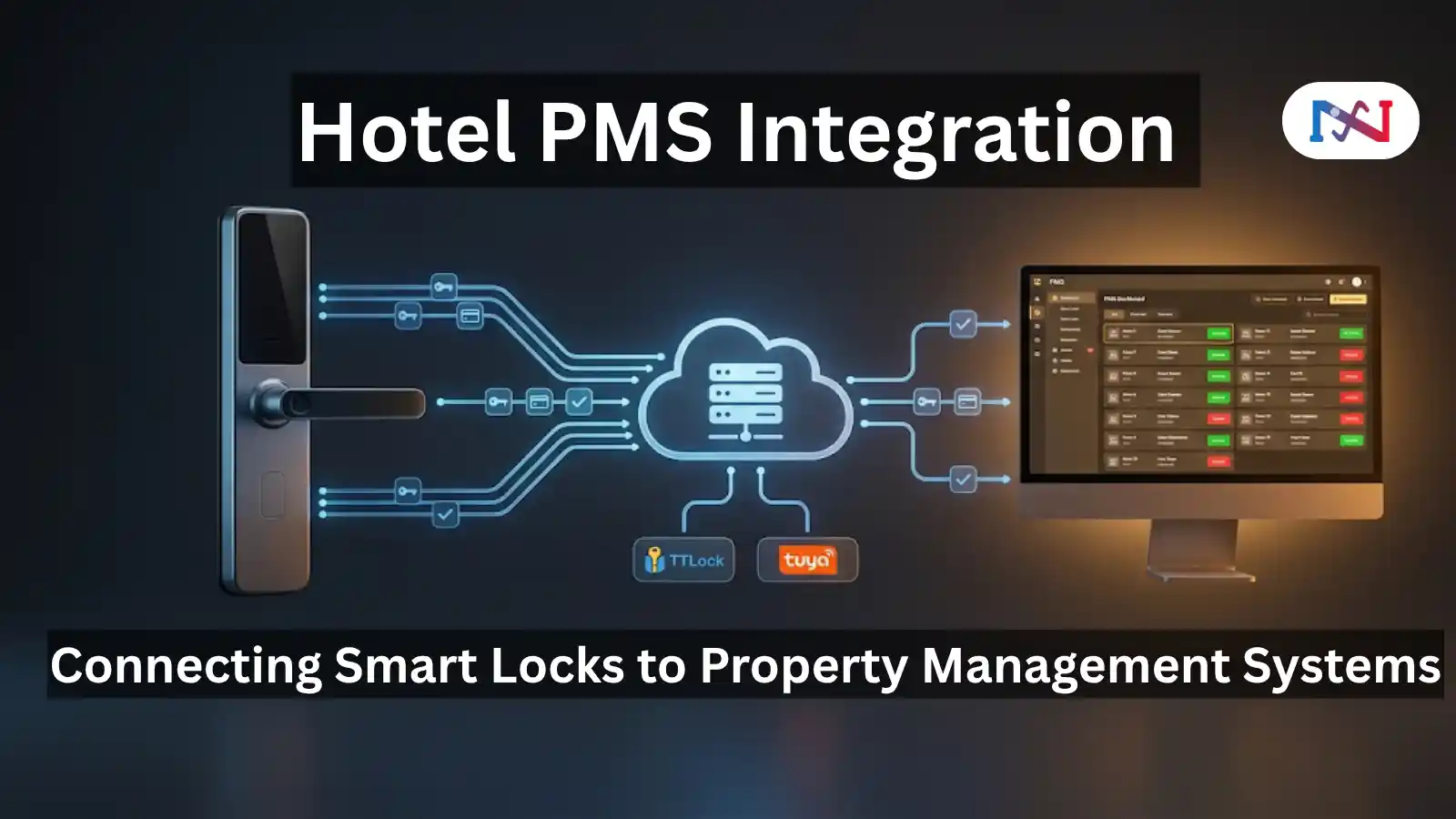
Hotel PMS integration for smart locks is the automated connection between electronic door lock hardware and a property management system that enables credential issuance, access permission management, and audit logging to be driven by reservation data rather than manual front-desk operations. When a guest checks in through the PMS, the integration automatically triggers the lock platform (TTLock or Tuya) to generate a room access credential — an RFID card encoding command, a time-bounded PIN code, or a mobile key — and delivers it to the guest without staff intervention. TTLock integrates natively with hotel PMS platforms including Cloudbeds, Mews, Opera Cloud (via middleware), Little Hotelier, and Hospitable through its RESTful API with webhook callbacks. Tuya connects via Cloud API with MQTT protocol, better suited for serviced apartments and smart home-integrated properties. This guide explains the integration architecture from the lock hardware manufacturer’s perspective — what data flows between the lock and the PMS, which platforms have verified integrations, what infrastructure each approach requires, and what hotel IT teams need to configure before deployment. For an overview of hotel lock hardware options, see our guide to hotel access control systems. For industry-specific solutions, visit our hotel and hospitality smart lock solutions page.
What Is Hotel PMS Integration for Smart Locks?
A property management system (PMS) is the central software platform that manages hotel reservations, room assignments, guest profiles, billing, housekeeping schedules, and operational reporting. Major PMS platforms in the hotel industry include Oracle Opera Cloud, Cloudbeds, Mews, Little Hotelier, RoomRaccoon, SabeeApp, Maestro, and Apaleo — each serving different property sizes and operational models.
Without PMS integration, smart lock management operates in isolation. Front-desk staff must manually encode RFID cards, generate PIN codes in the lock platform app, and track which credentials belong to which guest — a workflow that introduces human error, creates bottlenecks during peak check-in periods, and eliminates any efficiency advantage the smart lock was supposed to provide. A 100-room hotel processing 80 daily check-ins at 2–3 minutes per manual credential operation loses 160–240 minutes of front-desk productivity per day.
PMS integration eliminates this manual layer. The PMS becomes the single source of truth: when a reservation status changes (confirmed, checked-in, checked-out, cancelled), that event automatically propagates to the lock platform, which executes the corresponding credential action (create, activate, deactivate, delete). The front-desk staff interacts only with the PMS — the lock system responds autonomously.
Integration Architecture: How Lock Hardware Connects to PMS Software
The integration between a smart lock and a hotel PMS involves four layers, each with distinct hardware and software components. Understanding this architecture helps hotel IT teams, system integrators, and procurement managers specify the right infrastructure and avoid compatibility gaps.
| Layer | Component | Function | Example |
|---|---|---|---|
| Lock hardware | Electronic door lock | Reads credentials (card, PIN, fingerprint, BLE), controls deadbolt, logs access events | Nice Smart SU7-03 (RFID), K9 (multi-access) |
| Communication bridge | Gateway or Wi-Fi module | Connects the lock’s Bluetooth signal to the internet, enabling cloud communication | TTLock G2 gateway (BLE → Wi-Fi), Tuya Wi-Fi module (built-in) |
| Lock cloud platform | TTLock Cloud or Tuya Cloud | Receives commands from PMS, translates to lock operations, stores access logs, manages credentials | TTLock Open API server, Tuya IoT Cloud |
| PMS platform | Hotel management software | Sends reservation events (check-in, check-out, room change) that trigger lock actions | Cloudbeds, Mews, Opera Cloud, Little Hotelier |
The data flow follows a defined sequence:
- A guest reservation is created or modified in the PMS (room assignment, check-in time, check-out time, guest identity).
- The PMS sends a reservation event to the lock cloud platform via API call (RESTful HTTP request or webhook).
- The lock cloud platform translates the reservation event into a lock command — generate a time-bounded PIN code, prepare an RFID card encoding instruction, or issue a mobile key credential.
- The command is transmitted to the specific door lock via the communication bridge (TTLock gateway or Tuya Wi-Fi).
- The lock executes the command — storing the new credential in its local memory, ready to authenticate the guest upon arrival.
- When the guest presents the credential (taps card, enters PIN, uses mobile key), the lock validates it against stored permissions and unlocks.
- The access event (timestamp, credential type, lock ID) is logged locally on the lock and synced to the cloud platform.
- The PMS can query access logs from the lock cloud platform for operational reporting, security audits, and housekeeping verification.
This entire sequence operates without front-desk involvement after the initial reservation is entered into the PMS. The integration is bidirectional — the PMS sends commands to the lock system, and the lock system sends status data (access events, battery levels, lock status) back to the PMS.
TTLock PMS Integration: Architecture and Compatible Platforms
TTLock is the most widely adopted smart lock platform for hotel PMS integration due to its purpose-built access control features, open API documentation, and established partnerships with hospitality software providers. For a detailed platform comparison, see our Tuya vs TTLock platform comparison.
TTLock API Capabilities for Hotel Operations
The TTLock Open Platform provides a RESTful API with OAuth 2.0 authentication and webhook callback support. The API operations relevant to hotel PMS integration include:
| API Operation | Hotel Use Case | Trigger Event |
|---|---|---|
| Generate timed passcode | Create a PIN code valid only during the guest’s reservation dates | Guest check-in confirmed in PMS |
| Delete passcode | Revoke a guest’s access code at checkout or upon early departure | Guest checked out in PMS |
| Generate one-time passcode | Issue a single-use code for maintenance worker or delivery | Manual trigger from PMS or ops dashboard |
| Send eKey | Deliver a mobile key to guest’s smartphone via Bluetooth | Guest completes pre-arrival check-in |
| Revoke eKey | Deactivate mobile key at checkout | Guest checked out in PMS |
| Lock / unlock remotely | Open a room door remotely for late-arriving guest or emergency | Manual trigger from front desk or ops dashboard |
| Query access logs | Retrieve timestamped entry/exit records for a specific lock | Security audit, housekeeping verification, dispute resolution |
| Query lock status | Check battery level, online/offline status, lock/unlock state | Preventive maintenance dashboard |
| IC card management | Register, revoke, and manage RFID card credentials per lock | Card issuance at front desk encoder |
The API communicates via HTTPS with JSON payloads. Webhook callbacks enable the PMS to receive real-time notifications when a lock event occurs (door opened, tamper alert, low battery) — eliminating the need for the PMS to continuously poll the lock platform for status updates.
PMS Platforms with Verified TTLock Integration
The following PMS platforms have documented, production-verified integrations with TTLock smart locks — either through native marketplace integration or through certified middleware providers.
| PMS Platform | Integration Method | Connection Type | Typical Property Size |
|---|---|---|---|
| Cloudbeds | Cloudbeds Marketplace (via Mecx-Tech certified integrator) | API — automatic code/key generation on check-in | 20–500 rooms |
| Mews | Mews Marketplace + middleware (LOXE, Flexipass) | API — bidirectional reservation sync, mobile key delivery | 20–300 rooms |
| Oracle Opera Cloud | Via middleware (LOXE, ASSA ABLOY VingCard ecosystem, or custom) | Opera Cloud POST RoomKeysOutbound API + lock platform API | 100–1,000+ rooms |
| Little Hotelier | Native integration via TTLock Open API | API — automatic passcode generation linked to reservations | 5–50 rooms |
| Hospitable (formerly Smartbnb) | Native TTLock integration | API — automated code creation/deletion tied to booking dates | 1–200 units (STR focused) |
| Guesty (Locks Manager) | TTLock supported via Guesty Locks Manager module | API — centralized lock management across multi-channel bookings | 10–500 units (STR/hotel hybrid) |
| Operto | Native TTLock support | API — guest experience automation including lock access | 10–200 units |
| Apaleo | Via middleware (LOXE) | API — bidirectional sync, mobile key, PIN code delivery | 20–200 rooms |
| Maestro PMS | Via middleware (LOXE) | API — pre-arrival check-in with lock credential delivery | 50–500 rooms |
The “via middleware” notation indicates that the PMS does not connect directly to the TTLock API. Instead, a third-party integration layer (such as LOXE, Flexipass, or a custom connector built by a system integrator) sits between the PMS and the lock platform, translating reservation events into lock commands. This middleware approach is common for enterprise PMS platforms like Opera Cloud that use proprietary API structures.
For Nice Smart hotel locks, the SU7-03 RFID hotel lock on TTLock firmware connects to all platforms listed above. The lock hardware is platform-agnostic at the API level — the PMS integration connects to the TTLock cloud, which then communicates with the lock. The PMS does not need to know which lock hardware brand is installed.
TTLock Gateway Infrastructure for PMS-Connected Hotels
TTLock locks communicate via Bluetooth Low Energy (BLE 5.0). For PMS integration to function — which requires cloud connectivity — each lock must be within range of a TTLock gateway device that bridges the Bluetooth signal to the hotel’s Wi-Fi or Ethernet network.
Gateway planning for PMS-integrated hotel deployments:
| Property Layout | BLE Range per Gateway | Locks per Gateway | Infrastructure Note |
|---|---|---|---|
| Standard corridor (drywall/plasterboard) | ~15m radius | 8–12 locks | One gateway per corridor section, power outlet required |
| Concrete/brick construction | ~8–10m radius | 5–8 locks | Higher gateway density needed; test BLE propagation during pilot |
| Open-plan areas (lobby, co-working) | ~20m radius | 10–15 locks | Fewer obstructions extend range |
| Multi-building campus | Per-building coverage | Variable | Each building requires independent gateway coverage; campus-wide Wi-Fi backhaul needed |
Each gateway connects to the property’s 2.4GHz Wi-Fi network (5GHz is not supported by most gateway models) and requires a 110V/220V power outlet. Gateway devices are compact (approximately the size of a standard Wi-Fi plug) and can be mounted discreetly in corridor ceilings, electrical closets, or behind reception counters.
Tuya PMS Integration: Architecture for Serviced Apartments and Smart Properties
Tuya-connected smart locks integrate with property management systems through the Tuya Cloud API using MQTT protocol and OAuth 2.0 authentication. The Tuya integration path differs from TTLock in two significant ways: Tuya Wi-Fi locks connect directly to the cloud without gateway hardware, and Tuya’s API covers all device categories in its ecosystem (not just locks), enabling cross-device automation alongside access management.
Tuya’s PMS integration is less established in the traditional hotel vertical compared to TTLock. The Tuya Cloud API supports device control commands (lock/unlock), temporary password generation, device status queries, and scene/automation triggers — but does not have the same depth of native PMS marketplace integrations that TTLock has built with Cloudbeds, Mews, and Hospitable. Hotels and property managers using Tuya-connected locks typically require custom API development or middleware to connect the lock platform to their PMS.
Where Tuya PMS integration excels is in serviced apartment and smart property contexts. The Nice Smart K9 smart lock on Tuya firmware connects to the Tuya Cloud, which can trigger automation routines across the property: door unlock → activate interior lighting → adjust thermostat → send welcome notification. For operators who view access control as one component of a broader smart room experience rather than a standalone system, Tuya’s ecosystem integration provides capabilities that TTLock’s lock-only platform cannot match. For short-term rental operators evaluating platform options, see our guide to smart locks for Airbnb and short-term rentals.
Integration Types: Direct API vs Middleware vs Offline Card Systems
Not all hotel lock integrations work the same way. The integration type determines setup complexity, ongoing maintenance, real-time capability, and cost. Hotel operators should understand the three primary integration architectures before specifying hardware.
| Integration Type | How It Works | Real-Time Capability | Setup Complexity | Best For |
|---|---|---|---|---|
| Direct API (PMS ↔ Lock Cloud) | PMS sends reservation events directly to TTLock/Tuya API; credentials generated automatically | Near real-time (seconds) | Low — marketplace app install or API key exchange | Hotels on PMS platforms with native TTLock marketplace integration (Cloudbeds, Mews, Little Hotelier) |
| Middleware (PMS ↔ Integration Layer ↔ Lock Cloud) | Third-party software (LOXE, Flexipass, Operto) translates between PMS API and lock platform API | Near real-time (seconds) | Medium — middleware subscription, configuration, testing | Hotels on enterprise PMS (Opera Cloud, Maestro) or needing additional features (mobile check-in, upselling) |
| Offline card system (standalone) | Front desk encodes RFID cards via USB encoder connected to lock management software; no cloud required | Instant (local encoding) | Low — encoder + software on front desk PC | Budget hotels, properties without reliable internet, legacy upgrade from mechanical keys |
The offline card system deserves specific attention because it remains the most practical integration method for a significant segment of the hotel market. Properties in regions with unreliable internet connectivity, budget hotels that cannot justify middleware subscription costs, and hotels upgrading from mechanical keys to electronic access can deploy RFID card locks with a front-desk encoder and standalone management software without any cloud infrastructure. The Nice Smart SU7-03 supports this offline workflow: cards are encoded at the front desk with hierarchical permissions (master, floor, building, guest, emergency), and the lock validates credentials locally without network connectivity. Access logs are stored on the lock and can be retrieved via Bluetooth when needed.
What Hotel IT Teams Need to Configure
For hotels implementing cloud-based PMS integration with smart locks, the following infrastructure and configuration requirements must be addressed before deployment.
Network Infrastructure
TTLock gateways require access to the hotel’s 2.4GHz Wi-Fi network with outbound HTTPS connectivity (port 443) to TTLock cloud servers. The gateway traffic volume is minimal — each lock generates approximately 1–5 KB of data per access event. A 100-room hotel with 80 daily check-ins generates less than 1 MB of lock-related network traffic per day. However, the gateways must maintain persistent connectivity for real-time credential delivery — a gateway that disconnects prevents new credentials from reaching the locks it serves until connectivity is restored.
For Tuya Wi-Fi locks, each lock connects directly to the 2.4GHz Wi-Fi network. Ensure the property’s wireless infrastructure supports the additional device count (one lock = one connected device per network). A 100-room hotel adds 100+ devices to the network — verify that the access points and DHCP server can accommodate this load alongside guest Wi-Fi and other IoT devices.
PMS Configuration
The PMS must be configured to send reservation events to the lock platform. For marketplace integrations (Cloudbeds → TTLock, for example), this typically involves installing the integration app from the PMS marketplace, authenticating with TTLock API credentials (client ID and client secret), mapping PMS room numbers to TTLock lock identifiers, configuring trigger events (which PMS status changes initiate lock actions), and testing with a sandbox reservation before going live.
For middleware integrations, the middleware provider (LOXE, Flexipass, Operto) handles the configuration — the hotel provides PMS API credentials and room mapping data, and the middleware translates between the two systems.
Room-to-Lock Mapping
Every lock must be mapped to a room number in the PMS. When the PMS sends a check-in event for Room 305, the lock platform must know which physical lock corresponds to Room 305 to deliver the credential to the correct door. This mapping is typically configured during initial setup through the TTLock web portal or Tuya IoT platform console. For hotels with connecting rooms, suite configurations, or multiple doors per room (main entry + balcony), the mapping must account for each lock individually.
Selecting Lock Hardware for PMS-Integrated Deployments
The PMS integration operates at the platform level (TTLock or Tuya cloud), not at the lock hardware level. This means any lock running TTLock firmware — regardless of manufacturer — connects to the same TTLock cloud API that the PMS integrates with. The PMS does not need to be “compatible” with a specific lock brand. It needs to be compatible with the lock platform (TTLock or Tuya).
This platform-agnostic architecture gives hotel operators flexibility in hardware selection. The decision criteria for lock hardware in a PMS-integrated deployment focus on form factor and door compatibility (mortise, rim, deadbolt), access methods required (RFID only, multi-access, biometric), construction material and durability (zinc alloy, stainless steel, IP rating), power source and battery life (AA batteries vs rechargeable Li-ion), certification compliance for the destination market (CE, FCC, RoHS), and OEM branding requirements.
Nice Smart produces locks on both TTLock and Tuya firmware across the full smart lock product catalog. For traditional hotel deployments requiring PMS integration with RFID card access, the SU7-03 on TTLock firmware provides the most direct integration path. For serviced apartments and smart properties requiring multi-access capability with ecosystem automation, the K9 on Tuya firmware offers broader functionality. For guidance on evaluating manufacturers during the hardware procurement process, see our checklist for choosing a smart lock manufacturer.
Platform Specification at the Manufacturing Stage
A critical consideration that many hotel operators overlook: the lock platform (TTLock or Tuya) is configured during manufacturing and cannot be changed after production. The firmware, wireless module, and cloud binding are set at the factory. A lock manufactured with TTLock firmware will only connect to the TTLock cloud and only integrate with PMS platforms through the TTLock API. The same hardware manufactured with Tuya firmware will only connect to the Tuya cloud.
This means the PMS integration path must be confirmed before the lock order is placed. The decision workflow:
- Identify which PMS platform the hotel uses (or plans to use).
- Verify whether that PMS has a native or middleware integration with TTLock, Tuya, or both.
- Specify the corresponding platform when ordering locks from the manufacturer.
- If evaluating both platforms, request sample units on each firmware for integration testing before bulk commitment.
Nice Smart supports both platforms across the product line, with OEM firmware configuration handled during the production process. Mixed-platform orders are supported — for example, TTLock firmware for guest room locks (PMS integration) and Tuya firmware for common area locks (smart building automation).
Implementation Timeline: From Hardware Order to Live Integration
| Phase | Duration | Activities |
|---|---|---|
| 1. Platform and PMS verification | 1–2 weeks | Confirm PMS integration support with TTLock or Tuya; select integration method (native, middleware, offline); contact PMS vendor and middleware provider if applicable |
| 2. Sample order and integration testing | 2–3 weeks | Order 2–4 sample locks on confirmed platform; install on test doors; configure PMS integration in sandbox; validate end-to-end credential flow |
| 3. Bulk lock order and gateway procurement | 1–4 weeks | Place production order with platform specification; order TTLock gateways if needed; confirm OEM branding, finish, and mechanical adaptation |
| 4. Network and infrastructure preparation | 1–2 weeks | Install gateway hardware (TTLock) or verify Wi-Fi coverage (Tuya); configure network access; set up PMS integration with production API credentials |
| 5. Lock installation and room mapping | 1–4 weeks | Install locks on all doors (phased by floor/wing); map each lock to its PMS room number; verify BLE connectivity to nearest gateway |
| 6. Integration testing and staff training | 1 week | Run full check-in/check-out cycle for 5–10 test reservations; train front desk on PMS workflow; train maintenance on battery replacement and troubleshooting |
| 7. Go-live and monitoring | Ongoing | Monitor access logs, battery levels, and gateway connectivity during first 30 days; resolve edge cases (room changes, early departures, connecting rooms) |
Total implementation timeline from initial planning to go-live ranges from 6–12 weeks for a typical 50–200 room hotel, depending on construction schedule, network readiness, and PMS integration complexity. Properties upgrading existing electronic locks can often compress the timeline since door preparations are already in place. For guidance on international procurement logistics, see our article on smart lock certifications for global markets.
Frequently Asked Questions About Hotel PMS Integration
How do hotel smart locks integrate with property management systems?
Hotel smart locks integrate with PMS platforms through cloud-based APIs. The lock connects to a cloud platform (TTLock or Tuya) via Bluetooth gateway or Wi-Fi. The PMS sends reservation events (check-in, check-out, room change) to the lock cloud platform via API. The cloud platform translates these events into lock commands — generating PIN codes, encoding RFID cards, or issuing mobile keys. The integration can be direct (PMS marketplace app connecting to lock API), through middleware (third-party integration layer like LOXE or Operto), or offline (front-desk RFID card encoder with standalone lock management software).
Which PMS platforms work with TTLock smart locks?
TTLock has verified integrations with Cloudbeds (via Mecx-Tech certified integrator on Cloudbeds Marketplace), Mews (via middleware providers LOXE and Flexipass), Opera Cloud (via middleware), Little Hotelier (native API integration), Hospitable (native TTLock integration), Guesty Locks Manager (TTLock supported), Operto (native TTLock support), Apaleo (via LOXE), and Maestro PMS (via LOXE). Additional PMS platforms can integrate through the TTLock Open API documentation, which provides RESTful API endpoints and webhook callback specifications for custom development.
Can Tuya smart locks connect to hotel PMS platforms?
Yes, but with more development effort than TTLock. Tuya smart locks connect to PMS platforms through the Tuya Cloud API using MQTT protocol. Unlike TTLock, Tuya does not have extensive native PMS marketplace integrations in the hospitality vertical. Hotels using Tuya-connected locks typically require custom API development or middleware to connect the lock platform to their PMS. Tuya integration is better suited for serviced apartments and smart properties where access control is one component of a broader IoT ecosystem rather than a standalone hotel lock management system.
Does the PMS need to be compatible with a specific lock brand?
No. PMS integration connects to the lock cloud platform (TTLock or Tuya), not to the lock hardware directly. Any lock running TTLock firmware — regardless of manufacturer — connects to the same TTLock cloud API that the PMS integrates with. This means the PMS-lock integration is platform-dependent, not brand-dependent. A hotel can select lock hardware from any TTLock-compatible manufacturer (including Nice Smart) and connect it to the same PMS integration that works with any other TTLock-compatible lock.
What happens if the internet goes down — does the PMS integration fail?
An internet outage prevents new credentials from being delivered to locks, but does not affect credentials already stored on the lock. All access methods that operate locally — previously generated PIN codes, enrolled fingerprints, registered RFID cards, and mechanical keys — continue to work during an outage. Guests who received their credentials before the outage will access their rooms normally. New check-ins during an outage require manual credential issuance (offline RFID card encoding or manual code generation via Bluetooth from a smartphone within range of the lock). Connectivity restoration automatically resumes cloud sync and pending credential deliveries.
How long does it take to set up PMS integration with smart locks?
The integration setup itself (PMS configuration, API key exchange, room-to-lock mapping) typically takes 1–3 days for marketplace-based integrations and 1–2 weeks for middleware-based integrations. The broader deployment timeline — including hardware procurement, lock installation, gateway setup, and staff training — ranges from 6–12 weeks for a 50–200 room hotel. The fastest deployments are properties on Cloudbeds or Little Hotelier using TTLock marketplace integration with Nice Smart locks already installed, where the software integration can be configured in under 48 hours.
What is the cost of PMS integration for hotel smart locks?
The lock hardware cost is independent of the integration — see our team for project-level hardware pricing. The PMS integration cost depends on the method: native marketplace integrations (Cloudbeds, Little Hotelier) are typically included in the PMS subscription at no additional cost. Middleware providers (LOXE, Operto, Flexipass) charge per-room-per-month fees ranging from $2–$10/room/month depending on the provider and feature tier. Custom API development for non-standard PMS platforms requires one-time development investment estimated at $3,000–$15,000 depending on scope and developer rates. TTLock API access itself is free with no subscription fees.
Can the lock platform be changed after installation?
No. The lock platform (TTLock or Tuya) is configured during manufacturing — the firmware, wireless module, and cloud binding are set at the factory and cannot be changed in the field. This makes the platform decision permanent for each production batch. Hotel operators should confirm their PMS integration path and platform preference before placing the hardware order. Nice Smart recommends ordering sample units on both platforms for integration testing when the decision is not yet finalized.
Planning a PMS-integrated smart lock deployment for your hotel? Nice Smart’s engineering team can help you select the right hardware, confirm platform compatibility with your PMS, and coordinate a deployment plan aligned with your installation timeline. We supply TTLock and Tuya-configured hotel locks with OEM branding, MOQs from 20 units, and dedicated project management for orders exceeding 200 units. Request a PMS integration consultation or contact our hospitality solutions team via WhatsApp.