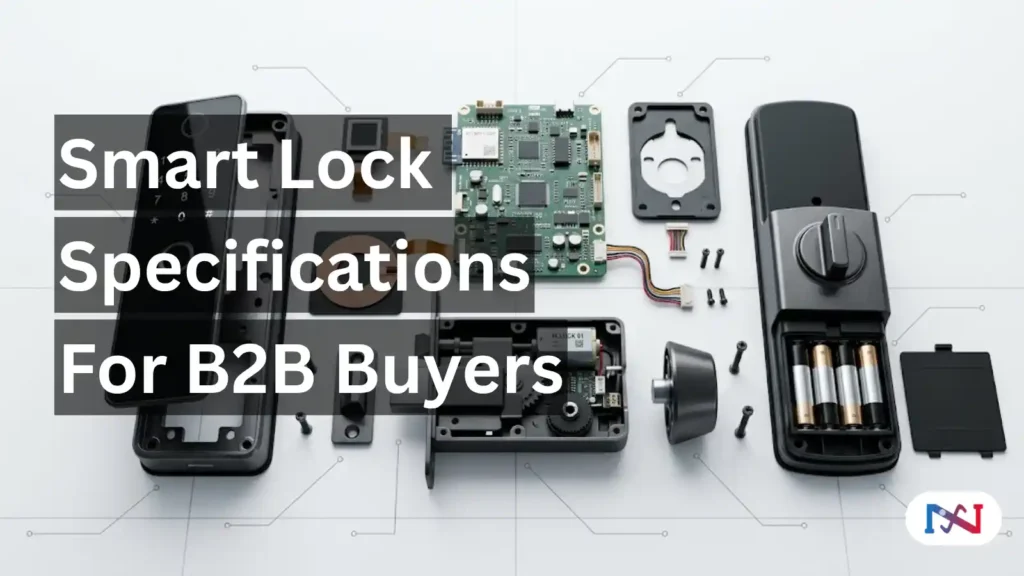
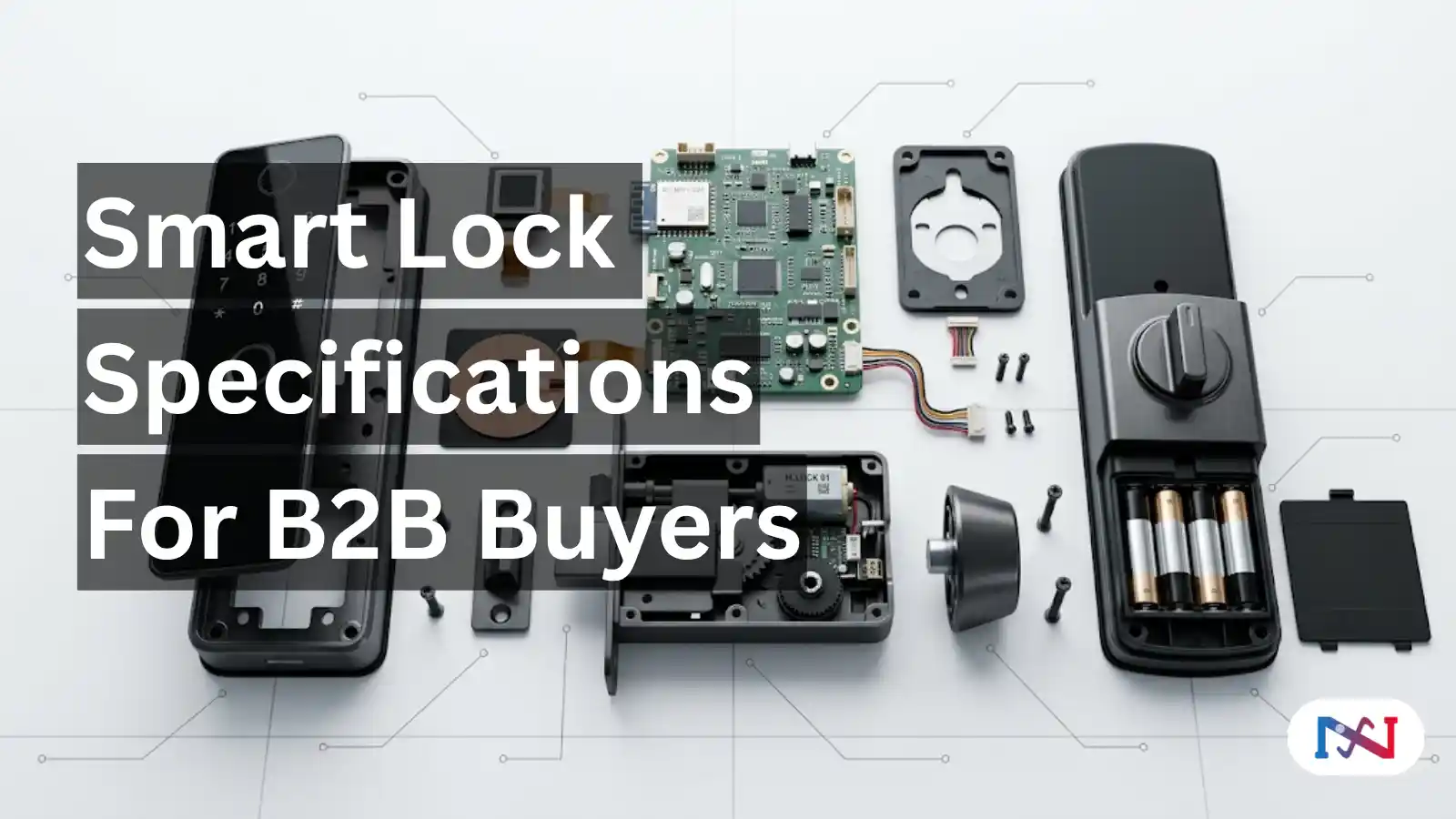
Smart lock specifications define the performance, durability, compatibility, and security grade of electronic door lock hardware. For B2B buyers — distributors, project developers, hotel operators, property managers, and system integrators — understanding these specifications is essential for evaluating manufacturer datasheets, comparing products across suppliers, and specifying hardware that meets the operational and regulatory requirements of a deployment. The critical specification categories are construction materials and finish (zinc alloy, stainless steel, aluminium alloy), biometric sensor type and performance (semiconductor vs optical fingerprint, 3D structured-light facial recognition), access method capacity (fingerprint, PIN, IC card, and app user limits per lock), connectivity protocol (Bluetooth 5.0, Wi-Fi 2.4GHz, Zigbee, NFC), power source and battery life (AA batteries vs rechargeable Li-ion, operations-per-cycle rating), ingress protection rating (IP65, IP67 per IEC 60529), operating temperature range, lock body type (mortise, rim/surface mount, deadbolt), and certification compliance (CE, FCC, RoHS, UL, BHMA). This guide explains each specification category with acceptable ranges for commercial deployment, what to verify on a manufacturer’s datasheet, and how each spec affects real-world performance. For manufacturer evaluation criteria, see our checklist for choosing a smart lock manufacturer./h2
Construction Materials and Finish
The housing material determines a smart lock’s weight, structural rigidity, corrosion resistance, and long-term appearance retention. Three primary materials are used in commercial-grade smart lock construction.
| Material | Properties | Weight | Corrosion Resistance | Cost | Common Use |
|---|---|---|---|---|---|
| Zinc alloy (Zamak) | High rigidity, excellent die-casting precision, accepts PVD and electroplated finishes | Heavy (~800–1,200g per lock panel) | Good — PVD coating extends lifespan to 10+ years | Mid-range | Most mortise and handle smart locks — industry standard for B2B hardware |
| Aluminium alloy (6063) | Lightweight, good strength-to-weight ratio, anodized or powder-coated finish | Light (~400–700g per lock panel) | Very good — natural oxide layer plus anodizing | Mid-range | Glass door locks, slim-profile locks, cabinet locks |
| 304 Stainless steel | Highest corrosion resistance, hardest surface, heaviest | Very heavy (~1,000–1,500g per lock panel) | Excellent — marine-grade rust resistance | Higher | Outdoor/gate locks, high-security commercial applications |
| ABS plastic | Lightweight, UV-resistant, used for interior panels and non-structural components | Light | N/A — interior use only | Low | Interior panels, battery compartment covers, back plates |
| Tempered glass | Scratch-resistant, touch-responsive, aesthetic surface for keypads | Moderate | Excellent | Mid-range | Touchpad panels on premium mortise locks |
What to verify: Ask the manufacturer for the specific alloy grade (zinc alloy is standard; stainless steel should be 304 or 316 grade). Confirm the surface treatment method — PVD (Physical Vapor Deposition) coating is more durable than standard electroplating, maintaining finish appearance under high-touch commercial use. Available finish options typically include matte black, satin nickel, gold, silver, and bronze. For custom finishes, see Nice Smart’s OEM customization and finish options.
Biometric Sensor Specifications
Biometric access methods — fingerprint recognition and facial recognition — are defined by sensor type, recognition speed, accuracy rates, and user capacity. These specifications directly affect the end-user experience and operational reliability of the lock.
Fingerprint Sensors: Semiconductor vs Optical
| Specification | Semiconductor (Capacitive) | Optical |
|---|---|---|
| Sensing method | Measures electrical capacitance differences across fingerprint ridges and valleys | Captures 2D image of fingerprint using LED light and camera sensor |
| Recognition speed | <0.5 seconds (typical: 0.3s) | 0.5–1.0 seconds |
| False Acceptance Rate (FAR) | <0.001% (1 in 100,000) | <0.01% (1 in 10,000) |
| False Rejection Rate (FRR) | <1% | <2% |
| Wet/dry finger performance | Good — reads subsurface ridge patterns | Poor — moisture and dryness degrade image quality |
| Spoof resistance | High — detects live tissue capacitance (cannot be fooled by printed images) | Low-moderate — 2D images can potentially fool basic optical sensors |
| Durability | 500,000+ touches typical lifespan | 1,000,000+ touches (fewer moving parts) |
| Sensor size | Compact — embedded in lock handle or front panel | Larger — typically requires separate sensor window |
| Cost | Higher | Lower |
| B2B recommendation | Standard for commercial-grade smart locks | Acceptable for budget applications only |
What to verify: Confirm the sensor type is semiconductor (capacitive), not optical. All Nice Smart smart locks use semiconductor fingerprint sensors. Ask for the FAR and FRR ratings — FAR below 0.002% and FRR below 1% are acceptable for commercial deployment. Check the fingerprint capacity — most commercial locks store 50–100 fingerprint templates. The Nice Smart K9 stores approximately 100 fingerprints with semiconductor sensing and <0.5s recognition speed.
Facial Recognition: 3D Structured Light vs 2D Camera
| Specification | 3D Structured Light | 2D Camera |
|---|---|---|
| Method | Projects infrared dot pattern, maps 30,000+ facial depth points | Captures flat 2D facial image |
| Spoof resistance | High — rejects photos, videos, and masks (depth verification) | Low — can be spoofed by printed photos |
| Low-light performance | Excellent — IR-based, works in complete darkness | Poor — requires visible light |
| Recognition speed | <1.0 second | 1–2 seconds |
| Face capacity | 50–100 profiles per lock (typical) | 50–100 profiles |
| Cost impact | Significant — adds $15–$30 to manufacturing cost | Lower |
| B2B recommendation | Required for any commercial face recognition deployment | Not recommended — security liability |
What to verify: If the lock advertises “face recognition,” confirm it uses 3D structured-light technology, not a 2D camera. The Nice Smart SU7 uses dual-camera 3D face recognition with approximately 100 face profiles and infrared sensing for operation in low-light and dark environments.
Access Method Capacity
Every smart lock has finite capacity for each access method — the maximum number of fingerprints, PIN codes, IC cards, and face profiles it can store simultaneously. For B2B deployments, these limits determine whether a lock can serve a family (5–10 users), a small office (20–50 users), or a hotel/commercial environment (100–500 credentials).
| Access Method | Typical Capacity Range | Commercial Minimum | What to Watch |
|---|---|---|---|
| Fingerprint | 50–200 templates | 50 minimum, 100 recommended | Some locks count multiple enrollments of the same finger as separate entries |
| PIN code | 50–200 codes | 50 minimum, 100 recommended | Verify support for timed, one-time, and recurring codes — not just permanent |
| IC card (RFID) | 100–500 cards | 100 minimum, 500 for hotels | Confirm card frequency (13.56MHz Mifare) and encryption (AES) |
| Face profile | 50–100 profiles | 50 minimum | Confirm 3D structured light, not 2D camera |
| App users (eKey) | Platform-dependent (unlimited via cloud) | N/A — managed via TTLock or Tuya platform | Verify whether eKeys are time-bounded and revocable |
The SU7-03 RFID hotel lock supports approximately 500 IC cards with hierarchical card management (master, floor, building, guest, emergency) — designed specifically for hotel-scale credential volumes. Multi-access residential and commercial locks like the K9 typically support 100 credentials per access method.
Connectivity and Protocol Specifications
Connectivity determines how the lock communicates with smartphones, management platforms, and cloud services. The protocol affects range, power consumption, remote management capability, and ecosystem integration.
| Protocol | Range | Power Draw | Remote Access | Ecosystem | Best For |
|---|---|---|---|---|---|
| Bluetooth 5.0 (BLE) | 10–15m | Very low | Requires gateway for remote/cloud access | TTLock, Tuya (BLE mode) | Hotels (with gateway network), battery-critical deployments |
| Wi-Fi (2.4GHz) | Property Wi-Fi range | High | Direct cloud access — no gateway needed | Tuya, some TTLock models | Scattered rentals, smart home, properties without gateway infrastructure |
| Zigbee 3.0 | 10–20m (mesh extends) | Very low | Requires Zigbee hub | Tuya, SmartThings, Hubitat | Smart home ecosystems with existing Zigbee infrastructure |
| NFC | <4cm (contact) | Negligible | N/A — local credential transfer only | Apple Wallet, Google Wallet (Matter-enabled) | Mobile key tap-to-unlock supplementing BLE or Wi-Fi |
| Z-Wave 700 | 30–100m (mesh extends) | Low | Requires Z-Wave hub | SmartThings, Hubitat, Alarm.com | US residential market with existing Z-Wave security systems |
What to verify: Confirm the exact wireless module installed — “supports Wi-Fi” could mean optional (requires factory configuration at order) or standard (built-in). Nice Smart locks support TTLock and Tuya app connectivity via Bluetooth as standard, with Wi-Fi and NFC available as optional modules configured during manufacturing. For a detailed platform comparison, see our Tuya vs TTLock platform comparison.
Power Source and Battery Life
Battery specifications directly affect deployment maintenance costs. A 100-lock installation where each lock needs battery replacement twice annually versus once annually represents a significant difference in maintenance labor over the life of the deployment.
| Power Source | Typical Battery Life | Replacement Method | Advantages | Disadvantages |
|---|---|---|---|---|
| 4× AA alkaline batteries | 10,000–12,000 operations (~10–14 months) | Pop-open rear panel, swap batteries | Standard batteries available everywhere, fast swap, no charging time | Recurring battery purchase cost, disposal considerations |
| Lithium-ion rechargeable (3,800–4,200mAh) | 10,000–12,000 operations (~10–14 months) | Charge via USB-C cable (in-place or remove battery pack) | Zero ongoing battery purchase cost, USB-C convenience | Requires charging access, longer downtime during charge if not hot-swappable |
| 2× AA batteries | 8,000–10,000 operations (~8–12 months) | Pop-open panel | Lighter lock, lower cost | Shorter life, more frequent replacements |
What to verify: Battery life should be stated in “operations” (lock/unlock cycles), not months — because actual calendar life depends on usage frequency. A hotel room lock handling 10–15 operations per day depletes faster than a residential lock handling 5–8. Ask the manufacturer for the operations count at standard test conditions. Also verify the emergency power method — most commercial locks include a USB or USB-C emergency power port on the exterior panel, allowing a portable battery bank to provide temporary power when internal batteries are fully depleted.
Critical spec for B2B deployments: Wi-Fi-connected locks consume significantly more power than Bluetooth-only locks — expect 30–40% shorter battery life when the Wi-Fi module is active. Factor this into maintenance planning for large deployments.
Ingress Protection (IP) Rating
The IP rating, defined by IEC 60529, indicates a lock’s resistance to solid particles (dust) and liquid ingress (water). This specification is critical for exterior-facing installations — main entry doors, outdoor corridors, pool access, gate-mounted locks, and any location exposed to weather.
| Rating | Dust Protection | Water Protection | Suitable For |
|---|---|---|---|
| IP54 | Protected against dust ingress (limited) | Protected against water splashes from any direction | Interior doors, covered corridors — minimum for any smart lock |
| IP55 | Protected against dust ingress (limited) | Protected against low-pressure water jets from any direction | Sheltered exterior locations, covered entryways |
| IP65 | Dust-tight (no ingress) | Protected against low-pressure water jets from any direction | Exterior doors with overhang protection, outdoor commercial entries |
| IP67 | Dust-tight (no ingress) | Protected against temporary immersion in water (up to 1m depth, 30 min) | Fully exposed exterior doors, tropical/monsoon climates, pool areas |
| IPX6 | Not tested for dust | Protected against high-pressure water jets from any direction | Industrial and high-wash environments |
What to verify: For any exterior installation, IP65 is the minimum acceptable rating. IP67 is recommended for fully exposed locations and tropical climates. Nice Smart locks carry IP67 certification across the product line — dust-tight and rated for temporary water immersion. If a manufacturer claims IP67 but cannot provide a test report from an accredited lab, treat the claim as unverified.
Lock Body Type and Door Compatibility
The lock body type determines how the lock is installed on the door and what structural preparation (cutouts, boring) the door requires. Matching the correct lock type to the door is a non-negotiable specification step — an incompatible lock body requires door modification or replacement.
| Lock Type | Installation Method | Door Preparation | Typical Use |
|---|---|---|---|
| Mortise lock | Lock body inserted into a rectangular pocket cut into the door edge | Rectangular mortise pocket + spindle bore + cable routing | Most common type for residential and hotel smart locks in Asia, Middle East, Europe |
| Deadbolt lock | Bolt mechanism installed through a circular bore in the door | Circular bore (2-1/8″ standard) + edge bore for bolt | Standard in North American residential market |
| Rim / surface mount lock | Lock body mounted on the interior surface of the door (no mortise pocket) | Minimal — mounting holes + cable pass-through | Retrofit installations, doors that cannot be mortised, older buildings |
| Glass door lock | Clamped onto glass panel without drilling | None — clamp mechanism grips glass (8–12mm typical thickness) | Frameless glass doors in offices, showrooms, retail, lobby entries |
| Handle/lever lock | Replaces existing lever handle with smart handle unit | Standard lever bore or Euro cylinder cutout | Interior doors, office suites, storage rooms |
| Knob lock | Replaces existing doorknob with smart knob unit | Standard knob bore | Interior doors, utility rooms, budget applications |
What to verify: Confirm supported door thickness range — most smart mortise locks support 35–65mm standard doors, with some models supporting up to 120mm with mechanical adaptation. Verify material compatibility — wood and metal doors are universally supported, but hollow-core doors may not provide adequate structural support for heavy mortise locks. For hotel door lock installations and door preparation requirements, see our hotel access control systems guide.
Operating Temperature Range
Smart locks contain electronic components (LCD displays, fingerprint sensors, Bluetooth modules, battery cells) that have defined operating temperature limits. Deploying a lock outside its rated temperature range leads to degraded biometric performance, accelerated battery drain, display failures, and potential electronic damage.
The standard operating temperature range for commercial smart locks is -20°C to 60°C (-4°F to 140°F). This range covers the vast majority of global climates including extreme desert heat (Middle East, North Africa) and cold continental winters (Northern Europe, Canada, Northern US). Nice Smart locks across the full product line are rated for -20°C to 60°C operation.
What to verify: If deploying in extreme cold (below -20°C), confirm that the fingerprint sensor maintains recognition performance at low temperatures — semiconductor sensors are less affected than optical sensors. Lithium-ion batteries also deliver reduced capacity below -10°C. For extreme environments, AA alkaline or lithium primary batteries may outperform rechargeable Li-ion at very low temperatures.
Display and Interface Specifications
Some smart locks include IPS displays for visual feedback, video conferencing, or camera preview. Display specifications affect user experience and power consumption.
| Display Type | Size Range | Function | Power Impact | Example Models |
|---|---|---|---|---|
| No display (LED indicators only) | N/A | LED status lights for lock/unlock, error, battery | Minimal | K9, H3, B1 |
| Status screen (OLED/LCD) | 1.5″–2.0″ | Time, date, battery level, access mode indicator | Low | V7 (1.8″), S8 (2.0″) |
| IPS touchscreen | 3.5″–4.5″ | Full-color UI, face recognition preview, video intercom, screen-based controls | Moderate-high | Q6 (4″ IPS), SU7-01 (4″ IPS) |
What to verify for display models: Confirm the display type is IPS (In-Plane Switching), not TN (Twisted Nematic) — IPS provides superior color accuracy and viewing angles. Check whether the display has an auto-wake/sleep function (triggered by human presence sensor) to conserve battery when not in use. Verify display visibility under direct sunlight for exterior installations.
Certification and Compliance Standards
Certifications are the manufacturer’s documented proof that the product meets electrical safety, electromagnetic compatibility, environmental, and functional standards required by destination market regulators.
| Certification | Governing Standard | What It Covers | Required For |
|---|---|---|---|
| CE | Directive 2014/30/EU (EMC), 2014/35/EU (LVD) | Electromagnetic compatibility + low voltage safety | All EU/EEA markets |
| FCC Part 15 | 47 CFR Part 15 | Unintentional radio frequency emissions | United States |
| RoHS | Directive 2011/65/EU | Restriction of hazardous substances (lead, mercury, cadmium) | EU + most global markets |
| IP67 | IEC 60529 | Dust-tight + temporary water immersion protection | Exterior installations (recommended for all) |
| GB4943.1-2022 | Chinese national standard | Safety of information technology equipment | China domestic market |
| UL 294 | UL standard | Access control system equipment safety | US commercial (often required by spec) |
| ANSI/BHMA Grade 1/2/3 | ANSI/BHMA A156 series | Mechanical durability and security grading (800,000+ cycles for Grade 1) | US commercial and institutional (often specified) |
| EN 14846 | European standard | Electromechanically operated lock performance | EU commercial and institutional |
Nice Smart products hold CE, FCC Part 15, RoHS, IP67 (select models IPX6), and GB4943.1-2022 certifications. Additional certification support (UL, BHMA, EN) is available for OEM/ODM projects requiring market-specific compliance. For a comprehensive breakdown of each standard and what it covers, see our smart lock certification guide.
How to Read a Manufacturer’s Specification Sheet
When evaluating smart lock hardware for a B2B project, use this checklist to verify the specifications that matter most for commercial deployment. Request the manufacturer’s full specification sheet (not just marketing brochure copy) and verify each item.
| Specification | Acceptable Commercial Range | Red Flag If |
|---|---|---|
| Body material | Zinc alloy, stainless steel (304/316), or aluminium alloy (6063) | Unspecified alloy, “metal,” or plastic body on exterior lock |
| Fingerprint sensor type | Semiconductor (capacitive) | Optical sensor on any lock positioned as commercial-grade |
| Fingerprint FAR | <0.002% | Not stated, or stated as percentage only without denominator |
| Fingerprint capacity | 50–200 templates | <50 for multi-user commercial deployment |
| Face recognition type | 3D structured light (infrared dot projection) | “Face recognition” without specifying 3D — likely 2D camera |
| Connectivity | BLE 5.0 + optional Wi-Fi 2.4GHz | BLE 4.0 (outdated), no platform specified |
| Battery life | 10,000+ operations per cycle | Stated in months without operations count |
| IP rating | IP65 minimum, IP67 recommended | No IP rating, or “water resistant” without IEC 60529 certification |
| Operating temperature | -20°C to 60°C | Narrower than -10°C to 45°C (limits deployment geography) |
| Door thickness range | 35–65mm (standard), up to 120mm (with adaptation) | Single thickness specified with no adaptation option |
| Certifications | CE + FCC + RoHS minimum | Claimed but no test report available upon request |
| Emergency access | Mechanical key + USB/USB-C emergency power | No mechanical key backup — single point of failure |
If a manufacturer cannot provide a detailed specification sheet with the data points listed above — or deflects specification questions with marketing language — treat this as a qualification signal. Manufacturers positioned for B2B supply should be able to produce technical datasheets, test reports, and certification documents on request. For a framework to evaluate manufacturing partners, see our smart lock distribution business guide.
Frequently Asked Questions About Smart Lock Specifications
What specifications should I look for when buying smart locks in bulk?
The essential specifications for B2B bulk purchasing are construction material (zinc alloy or stainless steel for commercial durability), fingerprint sensor type (semiconductor/capacitive for accuracy and spoof resistance), access method capacity (minimum 50–100 users per method), connectivity protocol (Bluetooth 5.0 with optional Wi-Fi for the required platform — TTLock or Tuya), battery life (10,000+ operations per cycle), IP rating (IP65 minimum, IP67 recommended for exterior doors), operating temperature range (-20°C to 60°C for global deployment), and certification compliance (CE, FCC, RoHS for international markets). Request the manufacturer’s technical datasheet and test reports to verify each specification independently.
What does IP67 mean for smart locks?
IP67 is an ingress protection rating defined by IEC 60529. The “6” indicates complete dust-tightness (no dust ingress under test conditions). The “7” indicates protection against temporary immersion in water up to 1 meter depth for 30 minutes. For smart locks, IP67 means the lock’s electronics, sensors, and motor mechanism are sealed against dust and rain, including direct water exposure during heavy storms or high-pressure washing of building exteriors. This rating is recommended for any smart lock installed on an exterior-facing door.
How long do smart lock batteries last?
Smart lock battery life is measured in operations (lock/unlock cycles) rather than calendar months, because usage frequency varies by application. Standard commercial smart locks with 4× AA batteries are rated for 10,000–12,000 operations per battery cycle — approximately 10–14 months under typical residential use (8–12 operations per day) or 6–8 months under heavy commercial use (20–30 operations per day). Rechargeable lithium-ion battery packs (3,800–4,200mAh) provide similar operation counts with USB-C charging. Wi-Fi-connected locks consume 30–40% more power than Bluetooth-only configurations, reducing battery life proportionally.
What is the difference between semiconductor and optical fingerprint sensors?
Semiconductor (capacitive) fingerprint sensors measure electrical capacitance differences across fingerprint ridges, providing faster recognition (<0.5 seconds), better wet/dry finger performance, and higher spoof resistance (cannot be fooled by printed images). Optical sensors capture a 2D image of the fingerprint using light, offering lower cost but slower recognition, poorer performance with moisture, and vulnerability to spoofing. For commercial-grade smart locks, semiconductor sensors are the standard. Optical sensors are acceptable only for budget applications where security requirements are minimal.
What materials are smart locks made from?
Commercial smart lock housings are constructed from zinc alloy (most common — high rigidity, excellent die-casting precision, accepts PVD and electroplated finishes), aluminium alloy 6063 (lightweight, used for glass door locks and slim-profile models), or 304 stainless steel (highest corrosion resistance, used for outdoor and high-security applications). Touchpad panels are typically tempered glass for scratch resistance and touch sensitivity. Interior panels and non-structural components use ABS plastic. Surface finishes include matte black, satin nickel, gold, silver, and bronze — applied via PVD coating (more durable) or electroplating.
How do I choose between a mortise lock and a deadbolt?
The choice depends on your market and door preparation standards. Mortise locks install into a rectangular pocket cut into the door edge and are the standard form factor for smart locks in Asia, the Middle East, and most of Europe. Deadbolt locks install through a circular bore and are the standard in North America. If your buyers are in North America, prioritize deadbolt-compatible models. If serving international markets, mortise locks cover the broadest range of door types. Rim (surface mount) locks are the best retrofit option for doors that cannot be mortised. Some manufacturers offer mechanical adaptation to fit both mortise and deadbolt door preparations — confirm compatibility with your target market’s door standards when ordering.
Need detailed specification sheets for a smart lock evaluation or project quotation? Nice Smart provides full technical datasheets, certification documents, and test reports for all models across the full product catalog with specifications. Our engineering team can also recommend specific hardware configurations based on your deployment requirements — access methods, connectivity, door compatibility, and certification needs. Request detailed spec sheets for your project or contact our technical team via WhatsApp.