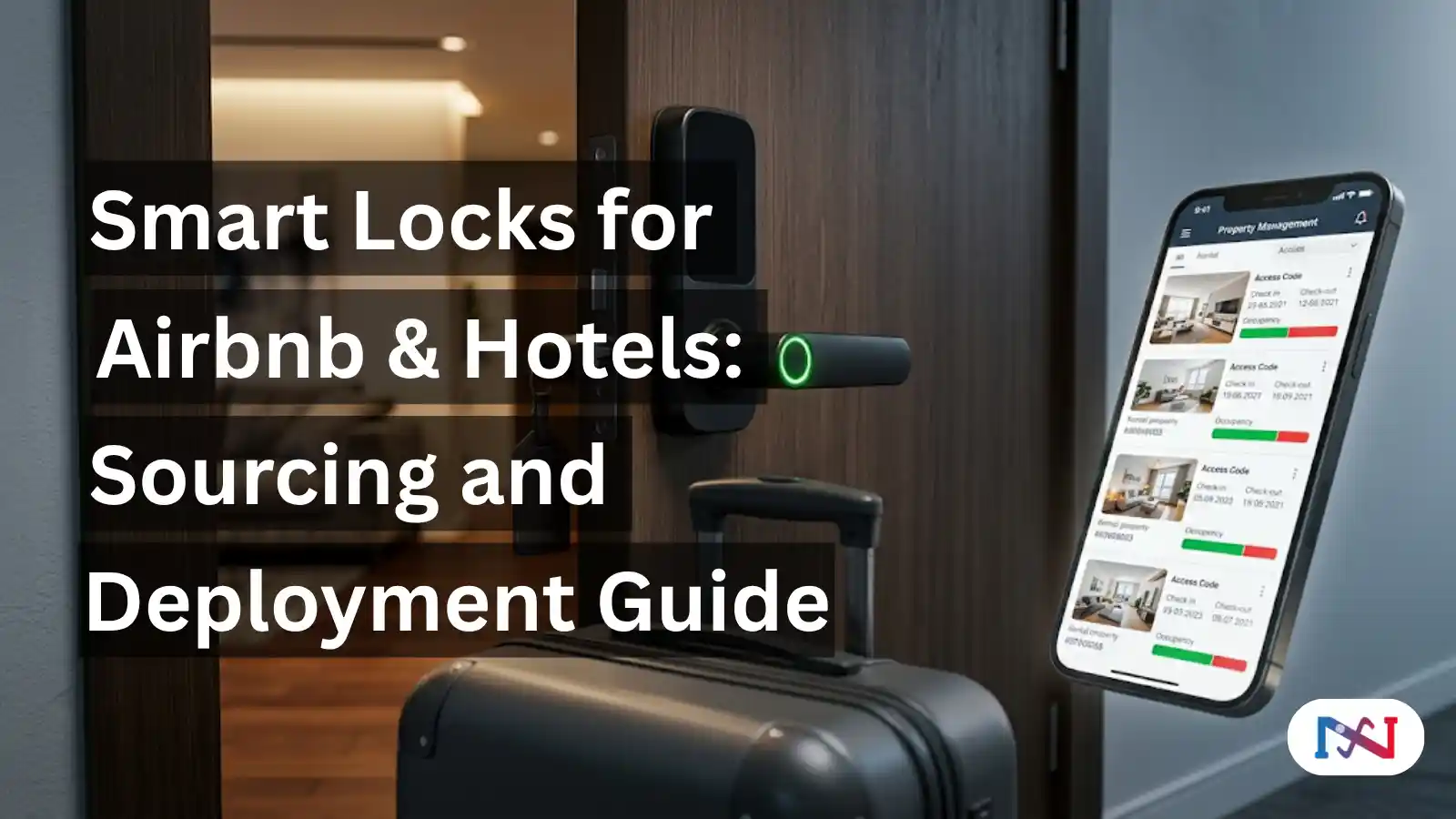
A smart lock for Airbnb and short-term rental properties is a keyless electronic door lock that enables hosts and property managers to issue unique access codes for each guest, manage entry remotely via smartphone app, and eliminate physical key handoffs. The core requirements for rental property smart locks are temporary passcode generation (time-bounded to reservation dates), remote lock management (lock/unlock and code creation from any location), access log recording (who entered and when), and multi-access capability (PIN code, fingerprint, IC card, and app). For individual hosts managing 1–3 properties, consumer-grade smart locks from retail channels are adequate. For property management companies, rental portfolio operators, and hospitality groups deploying locks across 10–500+ units, sourcing directly from a smart lock manufacturer provides significant cost advantages (typically 50–70% below retail pricing), OEM branding options, platform selection flexibility (Tuya or TTLock), and consistent hardware quality across all properties. This guide covers smart lock hardware selection, platform architecture, self-check-in workflow configuration, bulk sourcing, and deployment planning for short-term rental operators scaling beyond single-property management. For hotel-specific guidance, see our smart lock solutions for hotels. For industry-specific hardware configurations, visit our hospitality and property management solutions page.
Why Smart Locks Are Operational Infrastructure for Short-Term Rentals
Self-check-in is no longer a competitive differentiator in the short-term rental market — it is the operational standard. In 2026, Airbnb listings offering self-check-in consistently outperform those requiring in-person key handoffs across guest satisfaction ratings, booking conversion rates, and operational efficiency metrics. Smart locks convert the most coordination-intensive moment in rental operations (the key handoff) into an automated, contactless process that works regardless of guest arrival time, host location, or timezone differences.
For property managers operating multi-unit portfolios, the operational case for smart locks extends beyond guest convenience:
| Operational Problem | Physical Key Solution | Smart Lock Solution |
|---|---|---|
| Guest arrives at 11 PM — no one available for handoff | Lockbox with shared code (security risk) | Unique time-bounded code sent automatically before arrival |
| Guest loses key during stay | Emergency locksmith call ($100–$200) | Generate new code via app in 15 seconds |
| Previous guest copied key | Rekey lock ($75–$150 per instance) | Previous code expired automatically at checkout — zero cost |
| Cleaning crew needs access between guests | Separate key set management | Recurring scheduled code active only during turnover window |
| Maintenance worker needs one-time access | Meet at property or leave key under mat | One-time code generated remotely, expires after use |
| Manager needs to verify property is locked after checkout | Drive to property to check | Check lock status in app; auto-lock engaged after 30 seconds |
| Track who accessed property and when | No visibility | Timestamped access log with credential type identification |
A property manager operating 20 rental units with an average of 15 turnovers per unit per month handles 300 check-ins monthly. At an estimated 10 minutes saved per check-in through automated access management, smart locks recover 50+ hours of staff time per month — time that was previously consumed by key coordination, lockbox code changes, and lockout response.
Smart Lock Features Required for Airbnb and Rental Properties
Not every smart lock is suited for short-term rental operations. Residential smart locks designed for single-family homes prioritize fingerprint enrollment and smart home automation — features that matter less in a rental context where guests rotate every few days and never enroll their fingerprints. Rental property locks must prioritize credential management, remote operation, and reliability under high-turnover conditions.
Essential Features for Rental Property Smart Locks
| Feature | Why It Matters for Rentals | Specification to Verify |
|---|---|---|
| Temporary passcode generation | Each guest receives a unique code valid only during their reservation dates | Minimum 100 code capacity; supports timed, one-time, and recurring codes |
| Remote lock management | Lock/unlock and create codes from any location without being on-site | Wi-Fi direct or Bluetooth + gateway with cloud connectivity |
| Auto-lock function | Door locks automatically after closing — guests cannot accidentally leave property unsecured | Configurable auto-lock timer (typically 5–30 seconds) |
| Access log with timestamps | Verify guest check-in/check-out times, monitor unauthorized access attempts | Cloud-synced logs with credential type and timestamp per event |
| Low battery alert | Prevent dead-battery lockouts between turnovers | Push notification at 20% battery with sufficient lead time for replacement |
| Emergency mechanical key | Backup access when electronics fail — non-negotiable for rental properties | Physical key override on all units |
| Multiple access methods | Accommodate different guest preferences and use cases | PIN code + fingerprint + IC card + app (minimum PIN + app required) |
| Weather resistance | Exterior doors exposed to rain, humidity, temperature extremes | IP67 rating (IEC 60529) — dust-tight, temporary water immersion protection |
| Tamper alert | Notification if someone attempts to force or tamper with the lock | Push notification on tamper detection |
| Platform API for PMS integration | Automate code generation tied to booking platform reservations | TTLock API or Tuya Cloud API with webhook support |
Recommended Hardware: Nice Smart K9 for Rental Properties
The Nice Smart K9 multi-access smart lock is configured for the operational requirements of Airbnb hosts, serviced apartment operators, and rental property management companies. The K9 combines the access methods rental operators need — PIN code, fingerprint, IC card, and app-based access — in a form factor designed for high-turnover commercial use.
| Specification | Nice Smart K9 |
|---|---|
| Access methods | Fingerprint (~100 capacity), PIN code (~100), IC card 13.56MHz (~100), Doorbell, Mechanical key |
| Construction | Aluminum alloy body, tempered glass touchpad |
| Power | 4× AA batteries |
| Battery life | ~12,000 operations per cycle (~10–14 months typical use) |
| Connectivity | TTLock or Tuya app; optional Wi-Fi module |
| Operating temperature | -20°C to 60°C |
| Door compatibility | Wood and metal doors |
| Security features | Safety lock, tamper alert notification, auto-lock, battery alert |
| Available finishes | black, silver |
| Functions | Auto-awake, temporary unlock, access log, remote control, doorbell |
| OEM/ODM Customization | Yes |
For rental operations, the K9 provides three access pathways that address different guest scenarios. A first-time guest arriving at midnight receives a temporary PIN code generated via the TTLock or Tuya app — no app download required from the guest. A long-stay tenant in a serviced apartment enrolls their fingerprint for the duration of their lease. A cleaning crew uses a recurring code active only during the turnover window. And the property manager retains master access via app, fingerprint, or emergency mechanical key at all times.
The distinction between the K9 and traditional hotel locks like the SU7-03 RFID hotel lock is operational model. The SU7-03 is a card-only lock designed for front-desk-issued credentials in staffed hotels. The K9 is a multi-access lock designed for self-service operations where there is no front desk, no card encoder, and no on-site staff — the exact model of Airbnb and short-term rental management.
Platform Selection: Tuya vs TTLock for Rental Properties
The platform determines how you manage locks remotely, how codes are generated, and how the locks integrate with booking platforms and PMS software. For a comprehensive platform comparison, see our Tuya vs TTLock platform comparison. The following summary focuses specifically on rental property use cases.
| Rental Use Case | TTLock | Tuya |
|---|---|---|
| Temporary code management | Permanent, timed, one-time, recurring, dynamic offline codes | Permanent, timed, one-time, dynamic codes |
| Remote code generation | Via gateway (BLE → gateway → cloud) | Via Wi-Fi direct (no gateway needed) or BLE + hub |
| Multi-property management | Web portal + app — manage 50+ locks from desktop | App-based — manage all Tuya devices from one interface |
| PMS integration | Native: Hospitable, Operto, Enso Connect, Guesty Locks Manager | Via Tuya Cloud API (custom development or middleware) |
| Airbnb native integration | Via PMS middleware (Hospitable, Operto) | Via PMS middleware or custom API |
| Smart home automation | Lock only — no cross-device triggers | Full ecosystem — unlock triggers lights, thermostat, cameras |
| Gateway requirement | Yes — one per property (BLE range ~15m) | No — Wi-Fi models connect directly to router |
| Battery impact | Bluetooth = lower drain (~12 months) | Wi-Fi = higher drain (~6–8 months) |
| Offline code generation | Yes — TTLock supports offline dynamic codes | Limited — most code generation requires cloud connection |
| Best for | PMS-automated portfolios, properties with reliable Wi-Fi for gateway | Scattered portfolios (no gateway per unit), smart home-equipped rentals |
For rental operators managing 10+ units through a PMS platform (Hospitable, Guesty, Operto), TTLock provides the most established integration path — the PMS receives a booking, automatically generates a TTLock code for the reservation dates, and sends it to the guest without host intervention. For operators managing scattered units across a city where installing a TTLock gateway at each location adds cost and maintenance overhead, Tuya Wi-Fi locks provide direct cloud connectivity without gateway hardware.
Self-Check-In Workflow: From Booking to Door Open
The self-check-in workflow for a smart lock-equipped rental property follows this sequence — automated in most steps when a PMS integration is active:
- Guest books via Airbnb, Vrbo, Booking.com, or direct booking. The PMS receives the reservation with check-in date/time, check-out date/time, and guest contact information.
- PMS triggers code generation via the lock platform API (TTLock or Tuya). A unique PIN code is created with validity bounded to the reservation dates — typically activating at the configured check-in time (e.g., 3:00 PM) and expiring at checkout time (e.g., 11:00 AM).
- The code is delivered to the guest via email, SMS, or in-platform messaging — typically 24 hours before check-in. The guest receives the code along with check-in instructions including the property address, parking information, and any access notes.
- Guest arrives and enters the PIN code on the lock’s touchpad. The lock validates the code against its stored credentials, verifies the code is within its valid time window, and unlocks. The access event is logged with timestamp and credential type.
- During the stay, the guest uses the same code for entry and exit. The property manager can monitor access activity via the cloud dashboard, receive push notifications for door events, and verify the property is secured remotely.
- At checkout time, the code expires automatically. No manual code deletion required. The next guest’s code will not activate until their check-in time — preventing overlap even if both codes exist in the lock’s memory simultaneously.
- Between guests, a recurring cleaning crew code activates during the configured turnover window (e.g., 11:00 AM to 2:00 PM). The crew accesses the property, completes turnover, and the code either deactivates until the next scheduled turnover or expires after use (depending on configuration).
For operators not using a PMS, codes can be generated manually via the TTLock or Tuya app in approximately 30 seconds per code — setting the value, start time, and expiration. This manual workflow is functional for 1–5 properties but does not scale efficiently beyond that.
Sourcing Smart Locks for Rental Portfolios: Retail vs Factory Direct
Individual Airbnb hosts typically purchase smart locks through retail channels — Amazon, Home Depot, or direct from consumer lock brands. This is adequate for 1–3 properties where the host is buying individual units. For property management companies, rental operators scaling beyond 10 units, and distributors serving the short-term rental market, sourcing directly from a manufacturer provides economic and operational advantages that retail channels cannot match.
| Factor | Retail Purchase (Amazon, Home Depot) | Factory-Direct (Manufacturer) |
|---|---|---|
| Unit cost (multi-access smart lock) | $150–$350 per unit (retail markup) | 50–70% below retail (contact for project pricing) |
| Minimum order | 1 unit | 20–50 units (Nice Smart MOQ) |
| Brand options | Pre-branded (Schlage, Yale, August, etc.) | OEM — your logo, your packaging, your brand |
| Platform choice | Fixed (locked to brand’s platform) | Configurable — TTLock or Tuya specified at order |
| Hardware consistency | May change suppliers/models between purchases | Identical hardware across entire order — consistent quality |
| Customization | None — retail configuration only | Finish color, firmware language, app binding, mechanical adaptation |
| Lead time | 2–5 days (shipping) | 7 days (standard models), 15–25 days (custom OEM) |
| Warranty | 1 year (typical consumer warranty) | 24 months B2B warranty, extendable to 36 months for project orders |
| Support model | Consumer call center | Dedicated account manager, technical documentation, spare parts stocked |
The cost difference is substantial at scale. Factory-direct sourcing from a manufacturer like Nice Smart typically reduces per-unit hardware cost by 50–70% compared to retail brand pricing — savings that compound across a multi-property portfolio. For distributors building a product line to serve the rental property market, factory-direct sourcing with OEM branding and customization enables margin structures that retail arbitrage cannot support. Contact our team for project-level pricing based on your order volume and specifications.
OEM Branding for Property Management Companies and Distributors
Property management companies deploying locks across a portfolio benefit from consistent branding — the same lock finish, the same branded packaging, the same user manual with the company’s logo and support contact information at every property. This consistency signals professionalism to property owners who contract with the management company, and it simplifies training and support for maintenance staff who work across multiple properties.
Nice Smart OEM services for rental property operators include laser logo engraving on the lock body, branded packaging with the management company’s identity, firmware language configuration (English, Spanish, Arabic, French, Portuguese, and additional languages), and app platform binding to either TTLock or Tuya. For distributors building a private label smart lock brand targeting the short-term rental market, full white-label packages are available — including branded user manuals, warranty cards, and marketing materials.
Deployment Planning: From Sample to Full Portfolio Rollout
Deploying smart locks across a rental portfolio should follow a phased approach that minimizes risk and validates hardware, platform, and workflow decisions before full commitment.
Phase 1: Sample Evaluation (2–4 Units)
Order 2–4 sample units from the manufacturer — ideally one on TTLock firmware and one on Tuya firmware if platform selection is undecided. Install on representative properties (different door types, different Wi-Fi environments, different climate conditions). Test the full guest workflow: code generation, code delivery, guest entry, access log retrieval, and code expiration. Evaluate battery life over 60–90 days of real guest turnover. Nice Smart ships sample units within 3–5 business days. This phase validates hardware compatibility and platform preference before volume commitment.
Phase 2: Pilot Deployment (10–20 Units)
After sample validation, deploy across 10–20 properties. This phase tests scalability: can the PMS integration handle concurrent code generation across multiple properties? Is the web portal or app interface manageable at this scale? What is the support volume (guest lockout calls, battery replacement frequency, connectivity issues)? Document any installation variations across door types and develop a standardized installation checklist for the maintenance team. For TTLock deployments, validate gateway placement at each property and confirm Bluetooth coverage reaches the lock from the gateway location.
Phase 3: Full Portfolio Rollout
With sample and pilot validation complete, place a bulk order for the remaining portfolio. At this stage, OEM customization (logo engraving, branded packaging) is practical because the hardware model and platform are confirmed. Nice Smart supports phased delivery schedules aligned with installation timelines — a 100-unit order can be shipped in batches of 25 if installation capacity dictates a staged rollout. Stock 5–10% spare units for warranty replacements and new property onboarding. For detailed guidance on international procurement logistics, see our article on importing smart locks from China.
Cost Modeling: Smart Lock Deployment for a 50-Unit Rental Portfolio
The following framework identifies every cost component in a rental property smart lock deployment. Hardware pricing varies by model, quantity, and customization scope — contact our team for a project-specific quotation. This framework excludes PMS software subscription costs, which are independent of lock hardware.
| Cost Component | TTLock Configuration | Tuya Wi-Fi Configuration |
|---|---|---|
| Smart lock hardware | Request quote — 50–70% below retail per unit | Request quote — 50–70% below retail per unit |
| Wi-Fi / connectivity module | Included (TTLock + Wi-Fi module) | Included (Tuya Wi-Fi module) |
| Spare units (recommended 10% buffer) | Included in project quote | Included in project quote |
| OEM branding (logo engraving) | Included at 50+ unit orders | Included at 50+ unit orders |
| Shipping (FOB Shenzhen) | Quoted per project based on volume and destination | Quoted per project based on volume and destination |
| Installation (DIY) | $0 — 30 min per unit with included documentation | $0 — 30 min per unit with included documentation |
| Installation (professional locksmith) | $75–$150 per unit (local market rates) | $75–$150 per unit (local market rates) |
| Annual battery cost | ~$7.50/unit × 1 replacement/year (BLE = lower drain) | ~$7.50/unit × 1.5–2 replacements/year (Wi-Fi = higher drain) |
The key cost advantage of factory-direct sourcing is the per-unit hardware price. Retail-brand multi-access smart locks (Schlage, Yale, August) sell for $150–$350 per unit through consumer channels. Factory-direct pricing from a manufacturer like Nice Smart reduces hardware cost by 50–70%, with the exact per-unit price determined by model selection, order volume, and customization scope. Both TTLock and Tuya Wi-Fi connectivity modules are included in the unit price at no additional cost — no separate gateway hardware is required. Over a 50-unit portfolio, the hardware savings versus retail procurement are significant enough to fund the entire installation, shipping, and spare inventory budget from the price difference alone.
Compliance and Guest Safety Considerations
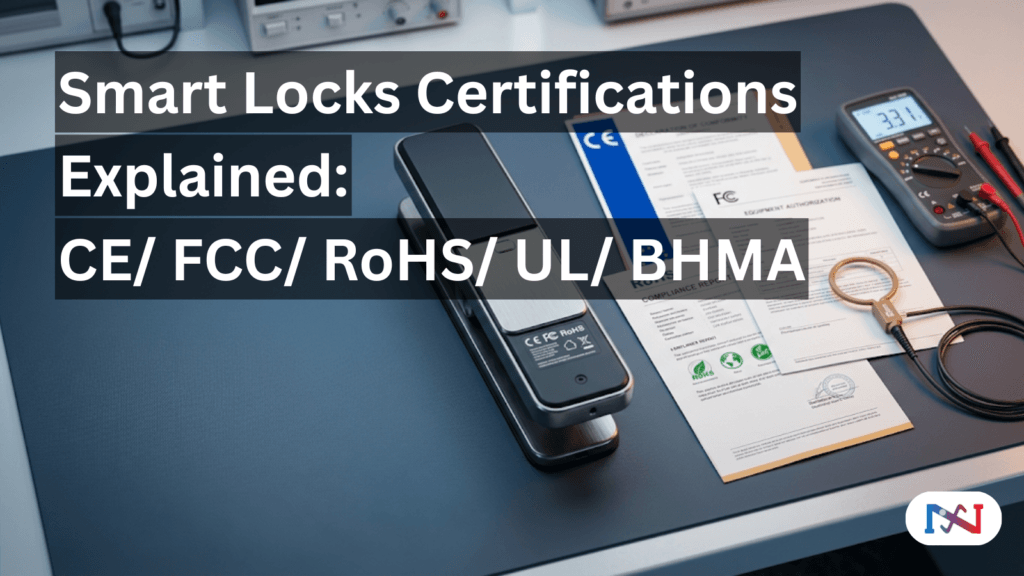
Smart locks for rental properties must comply with electrical safety and electromagnetic compatibility standards in the destination market. At minimum, verify CE marking (Directive 2014/30/EU for EMC, Directive 2014/35/EU for low voltage) for European deployments, FCC Part 15 certification for US properties, and RoHS compliance (Directive 2011/65/EU) universally. IP67 certification per IEC 60529 is strongly recommended for exterior-facing doors exposed to weather. For a complete certification breakdown by market, see our guide to smart lock certifications for export markets.
Guest safety requirements include mechanical key backup on every unit (non-negotiable — guests must be able to exit and enter even if electronics fail), emergency USB-C power port for dead-battery situations, and auto-lock functionality that secures the door automatically after closing. Some jurisdictions and property insurance policies require specific lock grades (ANSI/BHMA Grade 2 minimum for residential rental use) — verify local requirements before deployment.
Airbnb’s platform also requires hosts using smart locks to configure a backup access method and a backup access code in case of lock malfunction — check Airbnb’s current access settings documentation for the latest requirements.
Frequently Asked Questions About Smart Locks for Airbnb
What is the best smart lock for Airbnb and short-term rental properties?
The best smart lock for Airbnb properties is a multi-access lock that supports temporary PIN code generation, remote management via smartphone app, auto-lock, access logging, and mechanical key backup. For individual hosts, retail-brand locks like the Yale Assure Lock 2, Schlage Encode, or igloohome Deadbolt 2S are popular choices at $150–$350 per unit through consumer channels. For property management companies deploying across 10+ units, factory-direct multi-access locks like the Nice Smart K9 provide the same core functionality at 50–70% below retail pricing, with OEM branding and platform selection flexibility. The key differentiator at scale is not the lock itself but the management platform (TTLock or Tuya) and its integration with your PMS.
How does a smart lock work on Airbnb?
A smart lock on Airbnb works through automated or manual code management tied to guest reservations. When integrated with a PMS platform (Hospitable, Guesty, Operto), the system automatically generates a unique PIN code for each booking, sets the code to activate at check-in time and expire at checkout time, and delivers the code to the guest via email or messaging. The guest enters the code on the lock’s touchpad to unlock the door — no app download required. Without PMS integration, the host manually creates a temporary code in the TTLock or Tuya app and sends it to the guest before arrival.
How much do smart locks cost for rental properties in bulk?
Retail-brand multi-access smart locks (Schlage Encode, Yale Assure, August Wi-Fi) cost $150–$350 per unit through consumer channels. Factory-direct sourcing from a manufacturer like Nice Smart reduces per-unit hardware cost by 50–70%, with exact pricing determined by model, order volume, and customization requirements. Additional deployment costs include shipping (FOB Shenzhen, quoted per project), and optional professional installation labor ($75–$150 per unit at local locksmith rates). Both TTLock and Tuya Wi-Fi modules are included in the unit price. Minimum order quantities start from 20 units on select models. Contact our team for a project-specific quotation based on your portfolio size and specifications.
Should I choose Tuya or TTLock for Airbnb rental properties?
TTLock is better suited for operators using a PMS with established TTLock integration (Hospitable, Operto, Guesty Locks Manager) for automated code management. TTLock also supports offline dynamic code generation, which is useful for properties with unreliable Wi-Fi. Tuya Wi-Fi locks are better for scattered rental portfolios where installing a gateway at each property adds cost and complexity — each lock connects directly to the unit’s existing Wi-Fi. Tuya is also preferred if the rental includes smart home features (automated lighting, thermostat) that integrate with the lock through the Tuya ecosystem. Both platforms support temporary passcodes and remote management.
Can I install smart locks on Airbnb rental properties myself?
Yes. Most smart door locks are designed for DIY installation by replacing the existing deadbolt or mortise lock. Standard installation requires a Phillips screwdriver, a measuring tape, and approximately 30 minutes per door. Nice Smart includes installation documentation with door preparation templates, cutout dimensions, and step-by-step programming instructions with every order. For property managers deploying across many units, developing a standardized installation checklist during the pilot phase (10–20 units) creates efficiency for the full rollout. Professional locksmith installation costs $75–$150 per unit and may be worthwhile for non-standard door types or fire-rated doors with specific hardware requirements.
What happens if a guest is locked out because the smart lock battery dies?
All Nice Smart locks include two emergency access methods. A mechanical key backup allows manual entry at any time regardless of battery or electronic status. An external USB-C emergency power port allows the guest to connect a portable battery bank to temporarily power the lock electronics — sufficient to enter the PIN code and unlock. Smart lock platforms also send low-battery push notifications at approximately 20% remaining capacity, providing 4–6 weeks of advance warning before full depletion. For rental properties, including battery check as part of the turnover checklist between guests prevents dead-battery lockouts.
Do I need a separate smart lock for each rental property?
Yes. Each door requires its own lock unit. A rental property typically needs one smart lock on the main entry door. Additional units may be required for secondary entry points (back doors, garage entries, gate access) and interior secured areas (owner’s storage closet, utility room). For properties with multiple entry points, the same platform (TTLock or Tuya) should be used across all locks at a given property so all are managed from a single app interface. The lock hardware model can vary by door type — for example, a K9 mortise lock on the front door and an H3 handle lock on an interior storage room, both on the same TTLock platform.
Can smart locks for Airbnb be OEM branded with my company logo?
Yes. When ordering from a manufacturer like Nice Smart, OEM branding services include laser logo engraving on the lock body and interior panel, custom-branded packaging with your company identity, multilingual user manuals with your company’s support contact information, and firmware configuration for your preferred platform and language settings. OEM branding is available on orders of 50+ units for most models. For smaller initial orders (20–49 units), logo engraving is available while custom packaging may require a higher minimum. See our full OEM branding and customization services overview.
Deploying smart locks across a rental portfolio or building a product line for the short-term rental market? Nice Smart provides factory-direct pricing on multi-access smart locks configured for Airbnb, serviced apartment, and vacation rental operations — with TTLock or Tuya platform options, OEM branding, and MOQs starting from 20 units. Request bulk pricing for rental property locks or contact our solutions team via WhatsApp for a project consultation.