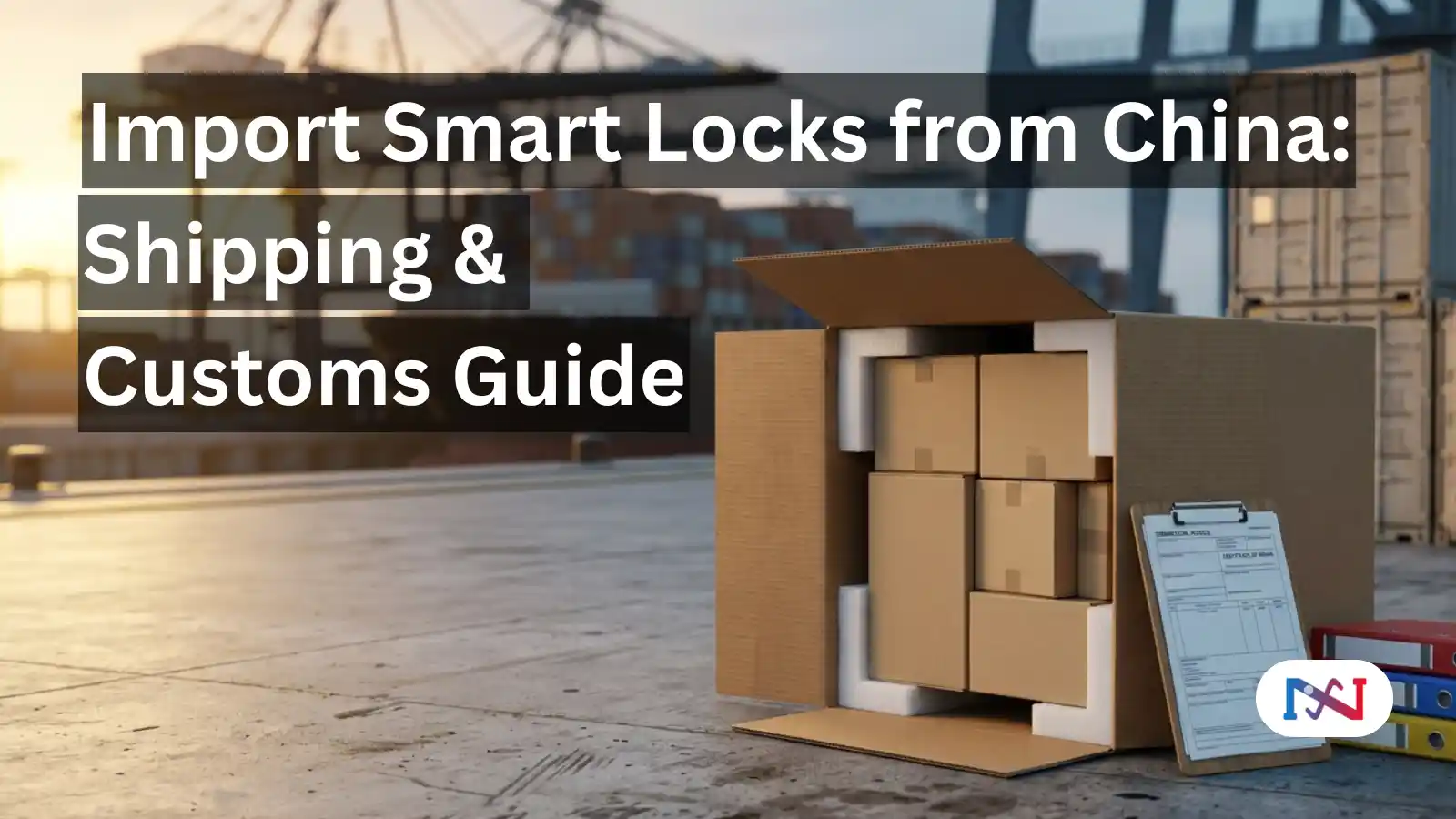
Importing smart locks from China requires coordination across four areas: product certification (CE, FCC Part 15, and RoHS at minimum for international markets), export documentation (commercial invoice, packing list, certificate of origin, and certification test reports), shipping logistics (air freight for orders under 200 units at 5–7 days transit, sea freight for bulk above 500 units at 20–35 days, shipped FOB Shenzhen as standard), and destination customs clearance (HS code classification under 8301.40 or 8301.70, applicable duty rates, and import tax calculation on CIF value). Smart locks are classified as electronic access control devices containing wireless modules (Bluetooth, Wi-Fi, Zigbee), which triggers electromagnetic compliance requirements in most markets. This guide provides the complete import process from factory order confirmation through delivery to your warehouse, covering certification by region, shipping method selection, documentation checklist, customs procedures, and common import issues. For manufacturer selection criteria, see our manufacturer evaluation checklist. For cost modeling including landed cost calculation, refer to our manufacturing cost breakdown and landed cost guide.
Step 1: Certifications Required Before Importing Smart Locks
Certification must be confirmed before production begins — not after shipment. Smart locks are electronic devices containing wireless communication modules, biometric sensors, and motorized lock mechanisms. This classification places them under electromagnetic compatibility (EMC), radio frequency (RF), product safety, and environmental compliance requirements in every major import market. Without valid certifications, shipments can be detained at customs, refused entry, or destroyed.
The manufacturer should provide all relevant certification documents and test reports as part of the order documentation. When sourcing from a manufacturer that already holds certifications on its hardware platform — such as Nice Smart’s certifications and factory profile covering CE, FCC Part 15, RoHS, and IPX6 — these certifications transfer to OEM-branded products using the same base electronics without retesting.
European Union (CE Marking)
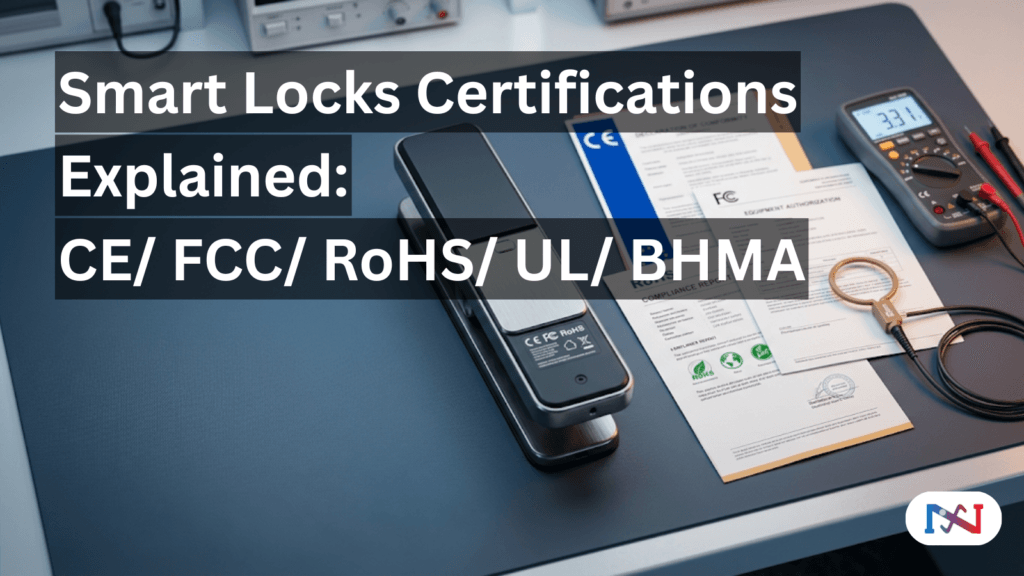
CE marking is mandatory for placing electronic products on the EU market. For smart locks, CE conformity covers three directives. The Low Voltage Directive (2014/35/EU) addresses electrical safety for products operating between 50–1000V AC or 75–1500V DC — battery-powered smart locks operating below these thresholds may still need to demonstrate safety compliance through relevant standards. The Electromagnetic Compatibility Directive (2014/30/EU) requires that the product does not generate electromagnetic interference that affects other devices, and functions correctly in the presence of external electromagnetic fields. The Radio Equipment Directive (2014/53/EU or RED) applies to smart locks with Bluetooth, Wi-Fi, or Zigbee wireless modules, covering radio spectrum usage, electromagnetic compatibility, and health and safety requirements.
CE marking requires a Declaration of Conformity (DoC) issued by the manufacturer and supported by test reports from an accredited laboratory. The test reports document the specific standards tested against (EN 55032 for emissions, EN 55035 for immunity, EN 62368-1 for safety). Request the DoC and test reports by certificate number — not just the CE logo — and verify the testing laboratory’s accreditation.
United States (FCC Part 15)
FCC authorization is mandatory for electronic devices sold in the United States that emit radio frequency energy. Smart locks with Bluetooth, Wi-Fi, or Zigbee modules require FCC Part 15 certification before import. The FCC ID — a unique identifier assigned to each certified product configuration — must appear on the product label or be accessible through the product’s electronic display (e-labeling is accepted for small devices).
Verify the manufacturer’s FCC ID at the FCC’s Equipment Authorization database (apps.fcc.gov/oetcf/eas/reports/GenericSearch.cfm). The database entry should match the product model, frequency bands, and wireless modules in the smart lock being imported. If the manufacturer modifies wireless components between production batches, a new FCC ID may be required.
Section 301 tariffs currently apply to certain Chinese-origin electronics imported into the US. Smart locks classified under HTS headings covered by Section 301 may carry additional tariff surcharges beyond the standard duty rate. Consult your customs broker for current Section 301 applicability and tariff rates specific to your product classification.
Environmental Compliance (RoHS)
The Restriction of Hazardous Substances Directive (RoHS, 2011/65/EU as amended by 2015/863/EU) restricts the use of ten hazardous substances in electrical and electronic equipment, including lead, mercury, cadmium, hexavalent chromium, and specific phthalates. RoHS compliance is mandatory for EU market entry and increasingly expected by importers in other regions as a quality assurance benchmark. The manufacturer should provide a RoHS test report documenting compliance for the finished product and its subcomponents (PCB solder, cable insulation, housing pigments).
Additional Market-Specific Certifications
Beyond CE, FCC, and RoHS, certain markets require additional certifications. UKCA (UK Conformity Assessed) replaced CE for the Great Britain market following Brexit — the technical requirements are similar, but separate UKCA marking and documentation are required. UL 294 (standard for access control system equipment) is relevant for commercial smart lock installations in North America and may be required by specifiers on commercial construction projects. BHMA/ANSI grading (A156.40 for commercial smart locks) applies to mechanical durability and security ratings in the US and Canada. For Middle Eastern markets, SASO (Saudi Standards, Metrology and Quality Organization) compliance may be required for electronic products entering Saudi Arabia. ECAS (Emirates Conformity Assessment Scheme) applies to UAE imports.
Not all manufacturers hold these market-specific certifications. Confirm which certifications are in place and which the manufacturer can coordinate through accredited laboratories before committing to production.
Step 2: HS Code Classification for Smart Locks
Correct Harmonized System (HS) code classification determines applicable duty rates, import tax calculations, and regulatory requirements. Incorrect classification can trigger customs delays, unexpected duty assessments, or penalties for misclassification.
Smart door locks are typically classified under HS heading 8301 (padlocks, locks, clasps, and frames incorporating locks, of base metal; keys for any of the foregoing articles, of base metal). The most relevant subheadings for electronic smart locks are 8301.40 (other locks, of base metal — covering electronic mortise locks, digital deadbolts, and smart handle locks) and 8301.70 (keys presented separately).
However, classification can vary depending on the product’s primary function and the importing country’s national tariff schedule. A smart lock with an integrated camera and video intercom system — such as the SU7 face recognition lock — could potentially be classified differently in some jurisdictions due to the camera component. RFID card-only hotel locks like the SU7-03 RFID hotel lock may be classified separately from biometric locks in certain national schedules.
Always confirm the HS code classification with your customs broker before shipment. The manufacturer provides the product description and technical specifications; the customs broker determines the correct classification under the destination country’s tariff schedule. Include the HS code on the commercial invoice to facilitate smooth clearance.
Step 3: Shipping Methods and Transit Times
Smart locks ship from Shenzhen, Guangdong Province — China’s primary electronics manufacturing and export hub. Shenzhen is served by Yantian Port (one of the world’s largest container ports), Shekou Port, and Shenzhen Bao’an International Airport. The shipping method depends on order volume, urgency, and cost sensitivity.
| Shipping Method | Best For | Transit Time | Cost Level | Notes |
|---|---|---|---|---|
| Express courier (DHL, FedEx, UPS) | Samples, 1–50 units | 3–5 business days | Highest per-unit | Door-to-door, includes customs brokerage in most cases |
| Air cargo | 50–200 units, urgent orders | 5–7 business days | High | Airport-to-airport; buyer arranges destination clearance and delivery |
| Sea freight LCL (Less than Container Load) | 200–500 units | 25–35 days | Moderate | Shared container; cost-effective for mid-volume orders |
| Sea freight FCL (Full Container Load) | 500+ units | 20–30 days | Lowest per-unit | Dedicated container; best unit economics for bulk orders |
Lithium battery shipping considerations. Smart locks powered by lithium-ion rechargeable batteries (3,800–4,200mAh) are classified as goods containing lithium batteries under IATA Dangerous Goods Regulations for air transport and the IMDG Code for sea transport. This requires specific packaging (UN-tested packaging or equipment-contained exemptions), battery test report documentation (UN38.3 certification), and proper shipping labels (Lithium Battery Handling Labels). The manufacturer should provide UN38.3 battery test reports and pack products in compliance with applicable transport regulations. Express couriers handle lithium battery documentation as part of their service; for air cargo and sea freight, confirm with your freight forwarder that lithium battery compliance is included.
Incoterms (shipping terms). Most smart lock manufacturers quote FOB Shenzhen (Free On Board) — the manufacturer delivers the goods to the port, clears export customs, and loads onto the vessel. The buyer is responsible for international freight, insurance, destination customs clearance, and domestic delivery from that point. CIF (Cost, Insurance, Freight) terms include freight and insurance in the manufacturer’s quote — the buyer takes responsibility at the destination port. DDP (Delivered Duty Paid) places all costs and risks on the manufacturer until the goods are delivered to the buyer’s specified address. FOB is standard for first orders; CIF and DDP are available for buyers who prefer simplified pricing.
Step 4: Export Documentation the Manufacturer Provides
A professional smart lock manufacturer handling international B2B orders provides the following export documentation as standard. This documentation supports customs clearance at the destination and should be requested and verified before shipment.
Commercial invoice. Lists the buyer and seller details, product descriptions, model numbers, quantities, unit prices, total value, currency, payment terms, and Incoterms. The commercial invoice is the primary document used by destination customs to assess duties and taxes. Ensure product descriptions match the HS code classification agreed with your customs broker.
Packing list. Details the physical shipment — number of cartons, dimensions, gross and net weights per carton, and total shipment weight and volume. Used by customs, freight forwarders, and warehouse receiving teams.
Certificate of origin (CO). Documents the country of manufacture. Required by many destination countries for duty rate determination and trade agreement preferences. Issued by the local Chamber of Commerce (China Council for the Promotion of International Trade, CCPIT) or through self-certification for certain trade agreements.
Certification documents. CE Declaration of Conformity and test reports, FCC authorization grant and test reports, RoHS test reports, IPX6/IP67 test reports, and any additional certifications applicable to the buyer’s market. These documents may be required by customs authorities to release the shipment.
UN38.3 battery test report. For products containing lithium-ion batteries. Documents that the battery has passed the eight UN38.3 tests (altitude simulation, thermal test, vibration, shock, external short circuit, impact, overcharge, forced discharge). Required for air and sea transport compliance.
Bill of lading (B/L) or airway bill (AWB). Issued by the freight carrier — the shipping contract document. For FOB shipments, the manufacturer provides the B/L after loading. For CIF/DDP, the manufacturer manages the entire shipping documentation chain.
For OEM and ODM smart lock manufacturing orders, all documentation listed above is provided as standard with every shipment. Documentation is prepared in English for international B2B transactions.
Step 5: Customs Clearance at the Destination
Customs clearance procedures vary by country, but the general process for importing smart locks follows a consistent pattern.
Pre-arrival filing. In many countries (US, EU, Australia, etc.), import declarations must be filed before or upon arrival of the goods. Your customs broker files the declaration using the commercial invoice, packing list, bill of lading, and certification documents. The declaration includes the HS code classification, declared value (transaction value method — based on the invoice price), country of origin, and applicable duty/tax calculations.
Customs inspection. Customs authorities may select shipments for documentary review (verifying that paperwork matches the declared goods) or physical inspection (opening and examining the shipment). Smart locks as electronic devices with wireless modules are more likely to trigger inspection if certification documents are not included with the filing, the declared value appears unusually low, or the HS code classification is inconsistent with the product description.
Duty and tax assessment. Customs assesses import duties based on the HS code tariff rate applied to the CIF value (or transaction value for FOB shipments with freight costs declared separately). VAT, GST, or import sales tax is then applied on the duty-inclusive value. Duty rates on electronic locks vary by country — for example, US HTS rates differ from EU Common Customs Tariff rates. Consult your customs broker for current rates applicable to your specific product and origin.
Release and delivery. Once duties and taxes are paid and any inspections cleared, customs releases the goods. Your freight forwarder or logistics provider arranges delivery from the port or airport to your warehouse.
Step 6: Pre-Shipment Inspection and Quality Assurance
For first orders and large-volume shipments, pre-shipment inspection (PSI) provides an independent quality verification before goods leave the factory. This is particularly important for OEM orders where the buyer’s brand is applied to the product.
Manufacturer’s internal QC. A professional manufacturer conducts incoming material inspection (IQC), in-line process checks (IPQC), and final quality testing (FQT) as standard production procedures. Final testing should include fingerprint enrollment and recognition verification, PIN code and RFID card functionality, Bluetooth/Wi-Fi connectivity and app pairing, mechanical key backup, auto-lock timing, tamper alert triggering, and battery voltage under load. Request the manufacturer’s QC report for your specific production batch.
Third-party inspection. Buyers can engage third-party inspection agencies (SGS, Bureau Veritas, Intertek, TÜV, or regional inspection firms) to conduct an independent pre-shipment inspection at the factory before goods are released for shipping. The inspection follows an AQL (Acceptable Quality Level) sampling protocol — typically AQL 2.5 for major defects and AQL 4.0 for minor defects. The inspection agency provides a pass/fail report. Third-party inspection is recommended for first orders above 200 units or when establishing a new supplier relationship.
What to inspect. Beyond functional testing, pre-shipment inspection should verify correct OEM branding application (logo placement, packaging, user manual language), correct model and color configuration per the purchase order, packaging integrity and protection for international shipping, quantity count and carton labeling accuracy, and certification markings on product labels (CE, FCC ID, RoHS).
Common Import Issues and How to Avoid Them
Several import issues recur across B2B smart lock transactions. Awareness and prevention are significantly less expensive than resolution after shipment.
Missing or invalid certification documents. If CE, FCC, or RoHS documentation is missing from the customs filing, the shipment may be held pending document submission — adding days or weeks of storage charges at the port. Prevention: confirm all certification documents are included in the shipping documentation package before the manufacturer releases the goods. Verify certificate numbers against the issuing laboratory’s database.
Incorrect HS code classification. Using the wrong HS code can result in overpayment of duties (if classified under a higher-rate heading) or customs penalties and reclassification (if classified under a lower-rate heading). Prevention: provide your customs broker with the manufacturer’s detailed product description and technical specifications. Have the broker confirm the classification before the first shipment.
Lithium battery shipping violations. Incorrectly packaged or undocumented lithium batteries can result in shipment rejection by the airline or carrier, significant delays, and regulatory penalties. Prevention: confirm the manufacturer provides UN38.3 battery test reports, uses compliant packaging, and applies correct lithium battery shipping labels.
Underdeclared shipment value. Declaring a value lower than the actual transaction price to reduce duties is illegal in all major import markets. Customs authorities routinely flag undervalued electronics shipments for review, and penalties include duty reassessment, fines, and potential import privilege suspension. Always declare the actual transaction value as stated on the commercial invoice.
Moisture damage during sea freight. Smart locks contain sensitive electronic components (PCBs, fingerprint sensors, displays) that are susceptible to moisture damage during extended sea transit, particularly through tropical shipping routes. Prevention: the manufacturer should pack products in moisture-barrier bags with desiccant inside sealed cartons. Request confirmation of moisture protection packaging specifications for sea freight shipments.
Import Process Summary: Order to Delivery Timeline
| Stage | Activity | Timeline | Responsible Party |
|---|---|---|---|
| 1. Order confirmation | Purchase order finalized, 30% deposit paid | Day 1 | Buyer + Manufacturer |
| 2. Production | Manufacturing, QC, OEM customization | 7–25 days (OEM) | Manufacturer |
| 3. Pre-shipment inspection | Internal QC report + optional third-party PSI | 1–3 days | Manufacturer + Inspector |
| 4. Balance payment | 70% balance paid upon QC approval | 1–2 days | Buyer |
| 5. Export clearance | Export declaration, documentation preparation | 1–2 days | Manufacturer + Freight forwarder |
| 6. International transit | Air: 5–7 days / Sea LCL: 25–35 days / Sea FCL: 20–30 days | Variable | Freight carrier |
| 7. Destination customs | Import declaration, inspection, duty payment | 2–5 days (standard) | Buyer + Customs broker |
| 8. Delivery | Port to warehouse transportation | 1–3 days | Buyer + Logistics provider |
Total timeline from order confirmation to warehouse delivery: approximately 2–5 weeks for air freight OEM orders, and 5–9 weeks for sea freight bulk orders. ODM orders with new tooling add 8–12 weeks of development time before the production stage begins. For a detailed comparison of OEM and ODM timelines and investment, see our OEM vs ODM manufacturing guide.
Frequently Asked Questions About Importing Smart Locks from China
What certifications do I need to import smart locks from China?
At minimum: CE marking for EU markets (covering EMC Directive and Radio Equipment Directive for wireless devices), FCC Part 15 for the United States (mandatory for any device with Bluetooth, Wi-Fi, or Zigbee modules), and RoHS for environmental compliance. Additional certifications may be required depending on the destination — UKCA for Great Britain, UL 294 for US commercial installations, or SASO/ECAS for Middle Eastern markets. The manufacturer should provide all applicable certification documents with the shipment.
What is the HS code for smart door locks?
Smart door locks typically fall under HS heading 8301 (locks of base metal). The most common subheadings are 8301.40 (other locks — covering electronic mortise locks, digital deadbolts, and smart handle locks) and 8301.70 (keys presented separately). Classification can vary by product features and destination country tariff schedule. Always confirm with your customs broker using the manufacturer’s product specifications.
How long does it take to ship smart locks from China?
Express courier: 3–5 business days for samples and small orders. Air cargo: 5–7 business days. Sea freight LCL: 25–35 days. Sea freight FCL: 20–30 days. All shipments originate from Shenzhen ports (Yantian/Shekou) or Shenzhen Bao’an International Airport. Add 2–5 days for destination customs clearance and domestic delivery.
What documents does the manufacturer provide for customs clearance?
A professional manufacturer provides: commercial invoice, packing list, certificate of origin (CCPIT-issued), CE/FCC/RoHS certification documents with test report numbers, UN38.3 battery test report (for lithium battery products), and bill of lading or airway bill. These documents are prepared in English for international B2B transactions and provided with every shipment as standard.
Can smart locks with lithium batteries be shipped by air?
Yes, with proper compliance. Smart locks containing lithium-ion batteries (3,800–4,200mAh) require UN38.3 battery test report documentation, UN-tested or equipment-contained packaging, and lithium battery handling labels. The manufacturer should provide all battery documentation and pack products in compliance with IATA Dangerous Goods Regulations. Express couriers (DHL, FedEx, UPS) handle lithium battery compliance as part of their service.
Should I use a customs broker or handle clearance myself?
A licensed customs broker is strongly recommended for commercial smart lock imports. Customs brokers handle HS code classification, duty rate calculation, import declaration filing, and inspection coordination. The cost of customs brokerage is minimal compared to the risk of misclassification penalties, clearance delays, or storage charges from documentation errors.
What is the import duty rate on smart locks?
Duty rates vary by destination country, HS code classification, and applicable trade agreements. US HTS rates for electronic locks under 8301.40 differ from EU Common Customs Tariff rates. Section 301 tariffs may apply to certain Chinese-origin electronics imported into the US, adding surcharges beyond the standard duty. Consult your customs broker for current rates specific to your product classification and destination.
How do I verify a manufacturer’s certifications are legitimate?
Request certification documents with specific test report numbers and testing laboratory names. Verify FCC IDs at the FCC Equipment Authorization database (apps.fcc.gov). For CE, confirm the testing laboratory is accredited under the relevant EU Notified Body scheme. For RoHS, verify the testing laboratory’s ISO 17025 accreditation. A manufacturer confident in its certifications will provide these documents proactively with any B2B inquiry.
Planning your first smart lock import from China? Nice Smart provides complete export documentation — commercial invoice, packing list, certificate of origin, CE/FCC/RoHS test reports, UN38.3 battery certification, and bill of lading — with every shipment as standard. Our team coordinates shipping logistics from our Shenzhen facility to your destination port. Request export documentation and shipping quote or reach us on WhatsApp at +86-189-2873-3871.